Wednesday, February 14, 2018

Niki Jabbour's VEGGIE GARDEN REMIX - Win One!


One of the best things about gardening is that there is an unlimited choice of things to grow. We tend to grow those things that we love, year after year, but it's always fun to try something new, too.

In 2008, I grew a lot of purple veggies. This
is Phaseolus vulgaris 'Purple Queen'.
One year, I decided to grow purple veggies. Researching what vegetables came in purple, I was surprised to find out how many there were. I already knew about eggplant and cabbage, of course, but there was also sweet corn, okra, potatoes, “green” beans, carrots, kohlrabi, lettuce, and several others.

Seeds were purchased and planted, and my purple vegetable garden was born.

When I would talk about my purple veggie garden, the number one question I got was, “Do the purple ones taste the same as the regular colored ones?” And the answer was yes. There was no discernible difference, other than slight variations you would expect from one cultivar to another, independent of color.

Besides being fun to do, I learned something along the way. Those purple beans magically turned green when they were cooked! We called them our magic beans.

For all of you adventurous gardeners, there's a new book that will have you salivating at all the wonderful and quirky choices available for growing. Niki Jabbour, star of growing year round, even though she lives in Nova Scotia, and author of bestselling The Year Round Vegetable Gardener, has written a fun new book – Niki Jabbour's Veggie Garden Remix.


http://amzn.to/2ClZ6Fh


This book is like looking at a catalog of 224 choices of a wide variety of edibles that you may not have thought about growing or may not have even known existed! But better than a plant catalog, Niki shares growing tips, plant origins, how and when to plant and harvest, different ways to use them, and a host of other information.

If your vegetable garden has become a little ho-hum, or you've lost a little enthusiasm for gardening in general, Niki's book can jump start it all again. How can you get bored growing things with names like 'Poona Kheera' (cucumber) and 'Orange Jelly' (turnip). I'm not a turnip fan, but ORANGE JELLY!

A carrot in parentheses!

I can think of no better way to begin this year's garden than flipping through this book and making a list of seeds that will elevate my veggie-growing space to stellar star status. It's like how I used to go through the Sears Christmas catalog the day it came and I made a list of all the toys I wanted. That was such fun, too.

We've been doing the Blue Apron thing for over a year now, and we've been introduced to some foods that we might otherwise not have known about. We found new foods to love, including some you'll find in Niki's book.


Win a copy of Veggie Garden Remix!

http://amzn.to/2CmqhQr

I was sent a complimentary copy of Niki's book and you could win a copy of your own! 

Just comment on this blog post by midnight, EST, on Sunday, February 25, 2018. One random commentor will get a copy of Niki Jabbour's Veggie Garden Remix sent to them from her publisher, Storey Books. Be sure to indicate how you'd like for me to contact you, in case you're the winner.


Good luck!

________________________________


Niki Jabbour is the award-winning author of Niki Jabbour’s Veggie Garden Remix, The Year-Round Vegetable Gardener, and Groundbreaking Food Gardens. Her work is found in Fine Gardening, Garden Making, Birds & Blooms, Horticulture, and other publications, and she speaks widely on food gardening at events and shows across North America. She is the host and creator of The Weekend Gardener radio show. She lives in Halifax, Nova Scotia, and is online at nikijabbour.com.


Monday, January 30, 2017

Grow Your Own Avocados


Wow, was this ever a throwback to my college days. Back in the days of macrame, yogurt makers, and prayer plants - otherwise known as The Seventies - homes, apartments, and dorm rooms everywhere could be seen with this sitting on their window sills:


It was ever so cool to grow your own avocado plant from a pit found inside one you'd gotten at the grocery store. I did it, my friends did it, and I'm betting some of you did it too. I honestly don't remember if I was successful at actually getting that thing to germinate or not, but I tried.

With the trade situation with Mexico kind of up in the air right now, there's been a lot of talk about what things are likely to go up in price if things change. Avocados and limes are mentioned, as is Corona beer and tequila. I can live without all of them, but each one enjoys popularity here in the U.S.

So, about this growing your own avocado thing . . .  Even if I can manage to get this avocado pit to germinate, it's highly unlikely that I will be able to grow an avocado tree that produces any fruit.

First of all, I don't live where avocados would be happy. They're hardy in USDA Zones 8-11 and I'm in Zone 5b, though I do have a greenhouse and they also make excellent house plants. Secondly, even if I can keep it happy, it can take from 4-13 years for an avocado tree to bear fruit. Some trees never do yield anything.


When I cut open an avocado last week and saw that pit, it took me back (sing it with me now . . . "You fill up my senses, like a night in a forest,") and I kind of wanted to try it again. What did I have to lose?

If you want to try it too, it couldn't be easier. Just clean the avocado pit, let it dry, then poke toothpicks into it to suspend it over a jar of water, with the fat side down. Place it in a warm spot and keep the water level so that its bum is submerged. In about 2-6 weeks, you should see both a root and a stem sprouting. At that point, be sure it's in a well-lit location.

As it grows, once the stem reaches 6-8 inches, prune it in half to induce branching. Once it has started to branch, you can plant it in a container of well-draining potting soil. Be sure to leave the top part of the pit exposed, similar to how you plant an amaryllis bulb.

Don't overwater, but don't let it dry out completely. In the summer, you can put it outside, where it will likely grow faster, but make sure to bring it in once temperatures dip below 45°F.

Far out, man.


Thursday, June 23, 2016

Celebrating National Pollinator Week: Food For Thought


It's no secret the pollinators are in trouble. Oh sure, you see plenty of butterflies, bees, flies, and other insects out there and even bats (yes, they're pollinators), so really, what's the big deal, right?


Consider this:

One out of every three bites of food we eat relies on pollinators.


Still not convinced?

To carry that point further, some plants require specific pollinators in order to get good production of their fruit. (And I use "fruit" in the general definition of whatever edible the plant produces.) Bees are the most well-known of the pollinators, but other insects and birds are more efficient at pollinating certain plants.

Zucchini, anyone?


If you're one of the people who has asked me, "Does it really matter if the monarchs disappear?" I can wholeheartedly answer, "YES."

My philosophy in general is this:  I believe that every living thing on the earth is here because it has a purpose.

In regard to the monarchs, perhaps we can live without them, but it's more complicated than that. The monarchs are in decline because of several factors, not the least of which is that their habitat is disappearing due to urbanization, and to a greater extent, due to the agricultural use of pesticides* that kill milkweed, the only food their babies eat.


If you think that monarchs are the only pollinator that is being affected by the pesticides, think again. They're just more visible and recognizable than most. They're the poster child for the greater problem we humans are causing in the environment.

It's a complicated issue, for sure, but if nothing else, during this, National Pollinator Week, please give these things some consideration. Think before you use pesticides yourself. You may not only be saving the pollinator's meal, you could be helping to save your own.


_________________________________________
* Pesticide is the general term used by the FAO (Food and Agriculture Organization), the USDA and the EPA, which includes, but is not limited to herbicides, fungicides, and insecticides. Read more here.


Sunday, July 26, 2015

I Went to a Garden Party...


Actually, I was the host for the garden party. I've been wanting to do this for several years now, because I could think of nothing more delightfully summery than to stroll through my gardens with friends, as we sipped on drinks, and chatted about the weather, families, flowers... anything, really. And this summer, we did it.

Photo by Susan Pieper

With the unpredictable weather we'd been having, I knew I was taking a real chance that it would be suitable on July 23rd for spending the day outside, but that's what faith is for, right? And it could not have been lovelier.

Nearly 20 of us gathered in the backyard and by the day's end, looking back I think I can say it was the highlight of my summer, eclipsed only by grandson Maverick's birth two weeks later. ❤

The Tower Garden provided plenty of leafy greens for our salads, and
celery for the Bloody Marys.

This summer was the first time I'd ever used a Tower Garden, and my intent was to serve a meal using the bounty from it and the rest of my garden, with a little help from the grocery store. Meghan Fronduti, my Tower Garden connection, encouraged me to do this and with Meghan in your corner, you think you can do just about anything.

My girl Jenny flew up from Texas for the party and she was such a help to me in pulling this off. I don't "do" parties, but if I can get Jenny to help me again, I just might do another one!

The Menu

We strolled and chatted and shared laughter and stories, and then settled down next to the pool for Curried Tuna Apple Salad on a bed of lettuce from the Tower Garden.


I made bite-sized biscuits containing petals from Calendula grown in my gardens out back. I used my friend Teresa O'Connor's recipe, and while the orange petals didn't really add flavor to the biscuits, they made them look pretty. They do add antioxidants and Calendula is often used as a more affordable substitute for saffron.

Not just a pretty face in the garden!
#edibleflowers

Various drinks were served, including water infused with cucumbers and strawberries (from the garden). There were Bloody Marys, with celery sticks harvested from the Tower Garden. This was a first for me for growing celery and while I had my doubts as to whether it was possible to grow it in the Tower Garden, it did beautifully!

For dessert, we had miniature cheesecakes, topped with blueberries from my Brazelberries® Peach Sorbet™ plants, grown in our Berry Barn.


After we finished eating, we all retired to a shady spot under one of our 200-year-old oak trees for a fun White Elephant type of gift exchange. In this instance, I provided the gifts, mostly from the bounty of swag bag items I've received over the years.

Photo by Meghan Fronduti

One member (not naming any names) liked her gift so well that she hid it and gave the stink eye to anyone who even looked her way with the intent of stealing it. It was all in good fun.

Crescent Garden provided a couple of containers that I fell in love with at
P. Allen Smith's Moss Mountain Farm in April. This one is "Eye Am" and it's
available in several colors.

The table arrangements were simple Ball jars filled with local wildflowers that
Jenny and I cut from the roadside nearby that morning - black-eyed Susans,
Queen Anne's lace, ironweed, and wild lettuce.

There's always a cat or two patrolling Our Little Acre.
Photo by Marsha Ross


The entrance to Max's Garden
Photo by Marsha Ross

Several people wore garden hats, including Marsha Ross and my mom.

Thank you, Meghan, for taking this photo of Jenny and me. We rarely get
our picture taken together, for some reason.

 
The day was warm and the pool was tempting, so Angie Bidlack, Sarah
Messmann and Kara Fritz took advantage of it.

The new kitchen saw its first party as the bar lived up to its name.

It was a beautiful afternoon with so many lovely guests, I'm not sure we could duplicate it, but I'm giving it some thought for next year. Thank you to everyone that attended, because without each and every one of you, this little get-together would not have happened.


Wednesday, November 26, 2014

Pumpkin Torte on the Thanksgiving Table


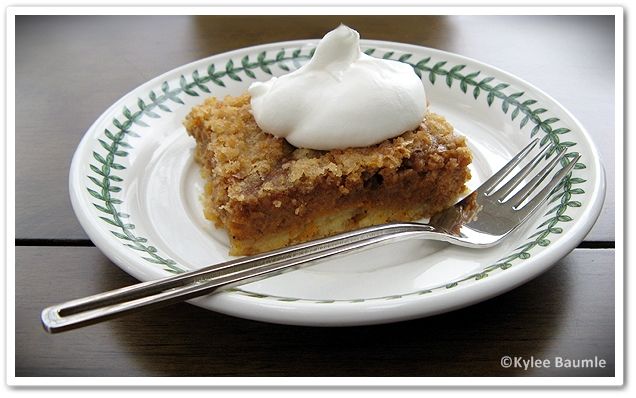
It's been two years since I posted my pumpkin torte recipe, but since there are always new readers to this blog, and I get asked for this recipe every year around this time, I'm posting it again. This is seriously good stuff and it's my personal favorite dessert of all time. Enjoy, and happy Thanksgiving to all!


With Thanksgiving looming on the horizon, thoughts turn to food and those special dishes we enjoy as we dine with family. I'll be doing the turkey again this year as well as the pumpkin torte that I'm known for. With the exception of my husband, our family likes this dessert better than pumpkin pie. It's not that he doesn't like the torte - he does. He just likes pie better.

To each his own, I say.

I've posted my recipe for the pumpkin torte a few times before, but I always get asked again for it when Thanksgiving rolls around, so here you go:


Kylee's Pumpkin Torte


1 yellow cake mix (take out 1 cup)
3 eggs
1¼ cup white sugar

¾ cup butter

¾ cup evaporated milk

1 teaspoon cinnamon

1 large can pumpkin pie mix
(30 oz.)

Crust
: Mix the cake mix (less 1 cup) with one egg and ½ cup butter. Press into the bottom of a greased jelly roll pan (10½ x 15½ x 1).
Filling: Mix until smooth - pumpkin pie mix, 2 eggs, and evaporated milk. Pour on top of the crust.
Topping
: Mix 1 cup cake mix, sugar, cinnamon and ¼ cup butter. Sprinkle on top of the pumpkin mixture. Bake at 350° for 45-50 minutes. Serve with whipped cream.

Enjoy the torte, enjoy the day, and don't forget to give thanks!


Wednesday, October 15, 2014

Wordless Wednesday: You Might Be a Gardener If ...


...this happens.


Saturday, September 27, 2014

The Grafted Tomato Experiment + A $50 Giveaway!


Earlier this year, Jung Seed Company contacted me about growing one of their grafted tomatoes. I'd first heard about grafted tomatoes just prior to and during the Garden Bloggers Fling in Seattle in 2011. I was somewhat fascinated with the science behind them, but since we are a family of two - only one of which likes raw tomatoes - I didn't give them much thought. We usually only grow two or three plants and two of them are cherry types.

Young 'Indigo Rose' fruits.
But this one that Jung wanted me to grow was different. First of all, it was GORGEOUS and I love growing beautiful edibles and beautiful plants for the sheer joy of looking at them. It went by the name of 'Indigo Rose' and not only was it a beautiful tomato, its reputation preceded it and I wanted it in my garden.

What's so special about 'Indigo Rose'?

Besides being dark purple, almost to the point of being black, 'Indigo Rose' is loaded with all the vitamins that any tomato is, PLUS it's very high in anthocyanins. These are what give it its purple color and anthycyanins are a type of antioxidant thought to fight disease in humans. 'Indigo Rose' has been called the healthiest tomato in the world because of this.

You have to eat the skins to gain the benefits of 'Indigo Rose' that makes them so good for you. The tomatoes were bred at Oregon State University and first introduced to the public in 2012. Breeding first began in the 1960s however, when cultivated tomatoes were crossed with wild tomatoes from Chile and Ecuador's Galapagos Islands.

Some of these wild tomatoes had anthocyanins in their fruit, but cultivated tomatoes had them only in their stems and leaves, which are inedible. The result of many crosses eventually yielded 'Indigo Rose', a 2-inch variety. Sold as both a grafted and seed-grown tomato, its beauty and health benefits are poised to make it a popular selection by home gardeners.

Here's the plan...

I had no intentions of eating this tomato - my husband would take care of that - but I wanted to do an experiment. I'd seen seed grown 'Indigo Rose' at our local Meijer store, and I thought it would be fun to grow the grafted and seed grown varieties of the same tomato side-by-side and do a comparison. Both the grafted tomato and the seed grown plants were nearly identical in size when I planted them.

Grafted version of 'Indigo Rose' on September 11, 2014


Why grafted?

Grafted tomatoes are supposed to have these advantages:

  • better disease resistance
  • increased vigor
  • higher yields

I wanted to see if this would prove to be true in my own garden.


My tomato experiment


I grew both the grafted and the seed-grown 'Indigo Rose' plants in the same location and treated them both exactly the same.  I didn't feed them and only twice did they receive any supplemental watering during the summer. We've had plenty of rain this summer and they didn't really need much extra watering. I pretty much planted them and then let them do whatever they wanted to do without any intervention.

Along with an abundance of rain, we had a cooler than usual summer, and we know that tomatoes prefer warmth. I think that's why these didn't start blooming and producing until later in the summer, but once they started, both of them really went to town. Both plants behaved nearly identical with neither one pulling ahead of the other, until late in the season.

'Indigo Rose' tomatoes are dark purple on the outside, but are
traditional red on the inside.

How do you know when they're ripe?

I began picking ripe fruits a little over a month ago. Deciding when they were ripe was sort of tricky until I knew what to look for. Since they're mostly purple, you really can't go by the color, although the shaded part of them - the bottoms - don't turn purple (because they're shaded from direct sun) so you can check that for the typical tomato red color. The purple parts also start out really shiny, but when they're ripe, the luster dulls. They also soften up a bit and a ripe fruit will come off the stem easily with a slight twist.

The results

Like I said, I couldn't tell much difference between the two plants in the early days of fruit production. But as time went on, the grafted tomato started pulling away from the seed grown one. Both continued to produce (and are still producing), but the number of fruits has differed. The grafted plant has been bearing more tomatoes in the last few weeks than the seed grown.


The grafted plant also looks healthier, with thicker foliage. Both plants were afflicted by late blight a bit, but not to the point of causing any real detriment to the plants. I had no issues with blossom end rot at all, and almost no splitting until just recently.

Taste-testing

You can't trust my taste buds to judge a good tomato from a bad one, because I don't like fresh tomatoes. I can't help it - there's a scientific reason for this. But my husband loves them, so it was up to him to let me know how these tasted.

While 'Sungold' is his absolute favorite (even after growing 'Sun Sugar' this year, which is supposed to be an even sweeter variety), he did say he liked 'Indigo Rose'. He thought it tasted like a traditional heirloom tomato, although the flavor wasn't quite as intense. Some of the fruits had an abundance of seeds and some strangely didn't have any, but the seeds were very tiny, so they weren't objectionable.

FINAL VERDICT:  The grafted tomato performed better when it came to length of productivity and number of fruits on the plant. I'll grow it again, for both its beauty and its healthy fruit.


A GIVEAWAY!

Want to grow a grafted 'Indigo Rose' of your own? Jung Seed Company has graciously provided a $50 gift certificate for me to give away that you can use to buy it! They've got much more than grafted tomatoes though, so you could use this gift certificate for any number of gardening goodies. They're shipping lots of items for fall planting right now.

To enter to win the $50 GC, just leave a comment here, telling me your favorite variety of tomato and why you like it so well. Then enter your information in the Rafflecopter form so that I'll be able to contact you should your entry be chosen as the winner. Do this by midnight EDT, Friday, October 3, 2014, and a winner will be chosen randomly by Rafflecopter, which I will announce on Saturday, October 4th. Best of luck to everyone!

a Rafflecopter giveaway

WINNER! Rafflecopter has chosen Emily Smith as the winner of the $50 gift card to Jung Seed Company. Congratulations, Emily! Thank you to everyone for participating in the giveaway. Stay tuned, because there will be another $50 gift certificate to another nursery soon!

_____________________
I was provided with a free grafted tomato plant from Jung Seed Company, as well as the $50 Gift Card for giveaway. I purchased the seed grown tomato plant myself for the purposes of this comparison test.

'Indigo Rose' Information Source: http://extension.oregonstate.edu/gardening/purple-tomato-debuts-indigo-rose

Wednesday, September 10, 2014

A Self-Seeded Surprise


Since the majority of the garden where we have the most space to grow edibles has become mostly shady, we needed to find somewhere else to grow things like corn and squash. Our neighbor to the south has a large yard with no trees at all and a few years ago, he graciously allowed us to dig up a rectangular area at the back of his property for us to garden.

Last year, we grew corn over most of it, including beautiful 'Glass Gem', a flint/popcorn variety that took the internet by storm the year before. Though we saved plenty of seed from last year for growing it this year, we didn't plant any.


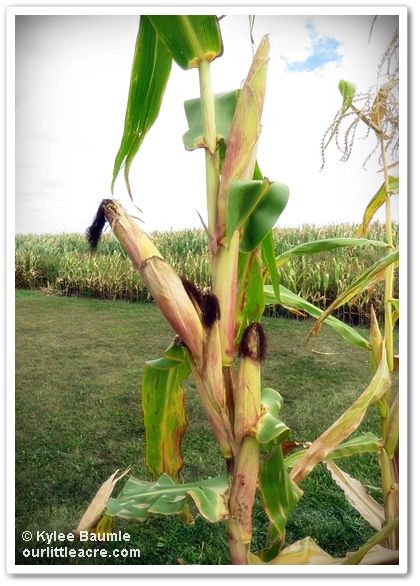
We did plant three different kinds of sweet corn and we got a decent crop for eating, but that season was over several weeks ago. Last weekend, Romie mentioned that there were several stalks in one corner of the plot that remained green while the rest were drying and straw-colored. He suggested that perhaps these were volunteers from last year's 'Glass Gem', since that matured later than our sweet corn varieties.

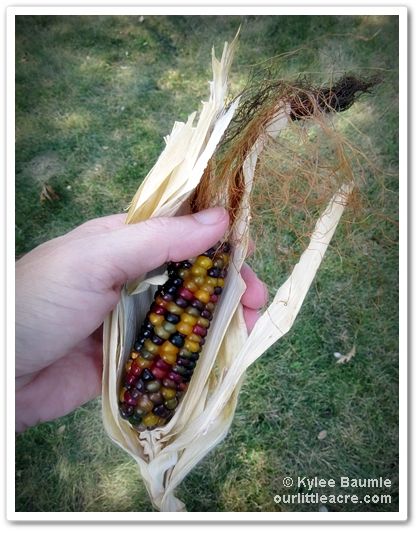
Curious, we walked over there and I peeled the husks back on one of the ears and how about that? 


Either these were seeds that we'd planted last year and they hadn't germinated until this spring (not too likely) or there was an ear that got left on the ground last year long enough that it dried sufficiently to have some kernels pop off the ear onto the ground. That doesn't seem too likely either, since we saved all available seed at the end of the season and I don't think we missed harvesting any ears.

However it happened, we're going to have eight or so ears of 'Glass Gem' this year! What a happy surprise. :-)


Saturday, August 16, 2014

Ball Celebrates International Can-It-Forward Day + A Giveaway!


Last year about this time, I helped Ball and Jarden Home Brands celebrate National Can-It-Forward Day by hosting a giveaway of some of their Limited Edition canning jars. Well, this year the celebration has gone international!  There are all kinds of activities planned to make it a fun day and the giveaway here on my blog is bigger and better than last year!

http://ball.yourbrandlive.com/c/canitforward2014/
In a special live event today, Saturday, August 16th, renowned chef and Bravo’s Top Chef judge Hugh Acheson will be on hand in Brooklyn Borough Hall Farmers Market, answering questions in real time as canning demos take place on a live webcast. You can participate here from 10:00 am - 2:00 pm EDT.

And you'll want to, because in addition to getting your questions about canning and preserving answered by Hugh and various demos, they're also giving away some really great prizes. I'd LOVE to win that FreshTECH Jam & Jelly Maker! Someone is going to and I hope it's ME! And if it isn't me, then I hope it's you! ;-)

In addition to the canning demos, there will also be segments on crafting, herb gardening and their new drinkware line. They will also be attempting a Guinness World Record for the World’s Largest Mason Jar Mosaic! Twenty-five farmers markets across the country will also be hosting Can-It-Forward Day celebrations.

Now, on to those great Ball products that make up my giveaway. Ball sent each of these things to me to try out and I honestly can't wait. I'm already a fan of Ball and have used their canning jars for my jellies and my pickled red beets for years. They've been providing America with canning supplies for over 100 years and they're a company I trust when it comes to preserving my own produce from the garden.

One reader will win all these things:

http://www.freshpreservingstore.com/ball-heritage-collection-quart-jar-set-of-6/shop/617634/
  • The New Limited Edition Spring Green Heritage Collection Jars - These limited edition jars commemorate the 100 year anniversary of the Ball brothers’ “Perfection” Jar and come in a beautiful green tint. These are being produced only in 2014 and are available in both pint and quart varieties, and you'll get a set of each! (Pint retail value: $9.99 per case / Quart retail value $12.99 per case)
     

  • http://www.freshpreservingstore.com/ball-new-fresh-herb-keeper/shop/596221/ 

  • Fresh Herb Keeper - Many new to gardening start with herbs as an easy first step. To savor the seasonings, Ball has developed a new product to keep herbs fresh for up to two weeks. (Retail value: $12.99)


  • Dry Herb Jars - A perfect-sized solution for storing your dried herbs. Great for storing seasonings, spices and rubs too! Stackable, low-profile design makes pantry or drawer storage more efficient than old, mis-matched containers. This is a set of four 4-oz. jars with lids and labels. (Retail value: $4.99)


  • Frozen Herb Starters - Preserve your fresh seasonings in ready-to-use cubes filled with butter, oil or other liquid for easy and flavorful meal starters. (Retail value: $11.99)


  • 5-Blade Herb Scissors - Stainless steel blades gently cut and evenly slice herbs like basil, parsley and cilantro. (Retail value: $9.99)


  • Ball Blue Book - Offering 125 pages that will guide you while you learn about preserving, this book provides information on equipment, instructions for the preserving method and recipes! (Retail value: $6.49) 


These items have a combined total value of $69.43 and should definitely help you get started with your canning, so here's what you need to do to enter to win:

1. Leave a comment to this blog post by midnight EDT next Friday night, August 21, 2014, telling me what your favorite item from the garden to can is. If you don't already can or preserve anything, just tell me why you want to win this awesome set of canning supplies.

2. Since I need a way for me to contact you should you be the lucky winner, you need to fill that information in on the Rafflecopter form below. Blogger comments do not automatically provide me with your name or your contact information especially if you use "Anonymous" when leaving a comment.  If your comment is randomly chosen and I can't figure out how to contact you, another winner will be chosen.


a Rafflecopter giveaway


If you want to follow along on social media as the day's activities are underway, be sure to use the hashtag #canitforward.

You can visit Ball's social media sites here:

www.facebook.com/BallCanning
www.twitter.com/BallCanning
www.pinterest.com/BallCanning

_______________________________
Ball and Jarden Home Brands provided me with the above products at no charge for me to try in my own kitchen. No other compensation was given other than these products and as always, any opinions shared here are my own. I won't promote products or services that I don't like or wouldn't use myself, and in the overwhelming majority of cases, I do use them.

Sunday, September 15, 2013

'Glass Gem' Corn Harvest


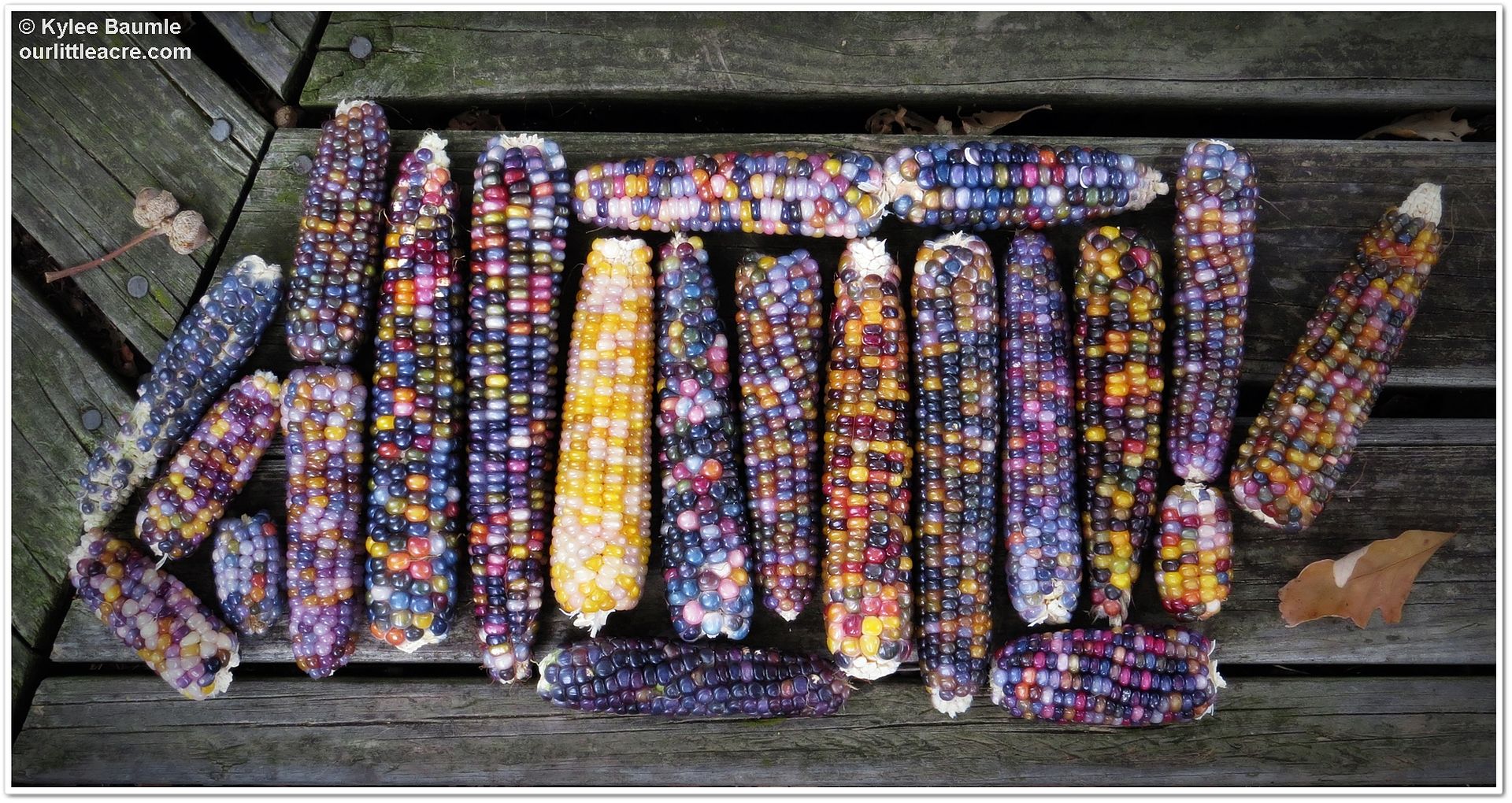
It's happened again.  A photo I posted on my Our Little Acre Facebook page has gone viral.  It was about a year ago at this time that I posted a photo of our first grandchild there and 4.8 million people viewed that, and shared it  more than 2,000 times.  This time the photo was of the 'Glass Gem' corn I grew this summer.

'Glass Gem', lit by the sun

It has already surpassed the Hannah photo in shares (currently at 5,732), but I doubt that it will garner as many likes as our sweet baby (356,315).  Back when all this happened with Hannah's photo, we dubbed it "The Hannah Effect."  I really think maybe she has something to do with this corn thing too, because she spent this weekend with us and was here when I posted the photo.  Viral by association.

We began harvesting the corn this past week and it lived up to all the internet sensation it was last year.  Each ear that I husked was as beautiful as the one before it.  They didn't all look alike, but they were all beautiful, and the majority of them were multicolored jewels - "glass gems."


Click on the photo to open a larger version so you can appreciate the colors better!


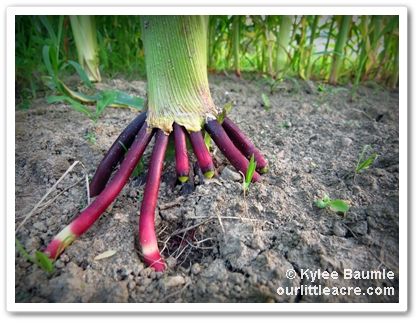
Parts of the corn plant itself were variable.  Some had pinkish-purple roots...


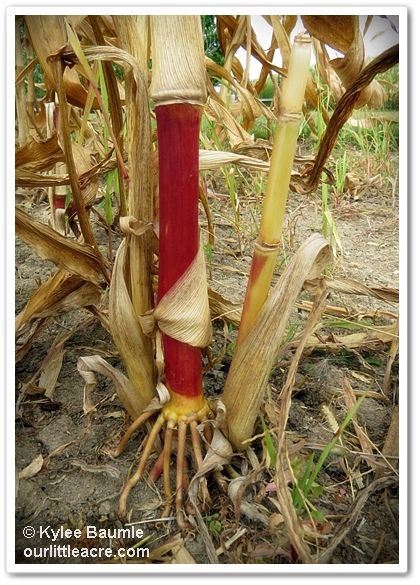
...and some had red stalks...


Many of the stalks had double ears, a few had triple, and one even had four ears!


Pretty much all of the corn germinated, but not all of it was pollinated.  And some of it had incomplete pollination.  I worried that there would be cross-pollination with our sweet corn that was planted in the same plot as well as the field corn planted in the adjacent farm field.  And there no doubt was.  But it didn't prevent us from getting stunningly beautiful corn.  We're going to grow it again next year, with seed saved from this year.

On this smaller ear, the colors are darker.


I've gotten many public and private messages asking several questions about this corn, so I want to answer those here:

  1. Is it real?

    Yes, it's real.  I planted the seeds this spring and just harvested it this past week.  The colors you see in the photos are the colors the corn really has.  They are just that beautiful.  So beautiful that I can't stop looking at them. 

  2. Is it a GMO (Genetically Modified Organism)?

    No.  'Glass Gem' seed is an open-pollinated seed, selected by Carl Barnes, a part-Cherokee farmer from Oklahoma, over many years.  He kept selecting the best and most vibrantly colored seed each year and the result is what you see here.

  3. Is it edible?

    Absolutely.  But not as a sweet corn variety.  It can be ground as corn meal or popped.  When popped, the kernels are white.  We're letting it dry out a little longer before we try to pop it, but that's what we're going to do with it, as well as save some seed for planting next year.

  4. Do you sell it?

    No.  I'm just a backyard gardener, like many of you.  I got on a waiting list last year to buy the seed from Native Seeds/SEARCH in Tucson, Arizona.  The seed was rare enough that there was a limit of one packet of 50 seeds per person and we received ours in late winter this year.  They have enough now for purchase that they've been able to lift the one-packet limit. You can purchase the seed here.


So, to summarize: Yes, it's real.  Yes, I grew it. Yes, you can eat it. No, it isn't GMO. And finally, no, I don't sell it. Native Seeds/SEARCH does.  Buy some from them and you'll help support their mission:

"Native Seeds/SEARCH conserves, distributes and documents the adapted and diverse varieties of agricultural seeds, their wild relatives and the role these seeds play in cultures of the American Southwest and northwest Mexico. We promote the use of these ancient crops and their wild relatives by gathering, safeguarding, and distributing their seeds to farming and gardening communities. We are a 501(c)(3) non-profit organization based in Tucson, Arizona."

Buy some and grow it just because it's so beautiful.


blogger templates | Make Money Online