Here in the north (zone 5b), we're wrapping up the growing season as the weather turns decidedly colder. We've had a few frosts here at Our Little Acre, though nothing that has killed everything off yet. But it's just a matter of time - probably days - before nearly everything green will have turned to mush. Only the evergreens will still look alive.
I've had to bring in many, many plants in the last few weeks. Tropicals that live outside all year are now safely in our warm house or temporarily in the garage until we can move them to the newly-constructed conservatory. In past years, I've overwintered around 175 plants and while that may seem like a lot to you, they fit quite comfortably in nooks and crannies of the house where their growing conditions are being met.
 |
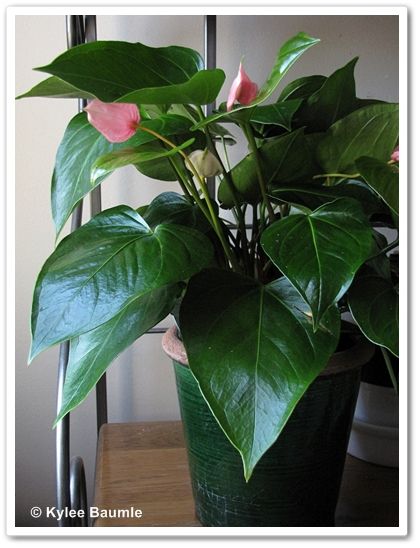
| Anthurium |
 |
| Dracaena |
Romie has always enjoyed having a lot of plants in the house. It makes him feel like he's out in the jungle, he says. But maybe there's another reason he likes them. Plants convert carbon dioxide into oxygen, so it just goes to reason that the more houseplants you have, the better the air quality, right? He's got many allergies, so maybe the plants are purifying the air for him.
Turns out, that's exactly what they do. Some plants are specialists at filtering common household toxins like benzene and formaldehyde from the air - as much as 87%! So not only do they add oxygen, they clean the air, too. Cool.
In 2009,
Costa Farms launched their line of
O2 For You: Houseplants With a Purpose campaign to bring the air-purifying qualities of houseplants to attention. Costa Farms is North America's largest producer of indoor plants and is number two in the world. Their plants are commonly found at Walmart, Lowe's, IKEA, Kroger, Costco, Home Depot, and many independent garden centers, among other places.
 |
| Nephrolepsis exaltata |
One thing I hear regularly from people is that they "can't grow houseplants." I actually used to say this myself and then the plant fairy touched me with her magic wand and lo and behold, I stopped killing them. Okay, so I lose one now and then, but it's not like the mass murder scenes that used to occur here. And would it be so that there really
is a plant fairy like that. *sigh*
But as I learned more about gardening outside my home, I naturally learned more about plants in general and applied those principles to my indoor plants. I did a little research on just what each plant likes as far as water, fertilizer, and light are concerned and then tried to locate them in a spot that I thought they'd prefer. If I can give just one big recommendation to people who are attempting to grow plants in the house, it's this (and you've heard it before): DON'T OVERWATER THEM!
~~~~~~~~~~~~~~~~~~~~~~~
Some ways to see if your plant needs watering is to...
...look at the leaves. Are they wilting? Is the plant drooping? Are some of the leaves browning on the edges or turning brown and crispy altogether? It probably needs watering.
...stick your finger into the soil, down about two inches. If you can't feel any moisture at this level, it probably needs to be watered. Water it thoroughly when you do it. None of that dribbly little stuff. The roots go deep into the pot in most cases and you want all the roots to have a drink. If your finger comes out with wet soil on it, don't water!
...use a watering meter. I've found this to be an invaluable tool. It's easy to use and tells me whether the soil is wet or not at whatever level I choose to stick it down into. There are many of them made by various companies, but they work on the same conduction principle.
~~~~~~~~~~~~~~~~~~~~~~~
Use some basic common sense, too. You don't like cold drafts and neither do your plants, so keep them away from drafty areas. Likewise, when it's too hot, your houseplants will show their irritation (unless they're cacti or something similar), so don't place them too near heaters.
Costa Farms are houseplant experts. For more growing tips and ideas, visit their site at
CostaFarms.com. They have an awesome
Plant Library that gives information on each of their plants.
 |
| Croton |
*Plants shown in the photos are courtesy of Costa Farms.


 "Bejeweled"