I have a heart for one the most iconic symbols of this country - the monarch butterfly. I've always been fascinated by them and entranced by their beautiful markings and how they metamorphose while being encased in a green jewel chrysalis. When I became a gardener, I learned of the importance they play in their role as a pollinator.
 |
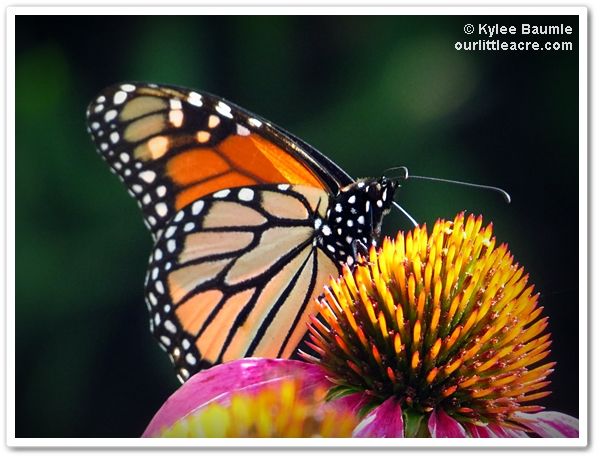
Monarchs nectar on many plants, such as this coneflower (Echinacea purpurea),
but they only lay eggs on milkweed plants. |
Besides their beauty and utilitarian function though, is the miracle of their migration. How a creature that is two months old or less knows to leave their place of birth at just the right time and travel thousands of miles to a very specific location where they've never been before is incredible. Not everything is known about just how they do this, but the fact that they do is one of the world's wonders.
 |
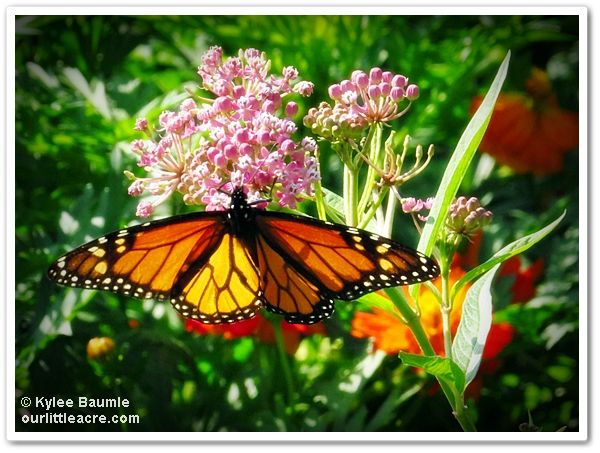
| This monarch is nectaring on swamp milkweed (Asclepias incarnata) in my garden. |
In recent years, the monarch population has declined drastically, due to loss of habitat and the use of pesticides. Monarchs require plants in the milkweed family (
Asclepias spp.) on which to raise their young. These are the
only things they eat as caterpillars. So gardeners are encouraged to grow milkweed in their gardens to try to help. Recent reports are that efforts are helping, even if the progress is very slow. Keep up the good work, people!
 |
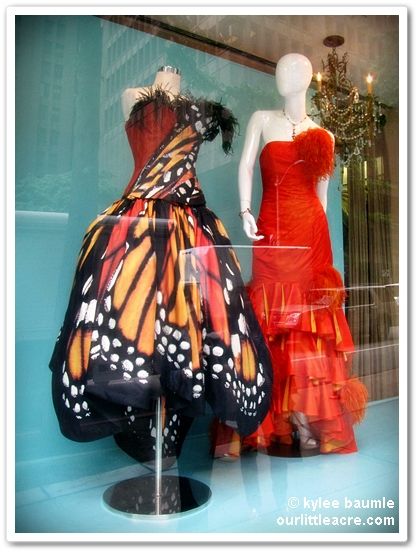
The monarch dress launched Luly Yang's
career as a fashion designer. |
When I was in Seattle a couple of years ago, a walk through downtown led me by the design house of
Luly Yang. Yang is famous for her monarch butterfly dress and there it was, in the window. I fell in love with it and could envision myself wearing it at some fancy schmancy social function.
I did a little research online about the dress and read an article about Luly Yang. The article had a photograph of Yang, wearing a beautiful monarch design scarf. Hmmm... a monarch scarf. I could do that. Because the monarch dress wasn't for sale and I wouldn't be able to afford a single wing of it anyway. So I began a search for a monarch scarf.
 |
| Kim Kennedy |
To make a long story short, I came upon
Kimberly Kennedy, an artist in San Antonio, Texas, who had created a beautiful silk monarch scarf and a quick inquiry to her let me know that yes, she could make a scarf for me. She does these "on demand," one at a time, and it's a lengthy process that I have neither the talent nor the patience to do myself.
As we communicated back and forth, I was interested in what led Kim to choose the monarch as the inspiration for her design. I had a feeling she felt a connection with nature, and I was right. We chatted one day about her art...
~~~~~~~~~~~~~~~~~~~~~~~~~~~~~~
How long have you
been designing scarves?
I have been designing scarves since 2002.
What inspires your
designs?
I am always finding inspiration all around me. I love the
great outdoors and often am inspired by being out in nature. I use a lot of
nature inspired designs in my work such as leaves, butterfly wings and abstract
sea-life. I always have a camera on hand to remember interesting patterns,
textures and wildlife that I see so I can reference it later.
 |
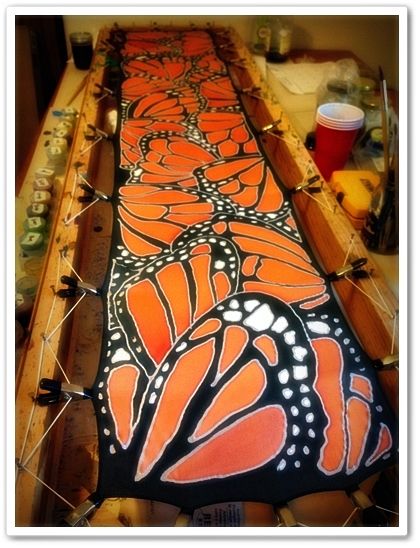
| That's my monarch scarf, nearly completed. |
How long does it take
for you to complete a design on a scarf, start to finish?
It really depends on the complexity of the design. There are
two main techniques I use, serti and shibori, and each has a different level of
involvement. The serti technique involved hand drawing onto the silk a pattern.
The more complex the pattern, the longer the scarf takes to complete. Typically
a serti scarf can take 4-36 hours to draw and dye.
A shibori scarf is much less
time consuming. Shibori is a Japanese binding technique where you use pipes and
wooden blocks to wrap, clamp and dye scarves. This yields completely random,
but beautiful patterns. After 24 hours the dyed scarf can be treated with a
dye-set. Therefore each scarf takes a minimum of 24 hours from start to finish,
mainly due to the required inactive time for the dye.
 |
| Kim works on creating one of her original scarf designs. |
How did you learn how
to do this?
It all started with a new art teacher in high school, Mrs.
Killmore. She taught the class some basic techniques, but I wanted to learn
more than just basics. She took me under her wing and taught me more and really
helped me to learn what dying was all about. Because of her I gained the
building blocks to be where I am today.
What is your favorite
design and why is it your favorite?
I love the butterfly designs! The butterfly takes the
longest and is the most difficult to create, but the end product is just so
amazing. They look so unique and really grab the attention of people around
you.
Have you done or do
you do any other kinds of art besides your scarves?
Oh my goodness yes! I actually went to an art college. I
have a BFA in Graphic Design from Maryland Institute College of Art in
Baltimore. I play with many areas of art including sculpture, painting, drawing,
ceramics and photography. I really enjoy working with my hands, so any
opportunity to do that makes me happy. One of my favorite forms of art is
photography on my old Pentax film SLR that was handed down to me by family. I
also like taking digital photography, but there is something so raw and special
about film. When I travel I bring both cameras, but the film photos almost
always win over the digital photos.
I know you've said
this is a sideline for you. Do you have future plans to make this your life's
work?
For now my business is a part time endeavor, but someday I
would like to open a shared gallery and studio space. It would be a place for
artists to collaborate on new and exciting work to share with the community,
not just a stationary place to view art.
Is there anything
else you want to share?
Besides fine art also I also enjoy building structures and
being the family handy-woman. I built my Chicken coop out back and have plans
to build a backyard studio soon too.
~~~~~~~~~~~~~~~~~~~~~~~~~~~~~~
I now own one of Kim's monarch design scarves and if you think it looks beautiful in photos, you should see it for real. I wore it one day at the recent National Children & Youth Gardening Symposium, held this year in Columbus, Ohio, and all day long I had comments and compliments on my scarf.
 |
| I don't usually wear the scarf in my hair, but it's long enough that I can! |
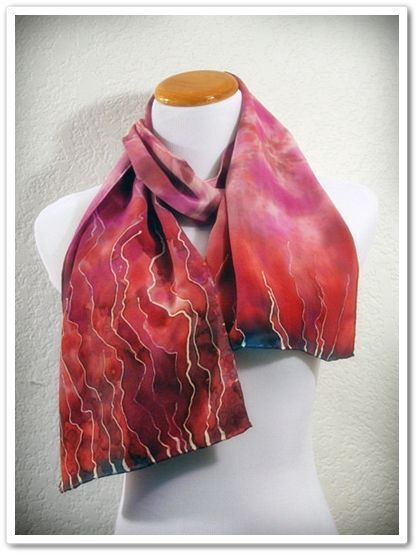
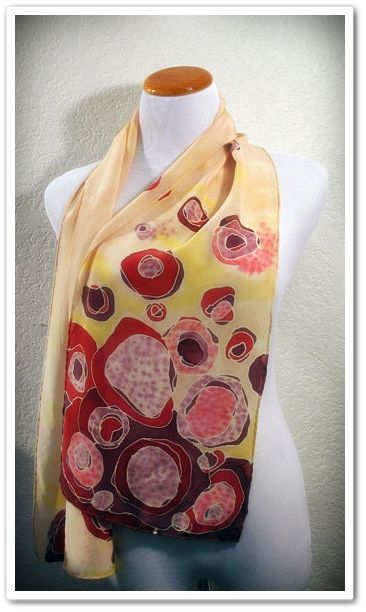
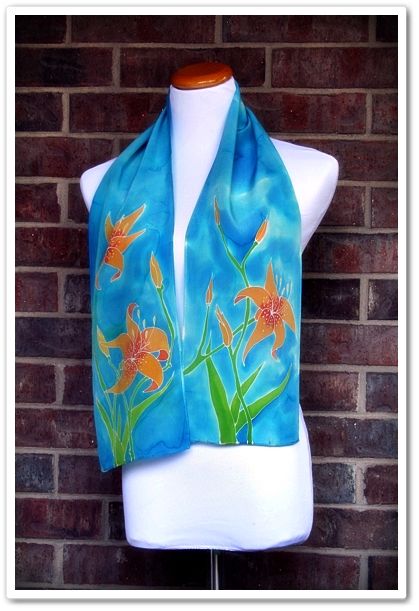
Here are a few of Kim's other scarf designs, which are just as beautiful:
What a special gift this would be for the upcoming holidays! Since it takes a bit of time (up to four weeks) for a design to be completed and shipped, it's not too early to think about it. She does custom orders too, in any pattern and color you like.
You can find Kim and her beautiful works of art at her website:








 "Bejeweled"


