Sunday, June 29, 2008

The Hills Are Alive on Green Thumb Sunday


"Blossom of snow, may you bloom and grow..."


It's not the prettiest flower in the gardens, but what it lacks in beauty, it makes up for as a
conversation starter. Visitors bend down to get a closer look at the plant marker to see what the fuzzy white star blooms are. Invariably, they'll get a smile on their face and say, "So that's what Edelweiss looks like!"

No doubt we all became familiar with this unique plant thanks to the classic movie, The Sound of Music. This was one of the very first movies I saw in a theater and I was so taken with it that I played my parents' soundtrack LP over and over and over again. I knew every song by heart and practiced my imitations of Maria, Liesl, Mother Superior, and little Gretl.

When our family was fortunate to get to visit the Swiss Alps area of Europe the summer of 1974, I once again encountered Edelweiss, incorporated into tourist items such as pressed and framed specimens, embroidered handkerchiefs, and the like. We got to visit Salzburg and saw familiar sites from the movie, including the gazebo where Liesl met Rolf on that rainy night.

I've had Edelweiss (Leontopodium alpinum) in my garden for three summers now and while it hasn't spread much, it's faithful about returning and producing several cottony blooms. When I walk by and take notice of them, I'm taken back to those days of my youth and I break into song...

"Small and white, clean and bright, you look happy to meet me."


Join Green Thumb Sunday

Saturday, June 28, 2008

Do You Want These Plants? Are You Sure?


When I started gardening for real, and Max's Garden was created, I accepted donations of plants of all kinds. It didn't matter what they were, I wanted them. I begged, borrowed, and nearly stole whatever I could get my hands on. Gardening was so new and exciting to me that if it flowered and had leaves, I wanted it!

Mom was cleaning out her garden, getting rid of a few things and dividing a few others, so she shared. And there was the garden club's sale where they offered plants from the members' gardens at a great price. I was glad for both and before I knew it, my garden was more than half full.


All was well, until a season or two went by. And then I figured out why many of the acquired plants were available for free or for sale at a cheap price. Things that are easily propagated don't cost much, if anything. They're like zucchinis - here, take some! There are plenty more where those came from!
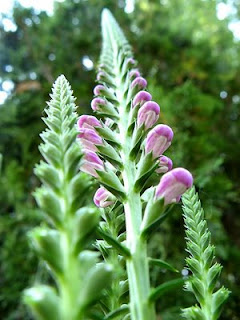

The first to try to take over the garden was the misnamed Obedient Plant (Physostegia virginiana). Who named that plant anyway? Was it someone's idea of a cruel joke? The flowers are pretty, and the plants are nice enough, with virtually no disease problems like powdery mildew or pest problems like slugs. A rampant grower like this ... well ... just dig out what you don't want, right? Sure. But make sure you don't leave any little bit of its root in the ground, because that's all it takes to grow a plant.

Next was the Ribbon Grass (Phalaris arundinacea). What a pretty grass it is, with its green and white striping! Who wouldn't love to see that in their garden? I loved it, that's for sure, and it was such a great grower. So great, in fact, that just two years later, it more than tripled in area. This one spreads by underground runners - it's sneaky that way - kind of like the iceberg that took down the Titanic.

If you really want this in your garden, it would probably be a good idea to plant it in a large container and sink it down into the ground. I still have it in my garden and I need to take my own advice. I'm really getting tired of ripping it out every time it has a growth spurt.

The next thing that grew REALLY WELL in my garden was the
spearmint (Mentha spicata). I hadn't yet learned about mints and their proclivity for spreading. They're all like that. Every last one of them. But remember the Obedient Plant? Same deal here. Even the most minute piece of root will grow amazingly into a big healthy plant. But they do smell good.


I found the most beautiful variegated plant at a local plant sale a couple of years ago and was thrilled with it the first season when it grew well and formed a nice thick carpet around the base of the Japanese Fantail Willow. The cats love sleeping in the Artemisia 'Oriental Limelight' (Artemisia vulgaris), which hides them in its lush foliage. This one sends out above ground runners, much like strawberries do, and if you don't watch out, you'll have an entire garden of it. If you can't grow 'Limelight' then you might want to consider another way to spend your time than gardening.

Then there are the daisies (Leucanthemum sp.). Don't ask me which kind I've got, but Mom gave me a clump of them and that clump has turned into two HUGE clumps. I adore white daisies, which is probably why she gave them to me, but even I don't need THAT many of them. I couldn't tell you how they spread; I just know that they do and each spring and fall, I end up digging out several clumps of them in an effort to control the size of my two daisy spots. Nothing makes me smile more than to see those daisies in full bloom.


Now how about those self-seeders? Sometimes it's a good thing and sometimes it isn't. First, the bad news: Northern Sea Oats (Chasmanthium latifolium). I love this grass with its herringbone seed heads, but I learned the hard way this spring that you do NOT want to let those seed heads dry and fall off. They don't just fall off, they miraculously spread themselves all over the garden. It doesn't matter how large or small your garden is, you'll find little seedlings in the nether regions and swear those seeds had legs.

Now the good news: Nigella. It's such a beautiful annual and if you plant it once, you'll likely have it forever. It's a well-behaved self-seeder though and I've never found it outside of the immediate area where it's previously grown. Can I say that about Snow on the Mountain? No. Or Balsam? No. Those two have explode-a-pop seed pods and it's amazing how far those seeds can be propelled!

Love-In-A-Mist (Nigella damascena)


Shirley poppies (Papaver rhoeas) are another well-behaved annual self-seeder for me. I thought I'd collected all the seed pods from these last summer, but this spring, I found out I wasn't as good at that as I thought I was. They returned, in all their papery loveliness and that was fine with me. I just added the collected seeds from last year to supplement those that already were growing.

This post wouldn't be complete without mentioning violets (Viola sp.). You'd better love them a lot if you plant them, because they'll come up everywhere. They self-seed, much like columbine does, and the seedlings are easy enough to tear out, but if you're like me, you just let them go and bloom where they're planted. They're small, and a violet bloom is just lovely, no matter where it happens to surprise you.

There are many others, these supposed garden thugs, but these are some of the ones that grow here at Our Little Acre and they grow here because we want them to. Choose carefully what you want in your own garden!

Friday, June 27, 2008

Aerial View of Max's Garden


I've been asked to show more photos of the gardens as a whole here at Our Little Acre, so today I take you to the roof of the pool house (actually we call it the cat house, since the kitties sleep there at night). From here, you can get a better idea of the size and scope of Max's Garden.

Looking southeasterly

This garden is actually a melding of the old and new and in my mind is still two gardens. What we call Max's Garden is just a part of the whole and is the newer of the two parts. It got its start in October of 2005, when I decided to get really serious about gardening. I'd been bitten by the bug earlier that spring, after visiting Cleveland Botanical Gardens during the Cleveland Flower Show. Nothing like visiting an outstanding public garden to inspire you to create a bit of that beauty at your own place!

Area of Max's Garden before its creation

We debated on how to get rid of the sod. Discussed it at length and with much disagreement, actually. I wanted to strip it out all at once, which was very labor intensive, but it would be done and over with and we could get on with the fun part. Romie wanted to spray it with Round-Up and then wait for it to die and till it under. We didn't have time to wait if we wanted to get it worked up and anything planted before winter. And I could see those tufts of grass that would resprout here and there and I didn't want those lumps in the soil anyway.

I didn't win, because it was too large of a project for me to do myself at that late point in the season, so Romie tilled the grass under, without using the Round-Up. We raked chunks of grass from there for three solid days. What a chore! But eventually we got it done and ready to go. The soil back there is fabulous, because our property used to be part of a small woods. Very rich and loose and you don't encounter our infamous clay until you dig down about 10-12 inches.

All that got planted that fall were a few shrubs that Mom had given us and I made a mental note of how I wanted paths to travel through the area. We had two weeping willow trees that had been planted a short time earlier and one of them would be in the middle of the garden. We were warned that that might not be a great idea, but in the three years since then, we've loved having that tree there. It hasn't been a problem at all.

Max's Garden is so named because the majority of the time, Max will emerge from the undersides of the garden to greet you as you enter. The other kitties are allowed to visit the garden but Max lets them know they are on his turf. Max is a very laid back cat, but we have seen him chase intruders out from time to time. This is the only time and place we've ever witnessed that behavior from him. It's as if he knows that we have designated this as his space.

From this aerial view, it's hard to judge the size of the garden. Max's part measures approximately 35 x 40 feet, not including those odd-shaped extensions you see in the foreground (new this year). The rest of the garden is similar in size, but a little more rectangular in shape, and this is where the vegetables grow, along with more flowers.

Click on photo to enlarge

Now, to focus in on what is growing and blooming in Max's Garden at the moment, here are some images taken in the last couple of weeks:


Dwarf Lupine (Lupinus polyphyllus 'Gallery Red')


Yarrow (Achillea millefolium)


Sea Holly (Eryngium 'Blue Hobbit')


Blanket Flower (Gaillardia 'Oranges and Lemons')


Lily of the Nile (Agapanthus)


Butterfly Weed (Asclepias tuberosa)


Dianthus (Dianthus 'Bouquet Pink Magic')


Coneflower (Echinacea 'White Swan')


Delphinium (Delphinium elatum 'Magic Fountain')


Rose (Rosa 'Ebb Tide')


Sea Holly (Eryngium amethystinum 'Sapphire Blue')


Leptodermis oblonga


Shirley Poppy (Papaver rhoes)


Daylily (Hemerocallis 'Etched Eyes)


Rose (Rosa 'Pompeii')


Thursday, June 26, 2008

Corn . . . Sweet!


The recent storms in the midwest have created a situation where the crops grown there have suffered to the point where the harvest will be much less. What this means is the price paid for those crops has steadily risen and if a farmer is fortunate enough to have some in storage or have a crop that is unaffected by the storms, he will be sitting pretty. For example, corn was selling for around $4 a bushel a year ago. Today, it's over $7 and still rising.

We've raised corn here at Our Little Acre for as long as I can remember. The small vegetable plot we have was here when we bought our house and while some years we only managed to plant a part of it, there was always sweet corn. Harvest time in August has always meant a five-pound weight gain, due to eating so much corn slathered in butter. Sometimes we not only have corn with our meal, sweet corn IS our meal.

Corn always took up the most room in the garden, which means it has been grown in pretty much the same location year after year. The quality of that corn has made a steady decline in regard to number of stalks and stalks that produce nice full ears.

Plants take from the soil what they need to grow and unless those elements are replaced, the soil will suffer and plants grown there will suffer, too. We've historically never applied anything to our corn, including fertilizer, which no doubt has affected the quality of our crop.


As you can see from this recent photograph of our corn, we have issues once again, with spotty germination being the biggest one right now. Timing is everything when planting seeds and this spring, shortly after we planted our corn seeds, we received lots of rain and cool weather. The seed sat in the ground and a lot of it rotted, necessitating replanting.

We grow the supersweet varieties of corn, usually one white corn and one bicolor (white and yellow together). This year, we tried another variety simply for its novelty - 'Ruby Queen' is red! I've never eaten it before, so we'll see how it compares to our usual variety, 'Serendipity.'

We put fertilizer between the rows last week, and hopefully that will boost those weaker plants. In any case, I don't think we'll be reaping the benefits of higher corn prices with the corn we're growing in our garden. It doesn't matter anyway - we eat all the profits.


Monday, June 23, 2008

My Dad's Better Than ... Well ... You Know


As the only daughter and only child of my father, I never had to share his attention with anyone except my mother. And she seemed to have a way of captivating him that took me years to truly understand - years of being married myself, and to a man very much like my father.

My dad is a quiet man of many talents, and one of these is his superb woodcrafting abilities. Nearly a life-long passion of his, he is a perfectionist when it comes to many things and the furniture he has made over the years is a testament to that.
Those of us that he loves (and love him) have been fortunate to be recipients over the years of many of his very special creations. He is a humble man, thinking that what he does is no big deal, even though we assure him it is.

Our home is filled with his works: a 3-section wall unit that holds many of my books and our television (and a cat now and then), built-in bookshelves along a stairwell wall, a cedar chest that doubles as a coffee table, a grandmother clock, a built-in desk and cabinets that house my Classic Pooh collection, a bookend that holds five wine bottles, and an inlaid walnut Reuge music box.

The star of our collection is our bedroom set which he made in 2000, to copy Thomasville's Encounter collection that I'd seen at Kittle's, and was a gift for our 25th wedding anniversary.


Photos taken in 2001

These are just a few of the things that we're fortunate enough to have in our home. Earlier this year, Dad made me something else that was a special request - a porch swing. When Kara, Jenna and I took a garden tour in Ft. Wayne a few years ago, one of the homes on the tour had a swing on their front porch and Kara remarked, "Mom, you need one of these on your front porch." Brilliant, that girl!

And now we have a porch swing, a la Dad:


But wait! There's more!


A matching chair!


Let's put it all together now...


Romie has decided that a matching rocker would be rather nice and Dad has graciously agreed to make one this winter, when he spends more time inside, in his fabulous woodworking shop.

Now lest you think that my dad has never said no to me, I assure you that's not true. I asked for a pogo stick for Christmas when I was two and I didn't get it.


Thanks, Dad. I love you!


Saturday, June 21, 2008

New at Our Little Acre - Campanula 'Pink Octopus'


Last spring, I looked all over for this in every garden center and nursery I visited. I asked about it but the closest I ever got was when we were in Columbus. "It was on the order list, but it never got sent to us."

It seemed I wasn't going to find it locally, so I ordered it from one of my favorite mail-order nurseries, Big Dipper Farm. The order arrived and while the plant itself wasn't all that big, it had a healthy root system. It wasn't in the ground too long before I realized it was going to be a strong grower. It spread a bit before fall and frost, but it didn't get large enough to bloom yet that year.

When spring arrived this year, 'Pink Octopus' was one of the first perennials in our garden to wake up and I could see that I was going to be very pleased with this plant. It has very lush foliage that has an interesting enough shape that I like it even when it's not in bloom.


In the last week or so, it has begun to bloom, and what fascinating blooms it has! I can see how it got its cultivar name.


I'm quickly becoming a big fan of Campanulas. They're proving to be vigorous, tough plants in our gardens and there are so many different leaf shapes and blooms in the genus. You could have a small garden comprised of nothing but Campanulas and there would be enough variation in form and color that it would be interesting to even the most veteran gardeners.

Example? Compare 'Pink Octopus' to 'Dickson's Gold':


Besides the obvious difference in foliage and bloom shape and color, the growth habit and size of the plants is quite different as well. 'Pink Octopus' grows to a height of about 12 inches, while 'Dickson's Gold' is a small-leaved ground hugger.


Friday, June 20, 2008

Sure Signs of Summer


I know the calendar says it's now summer, but there's one thing around here that means it truly is. Lightning bugs. And we saw them and all their cousins and brothers and sisters and friends tonight.

I was talking to our neighbor Tom as he was burning brush and our other neighbor Tim had walked over to join in on the chat, when we noticed the flashes of light that magically appeared before our eyes. None of us had seen any before tonight.

Tonight's appearance upped the percentage of averages for first sighting on the first day of summer. That's when they typically arrive to herald the start of summer. Last year they were a week early.

The Monarchs arrived a month ago. The Baltimore Oriole was here before that. All that's left is for the cicadas to buzz in.

____________________
Illustration taken from Wandering Home (Artist unknown)

Thursday, June 19, 2008

Old House Journal . . . and Us!


I've marveled before at just who happens to read my blog, and once again, have been surprised. A couple of months ago, I received an e-mail from Old House Journal, a publication of This Old House, requesting use of a photo from my blog for an upcoming issue. I granted that permission and yesterday, a copy of the August issue arrived in the mail.

The photo is one I took a year ago of our patio and pergola. It was the pergola that caught their eye, as they wanted to use the photo for an article on wood preservation.


The article is on page 60 and at the lower right corner, the credit for the photo is given. They even spelled my name right! (Over the years, it's been misspelled a hundred and eleven ways 75% of the time.)

When Romie saw the spread, he was so tickled. He couldn't imagine that his house would make it in a major publication. A pergola that he and my dad worked to build during one weekend back in 2001 was there for all the world to see. Good work, honey!


Monday, June 16, 2008

The "Grandma" Flowers


Petunias. Marigolds. Ditch Lilies. Red Salvia. Ageratum. Portulaca. Geraniums. What do these flowers have in common?

Your grandmother probably grew them. Maybe your mother, too. When you walk into a garden center, do you stop and ooh and ahh over them? Or do you do like I do and give them a cursory glance and walk right past them?


Somewhere along the way, petunias and marigolds became boring. Ditch lilies got taken for granted. Red Salvia and purple Ageratum became
cliché. Portulaca, or Moss Rose, perhaps bears too much resemblance to its cousin, that persistent weed, Purslane. Geraniums, which aren't really geraniums at all, but Pelargoniums, have just graced one too many window boxes.

But really now, how DID these plants become so overused and landscape abused? Just why did Grandma plant them every year? For as despised as some of them are, they are also:

  • Easy to grow
  • Colorful
  • Dependable
  • Heat and drought tolerant
  • Inexpensive
  • Readily available
  • Generally pest-free


When we look at what we want to grow in our gardens, aren't these characteristics the ones we want in a plant? But familiarity breeds contempt and while we may grow these in our own gardens, they aren't high on our list of favorites and they aren't the ones that we drag garden visitors over to see.


"Oh, come look at these ditch lilies! Don't they just have the most perfect blooms you've ever seen? [and they do] And look at that orange - so pure and bright! [and it is]"


There are new cultivars being introduced all the time. There must be a gazillion different petunias out there, and with the introduction of 'The Wave' petunias, they're gaining new respect.
But I say, respect your elders and the flowers they grew.


It's time we quit trash-talking flowers.
Grow the latest and greatest things in your garden - I do. But don't forget these tried and true oldies! They're part of our history and they've earned and deserve a spot in everyone's garden.


Grow some Ageratum and get down on your hands and knees and marvel at their intense blue-purple color and their fuzzy flowery finery. I'll bet when you visited Grandma's house as a child, you thought they were cool. That's because they were. And they still are.


Make new friends,

but keep the old.

One is silver,

the other is gold.

_______________
Photo Credits: Salvia from Texas A&M; Portulaca from Sunrise Seeds; Ditch Lilies from Gardeners Network; Ageratum from Alan's Flower Farm.

Sunday, June 15, 2008

Garden Bloggers' Bloom Day - June 2008


How did summer get here so fast? It seems as if just a few weeks ago we were still watching spring unfold in our gardens and now they're bursting at the edges with blooms and lush green growth. Maybe this is that third-year phenomenon going on in my garden, seeing that this summer is my third as a 'real' gardener.

The first year they sleep,
The second year they creep,

The third year they leap.
Definitely leaping here. And now I present to you some of the best blooms Our Little Acre has to offer if you were to visit today:

Astilbe x arendsii 'Peach Blossom'
I've said before that I haven't had tremendous luck with Astilbes, but last year this one negated that statement and it has continued to perform very well - the best of any of my Astilbes.


Kniphofia (Unknown cultivar)
I bought these several years ago from Spring Hill during one of their one-cent sales, and they've performed very well for me, in spite of being moved twice.


Campanula garganica 'Dickson's Gold'
I love this Campanula! It glows in the garden and the combination of purple and chartreuse is one of my favorite shockers.


Clematis 'Huldine' has really come into its own this year.


Rosa 'Chihuly' continues to wow me.


Rosa 'Disneyland' is still at the top of my list of favorite roses because of its beautiful blend of pink and orange hues.


Rosa 'Crown Princess Margareta'
The English Roses have begun their first flush of blooms.


Schizophragma hydrangeoides 'Moonlight' is also known as Japanese Climbing Hydrangea. In this first spring in our garden after a fall planting and surviving the winter, it seems to be very happy. It's grown like crazy and from what I've read, it can be a slow grower if it's not in the right conditions. We got lucky!


For the life of me I can't find the tag for this Allium I planted in so many places last fall. I love it, no matter what its name is!


After I purchased this first Astrantia 'Roma' last fall, it quickly became one of my favorite flowers. I've got a new darker burgundy one, too ('Ruby Cloud'), but the plant is not well-established enough yet to give a show of flowers like this one.


Clematis 'Niobe' blooms in spite of its location on the east side of the pool house, where it's shaded all day by a flowering crabapple tree.


Eryngium 'Blue Hobbit' has a profusion of smaller blooms on a dwarf plant in comparison to the other one I have ('Sapphire Blue').


Coreopsis 'Jethro Tull'


Veronica 'Royal Candles'


Dutch Iris (Iris x hollandica 'Oriental Beauty') has just finished its last blooms after looking like this last week.


Campanula persicifolia 'Kelly's Gold' keeps its brilliant lime green foliage nearly year-round, then blooms big white flowers in June.


This Paeonia lactiflora can be depended on to bring showy, frilly blooms that have that classic peony fragrance. Looks like the Leafcutter bees like these as much as we do!


I grew this Potentilla nepalensis 'Melton Fire' from seed the first year that I winter sowed (January 2006). I love the color of the small flowers it gets, but the plant is a sprawler and I don't care for that. Maybe I'd like it better in a different location, or maybe it could be helped by cutting back by half, early in the season. Maybe I'll try that next year.


Geranium pratense 'Victor Reiter, Jr.' has dark foliage that needs a brighter-leaved something around it, or it tends to fade into oblivion in a mulched bed. This year, I planted Helichrysum petiolare 'Limelight' around the base. Once that starts spreading, it should bring attention to Victor as well as itself.


Geum 'Double Bloody Mary'


There are other bloomers, too. It's been such a warm, wet spring that everything has just taken off and grown and bloomed like crazy. I almost can't keep up with what's flowering. The weeds are doing their thing too, of course, but in the three years that I've been actively gardening, this is by far the best spring ever.

I'm just loving living the lush green life of my garden . . .

Friday, June 13, 2008

New at Our Little Acre - Weigela 'French Lace'


Weigelas and I have a history. The first time I noticed one was several years ago when a beautiful variegated cultivar was in full bloom in my mother-in-law's yard. It was stop-you-in-your-tracks gorgeous and I asked her about it.

My father-in-law was the one in that family that enjoyed growing things, and he kept a journal of sorts with the original labels and the dates things were planted. But this one wasn't in there and neither my mother-in-law nor I knew what it was. I hadn't yet started gardening in earnest, so I took a sprig of leaves and a flower home with me and tried to identify it.


It was a variegated weigela, cultivar unknown. Shortly after that, I purchased two 'Wine and Roses' shrubs. Although that particular cultivar has dark burgundy foliage, the flowers were much the same, and the first year we had them, they bloomed profusely. The next year, they didn't bloom at all! To make a long story short, I learned that these shrubs are of the sort that bloom on old wood. I was pruning them in the spring, thereby cutting off the new blooms.


In the meantime, I'd found a nice variegated weigela with pink flowers at Lowe's and brought it home (pictured at right). This spring, we decided to move it to a new location. It seemed to survive the move okay, but a few weeks later it dropped all its leaves and died.

Both Romie and I were disappointed to have lost this shrub, and I kept my eyes open for a replacement. 'My Monet' was a possibility and I'd seen 'Ghost' online, but when I saw 'French Lace' a couple of weeks ago at Beining Nursery, I decided that it would be the new variegated weigela for us. The leaves are green and gold, which provides a nice backdrop for its dark red flowers.


Weigela florida 'French Lace' (a.k.a. 'Brigela')

Zone: 4-8
Height: 4-6'
Spread: 4'
Exposure: Sun to Part Shade
Soil: Prefers well-drained acidic


Thursday, June 12, 2008

What is Max Doing?


What is Max doing?

a. Stalking a bird.
b. Having a staredown with the camera.

c. Showing irritation because he was awakened from his 14th nap of the day.

d. Laying low so as to avoid detection.

When Romie built the deck that leads out from the French doors, I asked him to build a bench with a hinged lid for storage and sitting, with a taller square area where I could sit a potted plant. He did so, and for a short time there was a plant sitting on a small square shelf. That is, until the cats decided to take it over for napping and as a way to get up on top of the pergola. Plants don't last too long when they're under constant attack by 10-15 pound kitties.

So, did you guess 'a' ? Max does get that look in his eye when he sees a bird within reach, and he hunkers down into pounce mode just in case the unsuspecting bird is about to have a bad day. But it's not a bird this time.

How about 'b' ? Cats are experts at staring down everything from a fluttering leaf to the humans that feed them. They're so good at it that sometimes I wonder if they're really just taking a nap with their eyes open. But Max isn't looking at the camera.

If you chose 'c', you don't know Max. He's the most laid back cat we have. He can fall asleep in an instant, and like most cats, he loves his naps, but he loves people more. Wake him up, and he'll run to you and beg to lay on your lap. That's his very favorite spot for napping.

So the correct answer is 'd'. Max is trying to hide from something, and I'm sure he thinks that no one can see him. Of course we can, and so can whatever he's hiding from. I don't know what happened between Max and Boo, but whenever Boo is in the general vicinity, Max turns tail and runs. Unless Boo has his route of escape blocked, which is the case here.

Max's strategy worked, because Boo never even saw him and sauntered on by, in search of other conquests. Once Boo was out of sight, Max curled up for another of his many daily naps.

Wednesday, June 11, 2008

. . . and Some Things Take a Long Time to Bloom


Just after Christmas 2005, I decided to try a new thing I'd read about, called winter sowing. It sounded bizarre to me, this planting seeds in the middle of winter and putting them out in it until they started to grow in spring. Yeah, right. Grow.

But when the spring of 2006 made its appearance, so did the seedlings. I didn't have 100% success with everything I'd planted, but enough that I became a believer in winter sowing, and I've done it every year since.

One of the things I planted that first year were lupine seeds (Lupinus polyphyllus). I'd never seen lupines in real life, but I was fascinated by the tall, bubbly flower stalks in such pretty rainbow colors. When I saw seedlings appearing in the milk jug, I was a happy gardener. I transplanted them into the garden when it was the proper time, and they grew quite a bit that first year.


I'd hoped they would bloom, but by the time fall and winter came, I'd not seen a single flower. The plants were pretty enough, with their pinwheel foliage, but flowers would be nice, too. I waited patiently through the next winter, hoping the plants would survive until spring, and they did. Now that summer was here again, I could look forward to seeing my plants bloom!

Or not. Once again, they grew and were healthy, but with no signs of blooming, I wondered if I wasn't doing something right. They were planted in full sun in decent soil, but fall came, then winter, and I still hadn't seen the lupines flower.
Now two years had passed since I planted them; two summers had come and gone without flowers and I wondered if they would ever bloom.

This spring, the lupines once again survived the winter in fine shape and I didn't even think about if they'd bloom or not. I made plans to buy some plants if I came across them at one of the garden centers. Surely, their lupines would produce flowers, wouldn't they?

And then it happened.

About three weeks ago, I was spreading mulch in Max's Garden and when I came to the lupines, I noticed something. Several somethings. FLOWER BUDS! After more than two years of growing in my garden, the lupines decided it was time to let me see what color they were.

One is dark purple, while the other one that's bloomed (so far) is lighter lavender. I direct sowed more lupine seeds this spring, and I did pick up a plant at a garden center in Findlay a few weeks ago, that's supposed to be red. If it blooms, I'll find out for sure, but who knows when that might be. LOL.

In the meantime, I'm tickled purple that my lupine that I planted by seed in January 2006 is finally blooming!


Tuesday, June 10, 2008

Some Things Take a Long Time to Germinate...


Growing things from seed can be tricky. The darn things sometimes don't do what they're supposed to, in spite of your best efforts. I'm still trying to grow Himalayan blue poppies (Meconopsis beneticifolia), but my attempts this year have so far yielded no positive results. I've got an unopened packet of seeds left that I'm going to try growing in our cool basement under lights. If that doesn't work, I'll just admire Jodi's.

There's another blue flower that has eluded me for the last couple of years when I've tried growing it from seed. (What is it about the blue ones??) Nemophila menziesii, better known as Baby Blue Eyes, is a sweet little annual whose blooms resemble that of flax. I've tried a couple of times to grow them from seed, with no luck.

So last year, I saw these
Seeds in a Blanket things and decided to go that route. They were guaranteed to grow!The seeds were embedded into a biodegradable fabric of a sort which could be cut into sections and placed on top of the soil. Keep it all watered well and you'll have a nice little crop of pretty blue flowers that have that charming wildflower look. I did what I was supposed to do, but the seeds didn't hold up their end of the bargain.

Or did they?


Imagine my surprise when I noticed little seedlings coming up where I'd sown the Baby Blue Eyes last spring, this spring! I had to look up what the foliage looked like on these things to make sure that's what I had discovered growing. It was. And is.

Maybe I should just toss the Meconopsis seeds into some loose soil and forget about them until next year.

___________
*Nemophila seed photo from Hume Seeds.

Wednesday, June 4, 2008

I've Seen the Light!


. . . at the end of the tunnel, that is. Last spring and the spring before that, Romie and I worked like crazy people on projects, breaking new ground, amending the soil, planting seeds and plants and shrubs and trees, and spreading mulch. Last year, I told him that once we got things done, we wouldn't have to kill ourselves like that.

I said that the year before, too.

Yet here we are, both exhausted, both wondering if a garden is ever really done. I'm going to temper my statement this year by saying that after this year, I can't foresee any major projects for the garden. That's easy to say... now.

We've had good weather and bad, the latter coming most recently last Friday night, when at midnight, I received a severe weather alert from The Weather Channel. The National Weather Service had issued a tornado warning for our area, because they'd seen a severe thunderstorm with rotation centered over guess where? Our little village of less than 200 people!

I turned on the outside light and saw that it was raining hard and the wind was blowing, but I've seen it far worse. And then it became deathly still. The rain slowed to a sprinkle and there was no wind at all. It was eerie. Then it all started up again.

You'd think at this point I would have awakened Romie and we'd go to the basement, but for some reason, I didn't. I checked the radar online and it appeared that the storm had moved just east of us. I went to bed shortly after. The next morning, I looked out the front door and there was water over the road and a small lake in the field across from us.


Later, on the news, we heard that a tornado touched down in a couple of places, and that there was damage to property just five miles south of us. We went past it and saw that a metal grain bin had been destroyed, as well as an outbuilding. Debris was scattered for a fairly large distance in a couple different directions.

The cause of this particular damage was determined to be not a tornado, but straight line winds. It doesn't matter though, because it was still a powerful storm that caused tornado-like damage.


We got 3½ inches of rain out of that storm and the garden was gushy and soggy. I was glad that I hadn't planted seeds the day before, because it had rained so hard that some of the mulch we'd just put down was all piled to the side and had to be respread.

Later in the day, a tractor with a front-end loader was out scooping up the corn stalks that had floated out of the fields onto the road.

The garden is growing like gangbusters and I've also been kept busy trying to keep up with normal garden chores like weeding and deadheading. DEADHEADING! We're already into deadheading season! We're pinching back things like the coleus and mums, too! And today, I sowed the final seeds for the flower gardens.

Isn't it too late for planting seeds? No. In my limited experience, I've found that sometimes it doesn't really pay to get into a big hurry putting them in the ground. We'd planted the corn a few weeks ago, but we had to replant some of it because we'd had too much rainy, cool weather and the seeds rotted in the ground. Later-planted seeds will germinate quicker in the warm soil and once they're up, they'll grow fairly fast and will eventually catch up to their earlier-planted versions.

There's still some work to be done before I can declare the gardens ready for summer, but I expect I can get it done in a day or two. Last year, we went all summer with the mulch pile in our driveway turn-around in front of the house, and I vowed not to let that happen this year. At day's end tomorrow, I fully expect this year's pile to be where it's supposed to be - spread out in the gardens.

I've got a few bulbs to pot up (Acidanthera, Calla lilies, and Oxalis), and the Caladiums need to be planted in among the Cotoneasters and on the back side of the trellis. Once this is done, the gardens will be fully dressed and ready for us to enjoy watching things grow until fall is upon us once again.

So much has been done this spring and I will be blogging about it in the next week or so, trying to catch up with an account of it all. Several factors have been behind keeping me from staying current, with the main one being the fact that we've spent so much time and effort doing that which I still need to blog about and I'm just plain tired when I come in the house for the night. But a temperamental SD card that contains many of the photos that will accompany the blog posts has also been frustrating. And then there's my wonky ISP. It's a conspiracy, I tell ya!

Enough of that - and on with the fun stuff of gardening! Coming posts will include a series about new additions to the gardens in the way of shrubs and perennials, a post about the wildflowers of Litzenberg Woods, a bird and butterfly report, and the kitties will check in.

Stay tuned!

blogger templates | Make Money Online