As nice as some people can be - and humble, too - in reality we're a self-centered lot. Well, except for when we think we're the only one in the world who does this or thinks that, but even that is a bit egotistical at times. We all like to think we're normal, but as Erma Bombeck says, "Normal is just a setting on the dryer."
Making our way through life, we have experiences that seem normal to us, in that we think everyone does things the way we do. I mean, we've always done it that way or we've always been that way, so it must be the same for everyone else, right? Not necessarily.
When I was in college, studying dental hygiene, I learned about the protruberance (something that sticks out) that I'd had in the roof of my mouth for as long as I could remember. In fact, I never really gave it much thought until then. It seems that not everyone has this, even though I assumed they did.
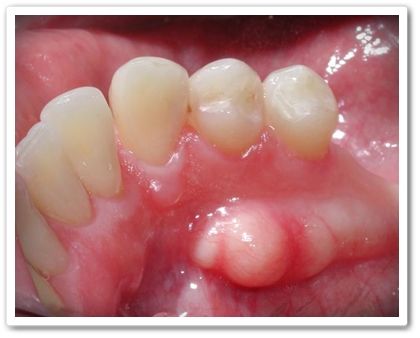 |
An example of mandibular tori
(Wikimedia/DRosenbach) |
I learned it's called a maxillary torus (although technically mine is a mid-sagittal protruberance because of its shape) and it's simply extra bone. No one really knows why some people have them and some people don't, but there is a hereditary factor. I also have tori on my lower jaw (called mandibular tori), on both the tongue side and cheek side, as well as on the cheek side of my upper jaw.
There's nothing to be done about it and it's not harmful, unless I ever find the need to get dentures (please NO). It creates a problem whenever I have to have impressions taken because the impression trays are not made to accommodate that extra bone. (Can't someone invent a flexible tray???) It also is a problem when I'm eating certain things like taco chips or very firm apples, because as I bite down, these things can scrape the tissue covering the bone and it gets sore.
About 7-10% of the U.S. population has mandibular tori. It's more common in the Asian and Inuit population, and it can continue to form as a person ages, apparently stimulated by bruxism (grinding your teeth). What does this say about me? That I'm highly stressed??
Well, anyway, it turns out that I'm "special" in yet another way. We're going to get very personal here. I've known for a long time that whenever I eat a lot of red beets that I'm going to have a "phenomenal" bathroom experience. Plainly put, it turns my pee pink. Sometimes I forget and for a moment I wonder if I've got a bladder or kidney infection. Then I remember the beets.
I've talked to other family members and I was skeptical when they said they'd never had that happen to them, because gee...this was normal, right? I mean, it happens to me just about every time I eat them. I was sure they just weren't taking notice of their own pee.
Turns out that only one in eight people experience what's called "beeturia." It's caused in certain humans by oxalic acid in the digestive system not allowing the betalaine in the beets to be absorbed, so it's excreted. Furthermore, they found that people that ate pickled beets experienced beeturia more often than those who ate boiled beets, due to the acidic nature of vinegar in the pickled beets.
Studies in the 1950s concluded that there was a genetic factor associated with beeturia, but later studies disproved this.
So now you know more about me than you ever wanted to and maybe yourself. If there's anything normal about any of us, it's that we're all unique.
__________________________________________________
*Thanks to Chris Tidrick for the "whizdom" pun.





























 "Bejeweled"


