Friday, August 2, 2019

Green Envy™ - An Exceptional Echinacea for Your Epidermis


For years, I've grown coneflowers (Echinacea sp.) in my garden, including one called Green Envy™. I love how its pink petals are tinged with green, as if designer Lilly Pulitzer had a hand in its creation. It gives coneflowers a special look, but it's also unique in its botanical qualities.


Echinacea has been used for centuries as a homeopathic way of boosting the immune system against colds. It can be found on many an ingredient list and many people swear by it when it comes to warding off disease.

Green Envy™ is notable because this particular cultivar, discovered by New York gardener Mark Veeder, contains considerably more of the phytochemical cichoric acid. An antioxidant, cichoric acid improves the condition of skin by inhibiting the enzymes that break down collagen. All echinaceas have it, but Green Envy™ has a higher concentration of it.

Farmacy, a skin care company in New York, bases its products on Green Envy™ and its pharmaceutical properties as related to the skin. They are partnered with Willow Wisp Organic Farm in Pennsylvania and Patent Wall Organic Farm in the Catskills, who grow the plants used in their products.

I've been using their Sleep Tight ointment for a couple of years now and have to say its my favorite skin treatment of the many I've used. It's not the sole product I currently use, but it's the one I reach for most often.

At first glance, it looks like petroleum jelly, but it's not as thick. You don't need to use a large amount at a time, and the skin absorbs it much like a serum.


Honey Potion comes with a metal
spatula, which stores on top of the lid
because the lid is magnetic!
I also use their Honey Potion on occasion and love how soft it makes my skin feel. This is a mask, though I've left it on longer than the typical mask time, even as long as overnight. When I do that, I use a smaller amount.

I'm often told I look younger than my nearly 62 years. I don't know if I do or not, and I don't know if Sleep Tight is part of the reason. But I do believe the research that has shown that the active ingredient in it is helpful for improving skin quality. I also like using a product that includes beneficial plant elements.

*************************************

Farmacy Beauty products are paraben and pthalate free, mineral oil free, formaldehyde donor free, synthetic fragrance free, and cruelty free. They also offer free shipping on orders over $40 and a flat rate of $5 on those under $40. They have free returns on all orders and Rakuten currently offers a 7% rebate on Farmacy Beauty orders.

____________________
* Because I like their products so much, Sleep Tight in particular, I decided to participate in Farmacy's affiliate program. If you click on the links to products in this blog post and then make a purchase, I will receive a small amount of compensation. I was not asked nor paid to write this post and my opinion of this product is honest and genuinely my own.

Thursday, June 23, 2016

Celebrating National Pollinator Week: Food For Thought


It's no secret the pollinators are in trouble. Oh sure, you see plenty of butterflies, bees, flies, and other insects out there and even bats (yes, they're pollinators), so really, what's the big deal, right?


Consider this:

One out of every three bites of food we eat relies on pollinators.


Still not convinced?

To carry that point further, some plants require specific pollinators in order to get good production of their fruit. (And I use "fruit" in the general definition of whatever edible the plant produces.) Bees are the most well-known of the pollinators, but other insects and birds are more efficient at pollinating certain plants.

Zucchini, anyone?


If you're one of the people who has asked me, "Does it really matter if the monarchs disappear?" I can wholeheartedly answer, "YES."

My philosophy in general is this:  I believe that every living thing on the earth is here because it has a purpose.

In regard to the monarchs, perhaps we can live without them, but it's more complicated than that. The monarchs are in decline because of several factors, not the least of which is that their habitat is disappearing due to urbanization, and to a greater extent, due to the agricultural use of pesticides* that kill milkweed, the only food their babies eat.


If you think that monarchs are the only pollinator that is being affected by the pesticides, think again. They're just more visible and recognizable than most. They're the poster child for the greater problem we humans are causing in the environment.

It's a complicated issue, for sure, but if nothing else, during this, National Pollinator Week, please give these things some consideration. Think before you use pesticides yourself. You may not only be saving the pollinator's meal, you could be helping to save your own.


_________________________________________
* Pesticide is the general term used by the FAO (Food and Agriculture Organization), the USDA and the EPA, which includes, but is not limited to herbicides, fungicides, and insecticides. Read more here.


Tuesday, October 21, 2014

Let's Drink to Apples!


My husband and I have taken many, many evening walks down our road over the years. As far as country roads go in these parts, this one provides some interesting scenery. There are the neighbors that have an assortment of animals, a cemetery that has many familiar names, and we cross two creeks lined with wildflowers.


Many years ago, we also noticed a mature apple tree growing in the deeper ditch on the west side of the road about three-quarters of a mile south of our house. I've always been curious as to how it got there, knowing that there are random apple trees planted by Johnny Appleseed in our general area.

Wikipedia
Logic tells me that while it's fun to fantasize, that tree more than likely grew from an apple that got tossed out the car window after someone long ago enjoyed it as a snack. And if that was the case, then it's highly unlikely that Johnny Appleseed had anything to do with planting it.

John Chapman planted several apple orchards as he traveled these parts, but the trees he planted didn't produce eating apples. Apples eaten for their fruit didn't become popular until the last century. Until that time, apples were almost exclusively used for cider.

This is because apples don't come true to seed and though they grow readily this way, the resulting fruit is almost always very, very sour. Henry David Thoreau described the taste of apple fruit as sour enough "to set a squirrel's teeth on edge and make a jay scream." So how do we get those deliciously sweet varieties such as 'Honeycrisp', 'Gala' and 'Jazz'?

Just like other new cultivars are created by crossing two varieties with the desired traits, so it is with apples, but because of their extreme variability, once a favorable result has been found, propagation is done by budding or grafting.

http://www.amazon.com/gp/product/0375760393/ref=as_li_tl?ie=UTF8&camp=1789&creative=390957&creativeASIN=0375760393&linkCode=as2&tag=theliteraryworld&linkId=QA73WYVJXEJYNA6B
I personally learned about apple genetics by reading The Botany of Desire by Michael Pollan as well as watching the PBS series by the same name. It never occurred to me that the apple wasn't commonly eaten until our not-so-distant past.

Like so many heirlooms, the apple varieties have dwindled to just a fraction of what used to be grown years ago. Back when they were open-pollinated, there were no less than 7500 different varieties of apples. Cultivated varieties for commercial use have basically created a relative monoculture, but apple enthusiasts are growing some of the older heirlooms in greater numbers.

The U.S. is number two in the world's apple production (China is number one), but apples aren't native to our country. They originated in what is now Kazakhstan and were brought to the U.S. by the Puritans. 'Red Delicious' currently leads all varieties in production.

I've not tasted the apples growing on the tree in that nearby ditch, mainly because there's a huge swath of poison ivy in the way of being able to reach the tree. But my curiosity may get the better of me and I might just have to figure out a way to pick that apple. I feel a bit like Eve...


Previously published as "Let's Drink to Apples!" by Kylee Baumle in the Paulding Progress newspaper in October 2013.  Reprinted and modified here with permission.

Saturday, September 13, 2014

Daylily Proliferations


Hemerocallis 'Sarah Christine'
I have never really thought of myself as being a daylily fan (no pun intended!), but I've been rethinking this in the last few years.  Every time I see a beautiful one, I want it. In spite of the foliage of some of them getting rather ratty looking late in the season, I still want it. I've made a compromise with those by cutting the foliage back to about 8-10 inches and pulling off the brown and yellowed leaves.

As a result of my non-love of daylilies, I have no less than 44 different ones (possibly a couple more that I missed when I just went out to count) and I have a wish list of some that I'll buy if I ever run across them.

One of my favorites is a very large lemon yellow one, called 'Sarah Christine'. The American Hemerocallis Society's Online Daylily Database says this about it...

 
 'Sarah Christine' 
Introduced by Millikan-Soules in 1993

Scape height: 28 inches
Bloom size: 6 inches
Bloom season: Early-Midseason
Ploidy:  Diploid
Foliage type: Evergreen
Fragrance: Fragrant
Bloom habit: Diurnal
Color: Pale yellow and ivory to pink bicolor with cream throat
Parentage: (Siloam Mama × Groovy Green)

I would challenge the bloom size as stated in the database.  Mine have gotten larger than that on a regular basis. Regardless, it's one of the larger blooming daylilies out there. Its color doesn't really command attention because there are a gazillion yellow daylilies (at least), but its size certainly does, and that makes it worth having.

This week as I was walking through the garden doing a bit of late summer clean-up, I noticed 'Sarah Christine' was doing something her friends and cousins hadn't. She had proliferations! I've had a daylily do this before, but I didn't do anything with them and merely cut off the scape and composted it.

What are proliferations?

Sometimes a daylily will start to form little plantlets at nodes on the stem of a flower scape. These will often form roots while still attached to the plant. If the stem of the scape is cut on both sides of the plantlet - the proliferation - and put into potting soil, a new plant can be grown. It will be a clone of the mother plant - in other words, identical to it.

'Sarah Christine' has several proliferations on this flower scape. The middle
one is actually two, which I will pot up together.


The reason I don't get too many of these is because I'm pretty obsessive about cutting scapes off once they're finished blooming.  I missed this one.


There are four proliferations on this scape.


I cut it off at its base and then cut each proliferation and put them in water so they can form some roots before I pot them up. I'll keep the potted plants in the greenhouse this winter and then plant them out near the mother plant in the spring.


'Sarah Christine' had babies!


Sunday, April 14, 2013

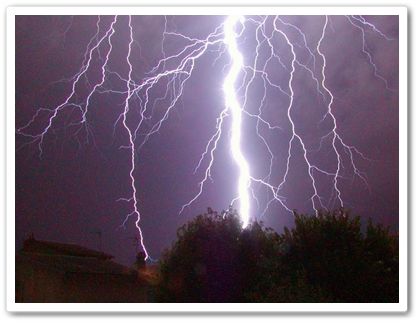
Weekend Wisdom: Does Lightning Make the Grass Greener?


You may have heard it said that following a thunderstorm, which by literal definition contains lightning, the grass will be greener.  It's not the rain, mind you, but the lightning that has been credited with greening up the grass.  Is it true?

Wikimedia Commons/Axel Rouvin


I trust scientists that know a whole lot more about this stuff than I do, but I have to say I'm a believer, no matter what they tell me.  I've seen it.  Simple rain has failed to green it up to the extent that I've seen a good thunderstorm with an abundance of lightning do.

This is a topic that has been in debate for longer than I've been alive, I imagine, but here's what I found out, put in as simple of terms as I can come up with:

Nitrogen in fertilizers is responsible for greening up the grass. The atmosphere contains 78% nitrogen, but in order for plants to  make use of it, the nitrogen bonds have to be broken so they can combine with oxygen to form nitrates, the form of nitrogen that plants can use to form more chlorophyll. The lightning provides enough energy to do this, causing the nitrogen to combine with oxygen in the air, which is then taken to the grass in the raindrops.  The grass drinks it up and is greener.

The debate over this is whether there are enough nitrates formed during a storm to make a difference. Those of us who have seen it happen are convinced there are.  Others will disagree and you can find just as many opinions on one side of the issue as the other.

As a dental hygiene student in college, I was taught that a teething baby's diaper rash has nothing whatsoever to do with the teething.  I believed that too, until I had my own kids and saw it happen. Over and over, that rash would appear at exactly the time a new tooth did.  So what about that?

I'm rather surprised at the number of people I encounter that have never heard of this lightning/green grass thing.  It's something I remember hearing many times from an early age. That, of course, doesn't make it correct, but years of personal experience have helped to form my own opinion on the issue.


This spring, we've had rain and we've had warm temperatures, but it was only after a thunderstorm with plenty of lightning one night this past week did I notice the extreme green that lay before me the next morning when I looked out the window.  The difference was dramatic enough for me to think about this lightning connection again.

You may say I'm wrong, but that's okay. We'll just agree to disagree.


Sunday, March 17, 2013

How To Get the Perfect Tomato


Tomatoes are pretty - I'll give you that.
My gardener friends are always talking about their tomatoes. There must be a bazillion kinds of tomatoes and they have their favorites, yet they're always on the lookout for a "better" one.  Those tomato lovers - it seems they're never satisfied.

Well, it's a pretty well-known fact that I don't like raw tomatoes.  I've got good company in Southern Living Magazine's The Grumpy Gardener (Steve Bender) and Chris Tidrick (From the Soil), who don't like 'em either.  Our distaste for raw tomatoes even garnered the attention of Scientific American ("Taster's Choice: Why I Hate Raw Tomatoes and You Don't") and Living Green Magazine, which republished my original article last May ("Please Don't Make Me Eat Them").

But now, just maybe there's a way to make the perfect tomato - maybe one that even I will eat without cooking it.  I doubt it though.  After all, it would still be a tomato, with that slimy, seedy texture that just feels ucky in my mouth. But that's not my point here.  The point is someone has written a book about creating custom vegetables and flowers in your own garden. So if you don't particularly like what you're growing, breed your own!

Requisite photo of Joseph and me in lieu of the video we intended to make,
but we talked too much, and then it was time for Joseph to go.

My mystery guest that came for lunch on Friday was Joseph Tychonievich, whose new book, Plant Breeding for the Home Gardener: How to Create Unique Vegetables and Flowers, was just released on March 7th.  Yes, there were several of you that guessed correctly in the giveaway - more about that in a bit, after I talk about Joseph's book.

I wasn't so sure how I was going to like it when it arrived here about a week ago.  I mean, really.  It's only plant geeks that like this kind of thing, right?  Don't you believe it.  (Okay, so I am a bit of a plant geek, but that's beside the point.) The short story is that I liked it quite a bit and there are some very good reasons that you just may like it too.  For the longer version, you can read my review on Horticulture Magazine's website.

Timber Press, the publisher, has provided a copy of Joseph's book to the winner of my giveaway, and Joseph, who is nursery manager at Arrowhead Alpines in Michigan (read about my visit there last year) threw in a plant for the lucky winner.  That plant will be custom chosen for the winner, depending on where the winner lives.  No use sending a plant that won't be happy in its new home, right?

So, now I suppose you're dying to know who the winner was.  Everyone who made a correct guess (and each person had three chances) got one entry for each correct guess.  I wrote each one on a piece of paper and had my husband, who couldn't care less about any of this, choose a name from the bowl.


 And the winner is...


Congratulations, Gregory!

I will be contacting you so that I can get your mailing address for shipping your prizes to you. And thanks to everyone who played along, including Timber Press, Arrowhead Alpines Nursery, and especially to Joseph, for wanting to stop and visit, and for writing the book in the first place.  Well done, one and all!

________________________________
I was also provided with a free copy of Plant Breeding for the Home Gardener for possible review.  I was not obligated to do so, however.  All opinions stated here and in my reviews published on the Horticulture website are my own.
Sunday, March 3, 2013

Weekend Wisdom: Is a Plant Virus Ever a Good Thing?


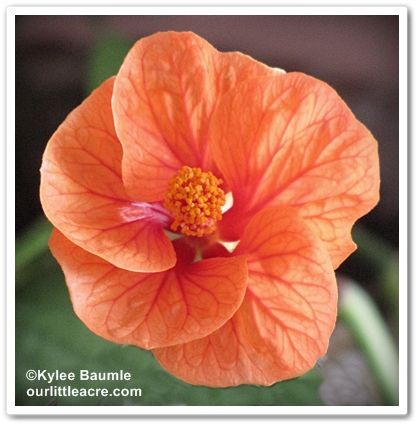
Looking up the skirt of an Abutilon bloom
I've grown abutilons, commonly known as parlor maples or flowering maples, for many years now.  I love their bright bell-shaped blooms and they're easy.  They're a houseplant for me, since I live in the north, but they go outside in summer.

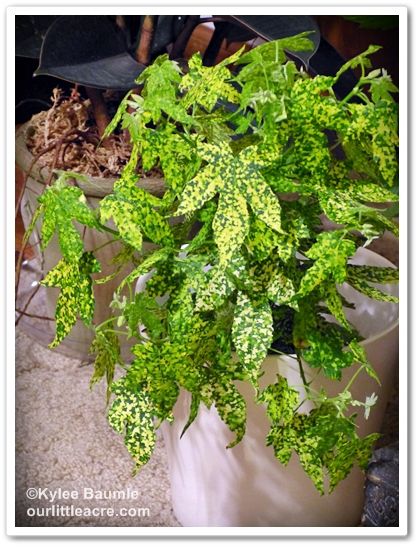
Most of the ones I've grown have the typical solid green maple-shaped leaves (in spite of not being maples), but my favorite one is Abutilon pictum 'Gold Dust' or Abutilon pictum 'Thompsonii'.  I don't know which of these I have, and frankly, don't know what the difference is between the two. (Can someone enlighten me?)

Instead of the usual solid green foliage, this one has leaves mottled with yellow.


This mottling is actually caused by a virus - the Abutilon mosaic geminivirus (AbMV).  Usually, you think of a virus as being a bad thing and harmful to the plant.  Not in this case.  For this Abutilon, it simply creates a beautiful plant with interesting foliage.

The virus can be transmitted from one Abutilon to another, but only through grafting, seed, or specifically the Brazilian white fly.  Other white fly species are not vectors for transmission.


The yellow coloring on the foliage is caused by the virus-infected cells; the cells in the green parts of the leaves are not infected with the virus. If the Abutilon is grown in low light conditions, the plant may lose its mottling, in spite of the virus still being present, and once the plant starts growing solid green leaves, it may continue to do so, even if the plant is returned to a location of high light.


Sunday, February 3, 2013

Weekend Wisdom: Coriander vs. Cilantro


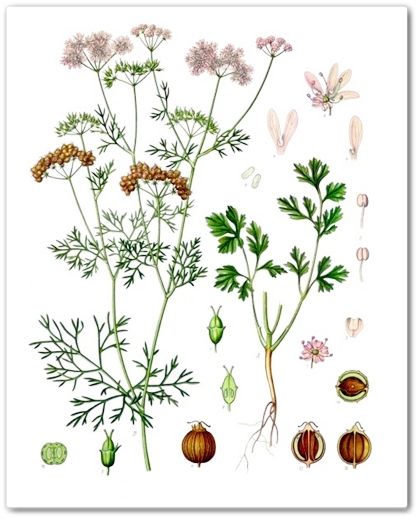
This isn't news to many cooks and gardeners, but on occasion I encounter one or the other that isn't aware of the relationship between the spice coriander and the herb cilantro. While very distinctive in taste, they both come from the same plant - Coriandrum sativum.

   Coriandrum sativum                          Wikimedia


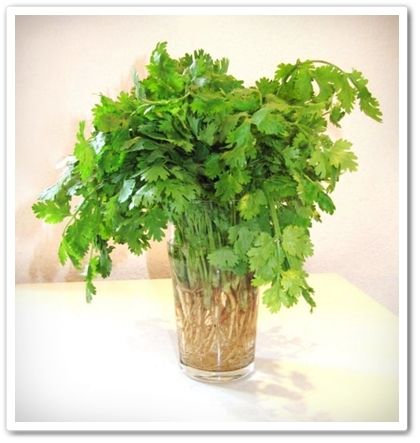
Simply put, the fresh green leaves of the plant are known as cilantro, which is used in many Mexican dishes. In fact, cilantro is the Spanish word for coriander.

Cilantro                               Wikipedia


To some, the leaves have a soapy taste and is undesirable.  It has been determined that there is a genetic factor that causes cilantro to taste this way to some people, but not to everyone.  Personally, I don't care for cilantro, because yes, it tastes a bit soapy to me.  I can handle it in very small amounts in food, but prefer that it not be used.

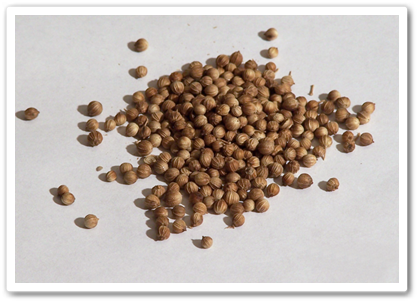
So what is coriander?  If the plant is allowed to go to seed, those seeds are what we know as coriander.

Coriander seed                            Wikimedia


Wednesday, January 30, 2013

British Invasion


We've had a wood split rail fence for years along two sides of our property.  It doesn't do much good for keeping anything in or out, and only serves to mark property boundaries in a pretty ordinary way.  But something is happening on that fence that's anything but ordinary.

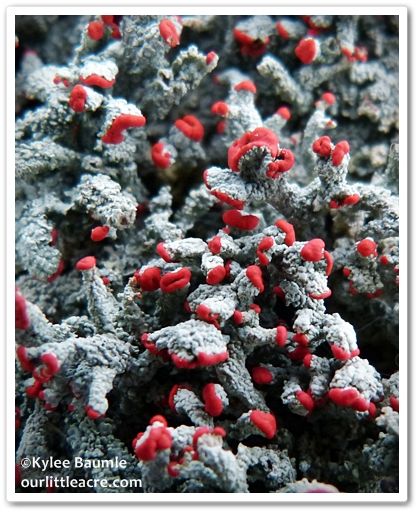
Lichens grow on the top side of several of the rails and they've been there for years.  They always make me smile, just like the times I find a tiny red spider mite in the soil as I work in the garden. Just like when I know there are citronella ants in the soil before I actually see them because I can smell their lemony goodness.


I never took the time to look the lichens up to see exactly what they were until last year, when I discovered that they were Cladonia cristatella, commonly known as British Soldiers, so named for their red "coats."

Lichens consist of a fungus and an algae living together, in a symbiotic relationship. Each could survive without the other, but together they're better. The fungus provides a house for the algae and the algae produces food for the fungus.


In the case of British Soldiers, the red part of the fungus makes spores, which are dispersed by the wind. These spores can form a new fungus, but it won't become another British Soldier until it is joined by the algae.  It also won't be red without the algae. 

 British Soldiers are a frutose lichen, which is an upright form of lichens that also tend to have bright colors. They grow on decaying wood, mossy logs, stumps, tree bases, and soil.  They help break down old wood, as well as taking nitrogen from the air, and in these ways enrich the soil. Lichens don't do well in polluted areas, so lichens can be an indicator of good air quality.

Lichens grow very slowly and British Soldiers only grow one to two millimeters a year.  The tallest part of these on our fence are about 10 millimeters tall. They won't make spores until they're about four years old.


__________________________________
Information gathered from http://www.fcps.edu/islandcreekes/ecology/british_soldiers.htm

Sunday, April 8, 2012

Gardening by the Map


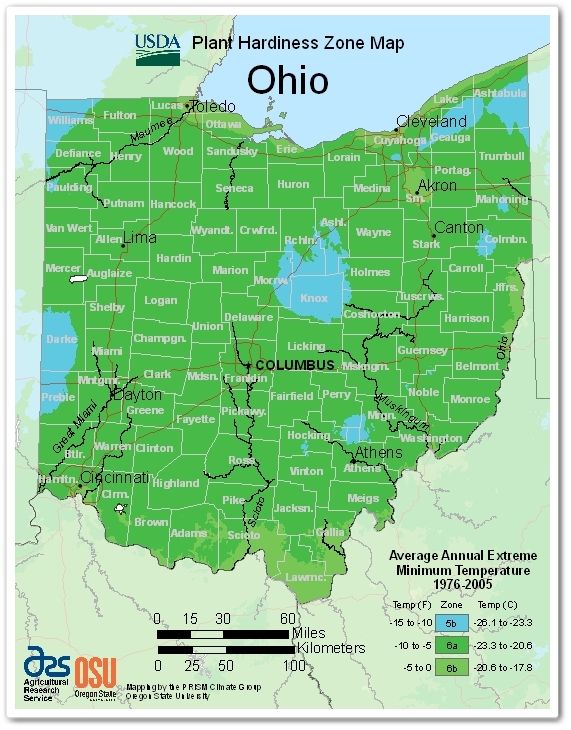
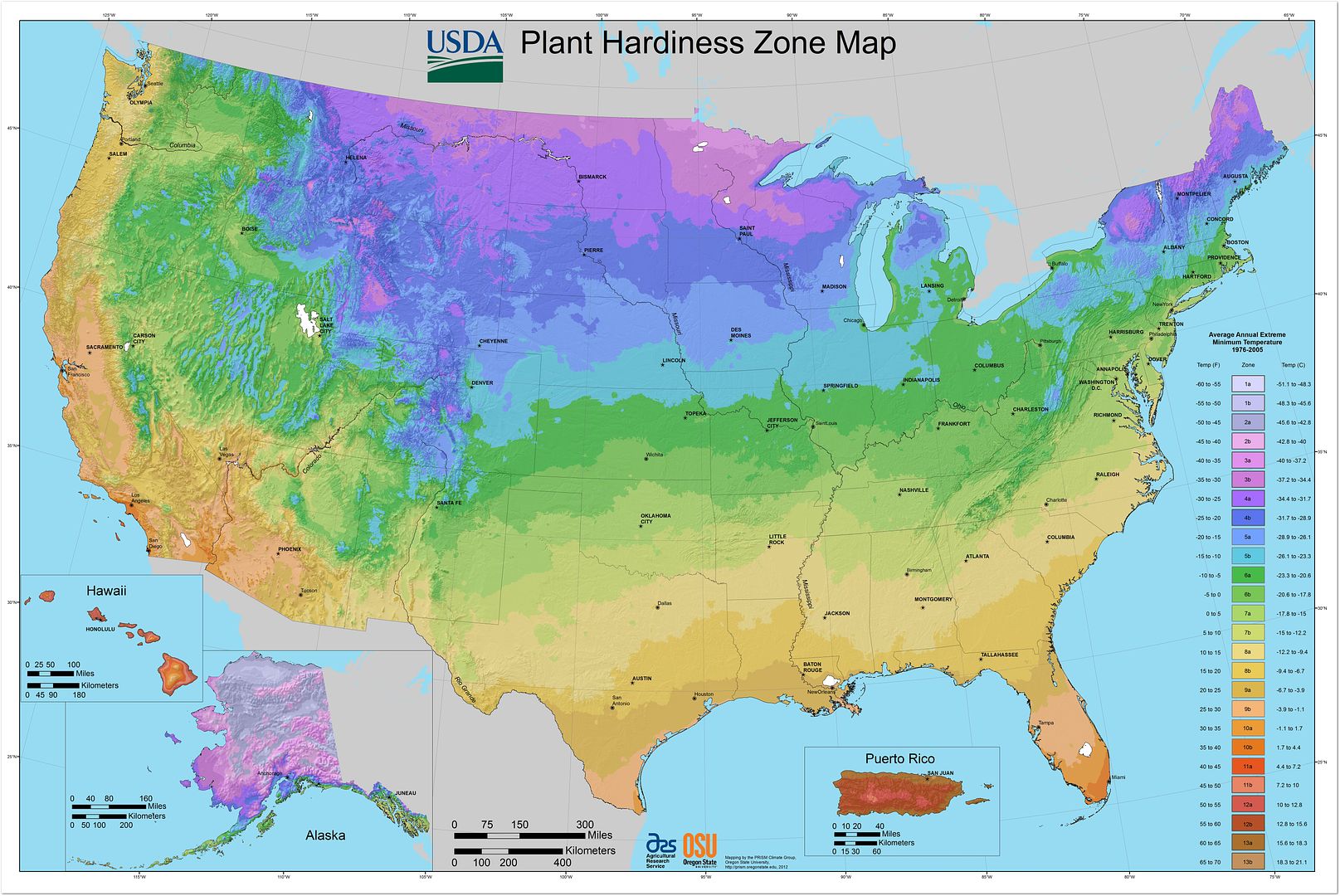
This is old news for some, but in case you haven't heard, the USDA released a new growing zone map in January. Many gardeners found themselves now residing and gardening in a zone warmer than they were previously. I thought that would be the case for me, but it wasn't.

I've been in Zone 5b for as long as I've been a gardener and that's where I am still. Though everyone around me jumped to Zone 6a, I'm still in a little pocket of Zone 5b and I agree with this. There's no way my garden is Zone 6.

Click here to see a larger version.
I'm in Paulding County - in the blue part.

For years, gardeners have lived and died by the growing zone ratings each plant is given, based on the highest and lowest temperatures a plant can typically survive. We read it and if it says the plant is only hardy to zones warmer than ours, we don't buy them, right? HA! I mean, who hasn't tried to push the limits by growing a plant that isn't supposed to live through the winter or summer where they live?

The sources of information for those tags aren't always in agreement with each other either. For example, when I first planted Origanum 'Kent Beauty' many years ago, the tag said it was hardy to Zone 6. But I was in love with it and I had a warmish spot on the south side of our family room where I knew the crocus bulbs emerged earlier in the spring, and the mini roses leafed out there before they did at any other location on our property. I had to try it.

Origanum rotundifolium 'Kent Beauty' ~ July 2011

It performed well that first summer and I was a happy girl. But after one winter, it didn't return the next spring. A couple of years later, I tried again. This time, the tag said it was hardy to Zone 5, and indeed, that second 'Kent Beauty' has returned for several years. Did anything change? No. Plant tags differ, and perhaps the winters were more mild or we had more snow cover. In any case, I consider this plant to be marginal for me, no matter which zone the tag says, based on my experience. Win some, lose some. In this case, I'm winning. (So far.)

A lot of data was used to come up with this new map - data that wasn't used in previous incarnations of it. So this new one should be more accurate. But experienced gardeners know what will grow in their gardens and what won't, regardless of what the hardiness maps say. They know that it's more than zone that determines a plant's viability.

Click on image for a larger version and click here for an interactive map.

This new map, just like the old one, will help the novice gardener by giving them an educated guess as to what their plant choices are. But they should also consider soil, protection from wind, sun exposure, moisture, and proximity to buildings, among other things. Nearly every garden has micro-climates that allow them to grow outside their zone.

Take the new map under advisement, but realize that living things are always subject to the effects of many different factors. It's only a guideline, not gospel.

For more information, visit the USDA website. Did your zone change with the new map?


Thursday, March 22, 2012

Did You Ever Wonder Why Pulmonaria Blooms Change Color?


Dan Heims
When I attended the Chicago Flower and Garden Show earlier this month, I had the pleasure of hearing the great Dan Heims speak. If you love heucheras, you may know who he is, but in case you aren't familiar with him, he is responsible for many of the heucheras on the market today. Based in Portland, Oregon, he is the owner of Terra Nova Nurseries, where all those beautiful plants get their start.

I always learn something from him and it's usually something very, very cool. This time, it involved another favorite plant of mine, and it wasn't Heuchera.

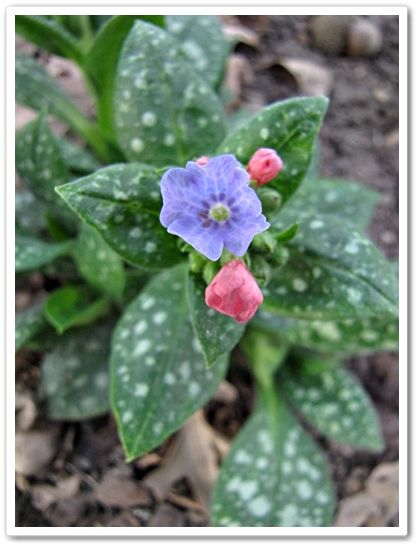
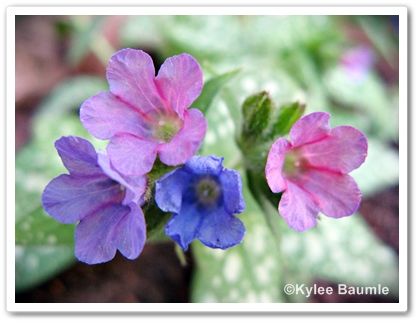
Pulmonarias are known for their gorgeous, fuzzy spotted foliage, and the early spring blooms of pink-turned-blue. Did you ever wonder why those blooms change color? Why not stay pink?

Pulmonaria longifolia 'Roy Davidson'

It turns out that it has to do with attracting pollinators. The color of a plant's blooms attracts specific pollinators - just the right ones for that particular plant. That's not a big surprise, but this changing color thing is.

When the plant is fully primed with pollen, the color of the plant attracts its pollinators. Once pollination has occurred, the plant changes color. The reason? Mother Nature can be very efficient.

Pulmonaria 'Trevi Fountain', hybridized by Dan Heims

To discourage pollinators from wasting their time visiting an already-pollinated plant, the bloom changes to a color that the pollinator isn't particularly attracted to. They'll pass this one by.

I find that incredibly, marvelously fascinating.


Monday, January 23, 2012

Linnaeus Day: Cornus sericea 'Cardinal'


Carl Linnaaus
My friend, Christopher Tidrick (From the Soil blog), has a new meme launching today that he calls Linnaeus Day. It is so named in honor of Carl Linnaeus (1707-1778), the Swede who is credited with the origin of plant taxonomy, or the naming of plants. He prepared the way for the use of binomial nomenclature, using Latin to provide each living thing with a unique name.

On Linnaeus Day, Chris challenges us to pick a plant from our garden and find out more about it. This is a wonderful project for information junkies like me. I find history of just about anything to be fascinating and when it involves one of my favorite pastimes, it’s irresistible. 

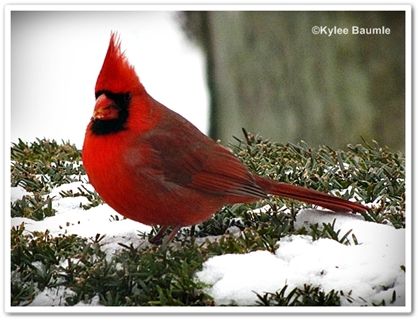
Since I have an acre to work with here, I’m doing my best to fill it up, growing hundreds of different plants in the gardens and landscape. How could I choose one to research? My inspiration came in the form of a beautiful red bird that frequents our bird feeders and it so happened that it posed for my camera yesterday, as I was trying to think of which plant I'd research.

Ohio's state bird, the cardinal, just outside our window

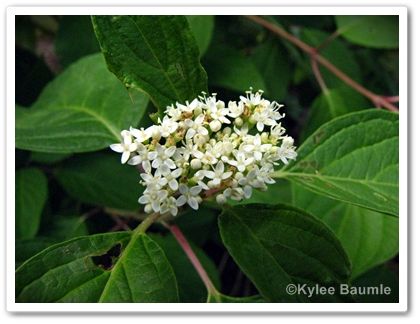
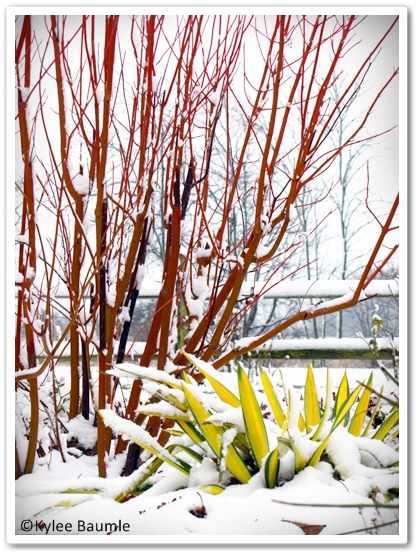
What does that have to do with my choice of plants for Linnaeus Day? I grow a red-twig dogwood in our gardens – three of them, in fact – whose botanical name is Cornus sericea ‘Cardinal’. Winter is its true time to shine, because once it’s lost its leaves for the winter, it allows the branches to be seen. And in winter, their normally green branches turn bright red. (Dirr notes that the red winter color is not as good in Zone 7, where it’s more of a yellow, with a trace of orange.)

Cornus sericea 'Cardinal' with Yucca filamentosa 'Color Guard' in December
 
To keep this shrub producing the best red branches in winter, it’s advised to prune the older branches in the spring, as the deepest red color is shown on the younger growth. Pruning isn’t necessary though for growth's sake, unless you want to rein in this fast grower. 

I remember when I got mine (2008) and I planted them in a group of three. My mom came for a visit and promptly advised me that I’d better spread them apart a little more, unless I wanted one ginormous shrub, because she knew their growth habit. I promptly followed her advice, and it wasn't long before I was glad I did.

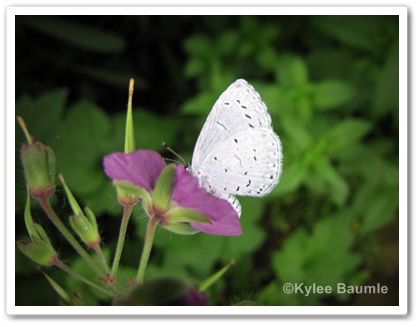
Azure butterfly on Geranium phaeum 'Lavender Pinwheel'
While researching information about this particular shrub, I learned that it’s a host plant for the spring and summer azure butterflies. We have both azures, but they look so similar, I can’t tell them apart when I see them flitting about in the yard and gardens.

‘Cardinal’ was developed by Dr. Harold Pellet in conjunction with the University of Minnesota Landscape Arboretum, which released it in 1987.  The University’s Woody Landscape Plant Breeding and Genetics program was formally initiated in 1954 to breed trees and shrubs capable of withstanding Minnesota's harsh climate. Since that time, the program has been responsible for the release of 46 cold hardy woody landscape plants.¹

Cornus sericea ‘Cardinal’


Deciduous shrub – Hardy in Zones 2-7
Light: Full sun to Part shade
Soil: Moist, acidic to mildly alkaline
Mature size: 8-10 feet wide and high
Fruit: Clusters of white berries follow tiny white spring blooms


__________________________________
Information gathered from the following sources:
Wikipedia, "Carl Linnaeus"
Dirr’s Encyclopedia of Trees & Shrubs
, Timber Press, 2011 ed., pp. 222-223.
Missouri Botanical Garden

¹University of Minnesota Landscape Arboretum


Monday, January 9, 2012

Maybe There's a Reason You Don't Like Brussels Sprouts


Ask me if I like Brussels sprouts and I'm likely to turn up my nose. But I really don't have a good reason to do that, because to be honest, I've never tasted them. But now I want to.

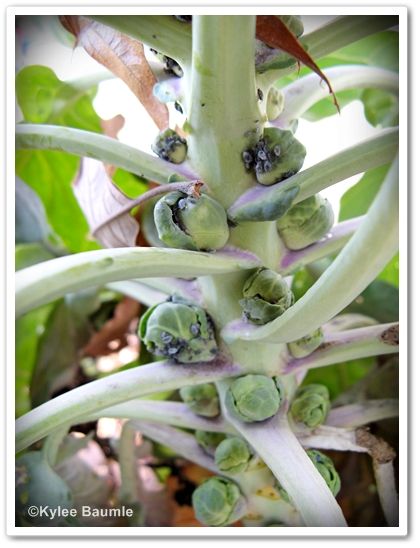
I grew Brussels sprouts in 2008, but I never ate them.
It wasn't because of the aphids either.
Annie White, Editor-at-Large of Inside Grower, brought an interesting little tidbit of information to my attention in her latest newsletter. It seems that there is a genetic predisposition for liking Brussels sprouts or disliking them. About half the population has a gene type that causes the vegetable to taste bitter to them. The other half has a mutation of the gene that allows them to eat Brussels sprouts without tasting the bitterness.

Brussels sprouts contain PTC - Phenylthiocarbamide - and people who can't taste it are more likely to enjoy eating them. This discovery was made by the Eden Project in Cornwall, Great Britain.

I grew Brussels sprouts once, four years ago, but I never ate them. Now that there's this genetic link to liking these or not, I want to grow them again and this time, I'll eat them. I'll eat them at least once, just to find out if I'm a "taster" or not. Then I'll make my husband eat them to see if he likes them. And then - you know what's coming, don't you? - I'll make our girls eat them to see whose genes they inherited.

Yeah, it will be a downright scientific experiment.


Friday, January 6, 2012

Save the Heirlooms! (And a Giveaway)


When our grandparents were busy plowing the fields and hoeing the gardens, they were likely growing plants from seeds that were saved from year to year. They saved the seeds from the best plants each season and each year the results were [theoretically] better than the year before. Why were they better? Because the plants that did well in their unique growing situation were more likely to do well in that same situation again. They thrived because they adapted to their environment. Same plants, only better.

'Sun, Moon and Stars' Watermelon
(Heirloom, introduced commercially in 1926)
Yes, it's usually larger than this!


Seeds that are saved in this way are open-pollinated, meaning one kind of plant wasn’t purposely pollinated with another to create a specific and different plant. They simply were pollinated naturally by insects, the wind, or birds. With hybrids, two different plants are purposely cross-pollinated with a specific purpose in mind – to create a plant with a specific color, growth habit, hardiness, or some other desirable trait.

As more and more plants are created by the hybridizers, the heirlooms (as those plants that have been passed down over the years via saving seeds are called) are disappearing. This is especially worrisome when it comes to seeds that grow edibles. Many of the varieties that our ancestors enjoyed are becoming scarce, if not non-existent. The diversity of crops, which is vital to the health of our homegrown food supply as well as the insect population (the balance of good guys to bad guys), is taking a huge hit.

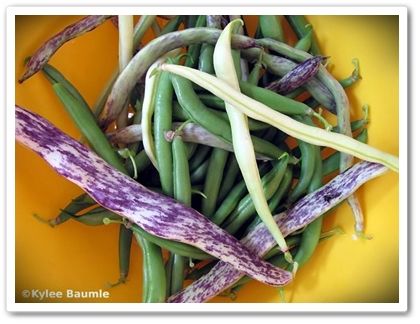
The purple streaked beans are 'Dragon Tongue', an heirloom from 18th
century The Netherlands.

I’m not against hybrids. Thousands of beautiful and delicious plants have been created by hybridization and I grow many of them in my gardens. I just hate to see so many of the heirlooms disappearing. We need to grow more of them to assure that they won't be lost. Hopefully, you're already growing some heirlooms in your gardens!

Emilee and Jere Gettle,
with daughter Sasha
Jere and Emilee Gettle, owners of Baker Creek Heirloom Seed Company in Mansfield, MO (home of Laura Ingalls Wilder), have devoted their lives to the preservation of heirloom seeds. They recently wrote a book about it. The Heirloom Life Gardener is a great read on the subject of heirlooms and how to grow them.

You can see my review of their book on my garden book review site,  Gardening by the Book, as well as on Horticulture magazine’s website.


And, since I received two copies of their new book, I’m giving one away to one lucky reader! All you need to do to be entered to win is leave a comment to this blog post and tell me what heirlooms you plan to grow this year. Are you trying a new one or do you have a favorite that you grow every year? Be sure to fill out the Rafflecopter form too, so I’ll have a way to contact you if you win. The giveaway ends in three days, at midnight EST this coming Monday, so don't wait to enter!

blogger templates | Make Money Online