It would just be too tacky to make a play on "that movie" that premiered over the weekend, so I won't do that. But I have to show how much better Mother Nature does it anyway.
In my last blog post, I shared some photos of last spring's visit to Longwood Gardens.The conservatory there is a world all in itself, with each partof it worthy of an essay highlighting its features. It was the lovely shades of gray in its Silver Garden that especially caught my eye this visit.
Take a look:
Monday, February 16, 2015
Longwood Gardens: Shades of Gray
Posted by Kylee Baumle 5 comments
Labels: books, container gardening, epiphytes, foliage, garden tours, succulents
Tuesday, January 29, 2013
Staghorn Fern String Planter - DIY
String gardens are popping up all over Pinterest these days. The concept is pretty simple, really. It's a hanging container with plants in it! But what sets a string garden apart is that the container used for planting isn't an ordinary container and they're usually hung in groups.
Most of the string gardens I've seen are made with Kokedama (moss balls) or grapevine spheres. All sorts of plants are planted in them, even small trees. Trees look especially stunning because they're usually hung low and appear to be suspended in mid-air if the "string" used is nylon fishing line. They can be a bit tricky though, because they're top-heavy, so proper balance and support is important.
I've wanted to make a string planter of my own, and I had a number of grapevine spheres that I've used as decorator items in my home for years. So I took one of those and in less than 30 minutes, I planted it up and hung it. Though mine isn't made using kokedama, the effect is pretty much the same and it really couldn't be easier.
Materials:
- hollow grapevine sphere
- sheet moss
- potting soil
- scissors
- 25-lb. strength nylon fishing line
- plant of your choice
First, cut an opening in the grapevine sphere, large enough that you can fit the root ball of the plant inside it.
Next, line the inside with sheet moss, keeping the greener side facing the outside of the sphere, because it will show through a little bit when you're finished.
Put a small amount of potting soil inside the sphere unless your root ball takes up the entire volume of the sphere. You should have some space to be filled around the root ball to allow for a bit of growth.
I used a clump of staghorn ferns (Platycerium sp.) that needed to be repotted because they were outgrowing their plastic nursery pot and they fit nicely inside the grapevine sphere. Once I had the plant potted up, I took lengths of the nylon fishing line and tied them around the top edge of the sphere, making sure they were secure enough to hold the weight of it when suspended.
After soaking the ball and letting it drain, I gathered the "strings" of fishing line at the top and tied a knot at the length I preferred for the sphere to hang from the ceiling - about 30 inches.
After hanging the sphere, I tucked in some sheet moss around the top edges to give it a more finished look.
This staghorn fern has been living in our bathroom for the last three months and it loves the more humid environment there. I put it in the shower periodically and wet it down, and I'll still be able to do the same thing with this container. I'll have to monitor it more closely since it will dry out more quickly in the grapevine sphere than it did in the plastic pot.
Posted by Kylee Baumle 4 comments
Labels: container gardening, epiphytes, garden crafts, how-to, projects
Saturday, January 28, 2012
Sweet on the Queen's Tears
About a year ago, I came across a photo online of a beautiful bloom. I read the caption, then read more about the plant sporting it. Ah...it was a tropical, so I kind of dismissed it because finding certain tropicals in the north can be as much a waste of time as shoveling the snow while it's still snowing.
Just a few short weeks later, I attended the Fort Wayne Home and Garden Show, as I usually do each year. Making a bee line for the Foellinger-Freimann Botanical Conservatory's booth, I was anxious to see what they had to offer for sale. They have great stuff and sometimes unusual plants, for quite reasonable prices.
I picked a couple of things out, paid for them, and had them hold them until I was ready to leave the show. As I was walking away to see what else was at the show, something caught my eye that I hadn't seen, somehow. It wasn't in bloom, but the stiff spears of foliage made me take a closer look. When I read the tag - Billbergia nutans or Queen's Tears - I couldn't believe it. This was the plant that I'd read about.
This one wasn't in bloom and wasn't exactly something that would warrant anything more than a passing glance. I'm not sure why I checked it out, but I snatched it right up and took it home with the rest of my treasures. It was bursting out of its small plastic pot, so much so that it was misshapen, so I made a mental note to repot it into something slightly larger when I got the time. I put it in the conservatory.
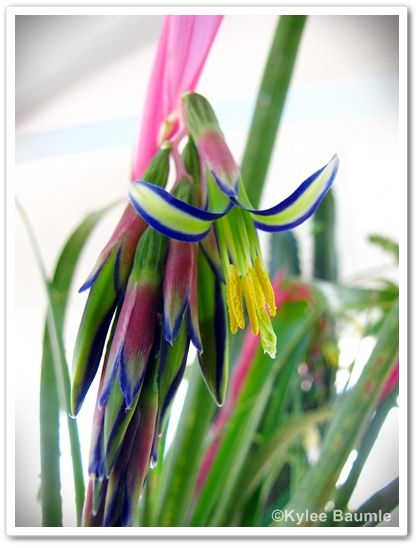
I forgot about the repotting, but it must not have minded, because it bloomed a few weeks later. It was as beautiful as I'd seen, even though it only had a couple of blooms.
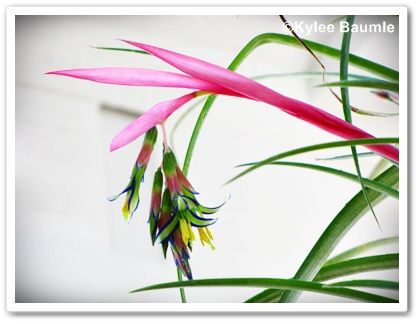
Spring came and things got busy around here. The Billbergia finished blooming and I kept putting off the repotting. I left it in the conservatory for the summer, watering it as it needed. Soon it was fall and time to start loading up the conservatory with the tender plants that had enjoyed the summer outside. Still, the Billbergia was waiting for repotting, and I knew I couldn't put it off any longer.
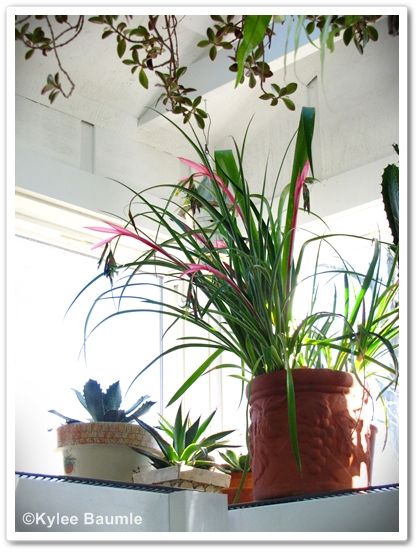
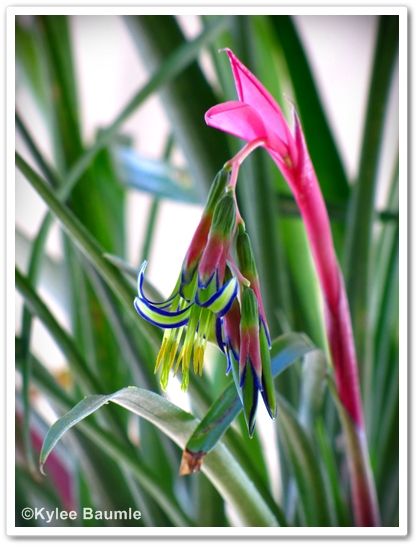
Earlier this week, it rewarded me for giving it more room. There are eight shoots of blooms on it this year and I'm not sure it's done shooting them out yet. Normal time for them to bloom is mid-spring, so it's early. Last year, it bloomed in mid-April.
They're as beautiful as ever, as seen in the photos here. This plant, which is a terrestrial epiphyte, couldn't be easier to care for, in fact, it tends to thrive on neglect, I've found. It's also called Friendship Plant because it produces "pups," which can eventually be separated from the mother plant and potted up.
While they might be common in warmer climates, they aren't that easily found here where I live. Keep your eyes open and you might find one, too.
![]() |
| Billbergia nutans Zone 9-11 Bright indirect light. If grown outside, keep in shade. |
Posted by Kylee Baumle 12 comments
Labels: blooms, container gardening, epiphytes, greenhouse/conservatory, houseplants, tropicals
Thursday, November 17, 2011
Thanksgiving or Christmas? Which Kind of Cactus Do YOU Have?
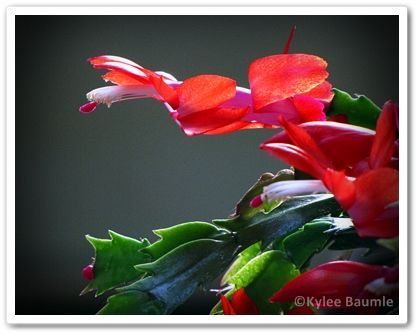
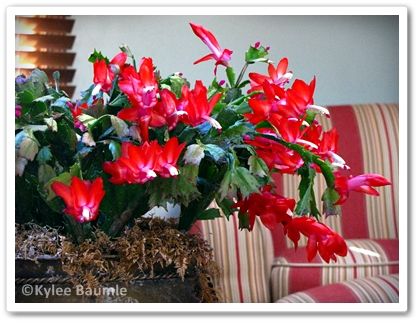
My Thanksgiving cactus is coming into full bloom right now. It's pretty much on schedule, although it will have lost some of its blossoms by next Thursday (Thanksgiving). I bought 'Caribbean Dancer' two years ago, almost to the day, and it's been one of the easiest houseplants I've ever owned.
Before I got it, I thought all cacti of this kind were called Christmas cactus. Then I heard about Thanksgiving cacti. Yes, Virginia, there is a difference.
![]() |
| Thanksgiving cactus (Schlumbergera truncata) |
Thanksgiving cactus (Schlumbergera truncata) has a distinctive look to its foliage. Each segment is much more sharp-cornered, more square than its Christmas cactus (Schlumbergera x buckleyi) cousin. A little less noticeable is the way the bloom is held at the end of the foliage. Thanksgiving cactus has a more upright bent to it. When you see them side-by-side, it's easy to see the differences.
![]() |
| Christmas Cactus - 2010 (Schlumbergera x buckleyi) |
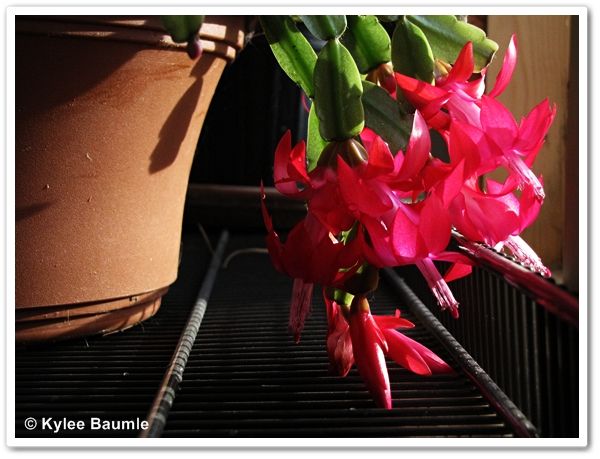
I've also got a Christmas cactus, although I didn't intentionally buy it. Not exactly. When I visited the Fort Wayne Home and Garden Show a couple of years ago, I bought a planter that had several succulents planted in it, one of which was a Christmas cactus - a true Christmas cactus. That one is just now beginning to put buds on and it will likely be blooming by Christmas, just as the Thanksgiving cactus is dropping its last blooms.
There's a third kind, too. Want to guess what its common name is? That's right - Easter cactus. Easter cactus blooms even later and belongs to a different genus (Hatiora gaetneri), but the foliage and blooms on all three look strikingly similar. All are native to Brazil.
Bloom times are different for each, which is how they got their common names. But don't count on the plant you see in the grocery store or the big box store having the correct common name attached to it. Most people don't really care about that, but just in case you do, now you know.
![]() |
| Thanksgiving cactus |
Posted by Kylee Baumle 5 comments
Labels: container gardening, epiphytes, holidays, houseplants, NaBloPoMo
Friday, January 21, 2011
Focus on Houseplants: Rhipsalis
One of my newer internet gardening friends, Steve Asbell of The Rainforest Garden, mentioned something about mistletoe cactus awhile back. I'd never heard of it, but I'm not very knowledgeable in the world of cacti, so that's not surprising.
What was surprising to me, however, is that lo and behold, I already had a mistletoe cactus and didn't realize it! I was able to take part in a houseplant survey recently conducted by Costa Farms. For the survey, I was to purchase several houseplants (paid for by Costa Farms) and complete surveys for them about my experiences. Now, when someone gives me money to go buy houseplants, I'm out the door to do just that (after jumping up and down with glee)!
One of the first plants I bought was this Rhipsalis, also known as a mistletoe cactus. Of course, I didn't know they were called this until Steve brought it to my attention, indirectly.
I. Love. This. Plant.
This has got to be one of the easiest plants to grow, ever. It's a succulent, so it's pretty forgiving on watering, as long as you don't overdo it. I have it near a south window where it gets indirect bright light and it has grown even in the short time I've had it. It doesn't shed and it has a beautiful weeping habit. Though it's a cactus, it isn't prickly either.
According to Wikipedia, Rhipsalis make up the largest and most widely distributed genus of epiphytic cacti. Epiphytic means that it grows on other surfaces, such as trees, using its roots for gaining a foothold. They gain most of their nutrients from the air and rain and sometimes from debris that may accumulate around them.
Rhipsalis is generally only hardy to zone 10, but it adapts well to being grown as a houseplant. They like part shade to shade, although some direct morning sun is okay.
Posted by Kylee Baumle 8 comments
Labels: epiphytes, houseplants, succulents, tropicals
Saturday, January 1, 2011
Ric-Rac Cactus - A Unique Epiphyte
![]() |
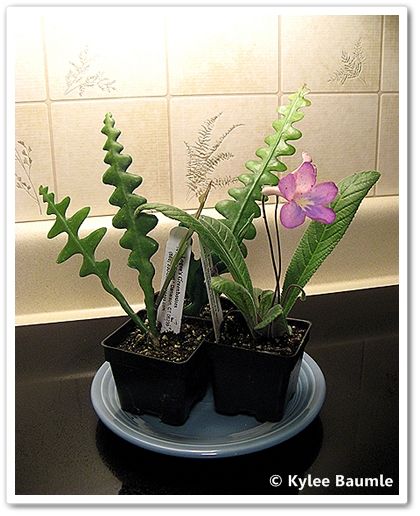
| Ric-rac cactus, with Streptocarpus 'Party Doll', as I received them from Logee's. |
What attracted me to the Ric Rac Cactus was its unique foliage. It does indeed look like rick-rack trim used in sewing. Beyond the shiny, somewhat puffy foliage, its bloom is gorgeous. Mine has never bloomed, but I'm hopeful it will someday. The "cereus" in one of its botanical names brings to mind the Night-Blooming Cereus (Epiphyllum oxypetalum) and so does its bloom. Instead of being all-white though, the Ric-Rac's bloom has a soft shade of peach sepals to go with its white center petals.
Posted by Kylee Baumle 11 comments
Labels: blogging, epiphytes, meme, succulents


"Bejeweled"