Saturday, January 20, 2018

How the Lifesaver Plant Got Its Name


Winter is a time when most of my houseplants get the most love they're ever going to get. That's because if I want to keep these plants - mostly tropicals - they have to live in the house with us during the winter and I generally pay more attention to those things that share my living space. We're in Zone 5b here and it gets way too cold for them to stay outside year round.

These begonias do well in the bright shade of the pergola, but need to
go inside for the winter.

One day, in the summer of 2016, I went nursery hopping with my good friend, Shelley, and while I showed some restraint as we visited various places, only buying what I needed for a photo shoot for a trade industry magazine article I was doing, I found something I couldn't live without. It only cost a few dollars, but we all know that when it comes to plants, cost often has little to do with our buying decisions.

I'd heard about the lifesaver plant many years ago and had seen photos of it - such a cactus-y looking thing with surreal candy blooms. I wondered if those flowers (I felt funny even calling them that) really looked as plasticky in real life.


But now here it was, right in front of me, and oh boy, yeah. It really did look like its photos. So I bought it. In the time since that day, it has taken turns growing in the house, in the conservatory, and outside during the summer. It seems to be a happy camper no matter where it is. You've got to love a plant like that.


Here are the growing stats:

Common name: Lifesaver plant
Botanical name: Huernia zebrina
Plant type: Succulent
Zone: 10
Light: Full sun
Water: Let dry thoroughly between watering, then soak. Tolerates neglectful watering.
Height: Under 6 inches 
Bloom time: Intermittent


FUN FACT: Huernia zebrina belongs to the same family as milkweed -  Apocynaceae. But no, monarch butterflies don't use it as a host plant. 😉


http://amzn.to/2EYfttk


For ideas on how to use houseplants that coordinate with your personal style and decor, see my first book, co-authored with Jenny Peterson: Indoor Plant Decor: The Design Stylebook For Houseplants. (2013, St. Lynn's Press)


Monday, January 30, 2017

Grow Your Own Avocados


Wow, was this ever a throwback to my college days. Back in the days of macrame, yogurt makers, and prayer plants - otherwise known as The Seventies - homes, apartments, and dorm rooms everywhere could be seen with this sitting on their window sills:


It was ever so cool to grow your own avocado plant from a pit found inside one you'd gotten at the grocery store. I did it, my friends did it, and I'm betting some of you did it too. I honestly don't remember if I was successful at actually getting that thing to germinate or not, but I tried.

With the trade situation with Mexico kind of up in the air right now, there's been a lot of talk about what things are likely to go up in price if things change. Avocados and limes are mentioned, as is Corona beer and tequila. I can live without all of them, but each one enjoys popularity here in the U.S.

So, about this growing your own avocado thing . . .  Even if I can manage to get this avocado pit to germinate, it's highly unlikely that I will be able to grow an avocado tree that produces any fruit.

First of all, I don't live where avocados would be happy. They're hardy in USDA Zones 8-11 and I'm in Zone 5b, though I do have a greenhouse and they also make excellent house plants. Secondly, even if I can keep it happy, it can take from 4-13 years for an avocado tree to bear fruit. Some trees never do yield anything.


When I cut open an avocado last week and saw that pit, it took me back (sing it with me now . . . "You fill up my senses, like a night in a forest,") and I kind of wanted to try it again. What did I have to lose?

If you want to try it too, it couldn't be easier. Just clean the avocado pit, let it dry, then poke toothpicks into it to suspend it over a jar of water, with the fat side down. Place it in a warm spot and keep the water level so that its bum is submerged. In about 2-6 weeks, you should see both a root and a stem sprouting. At that point, be sure it's in a well-lit location.

As it grows, once the stem reaches 6-8 inches, prune it in half to induce branching. Once it has started to branch, you can plant it in a container of well-draining potting soil. Be sure to leave the top part of the pit exposed, similar to how you plant an amaryllis bulb.

Don't overwater, but don't let it dry out completely. In the summer, you can put it outside, where it will likely grow faster, but make sure to bring it in once temperatures dip below 45°F.

Far out, man.


Monday, November 23, 2015

A Taste For the Exotic: A Holiday Giveaway with Longfield Gardens


From my earliest days as an honest-to-goodness gardener, I've been fascinated with unusual bulbs. Tulips and daffodils are nice, of course, but those quirky ones that you can't find just anywhere always grab my attention.

I've grown quite a few tropical bulbs over the years, in summer and winter, depending on availability, including Scilla peruviana. It's an unusual one, but not so much as its cousin, Scilla madeirensis, commonly known as Giant Madeiran Squill, which until now has not been available to the general public. If you wanted to see it, you either had to view it at a botanical garden or in its native environment.

Found on the Portuguese islands of Madeira, off the coast of northern Africa in the Atlantic, this beautiful and rare species of hyacinth is only hardy to Zones 9-10. It is easily grown in containers as a houseplant and is now being propagated commercially in Israel. Longfield Gardens sent one to me in a kit a couple of weeks ago so I could grow it for myself.
 

Everything I needed was contained in the kit: a birch bark container,
potting medium, a nice-sized bulb that was already showing signs
of growth, and some decorative Spanish moss to top it off.

I've grown bulbs from Longfield Gardens before
and they've always been some of the biggest
and healthiest bulbs I've ever seen.

All I needed to do was pot it up and water it, which didn't take me more than a couple of minutes. (Instructions for planting are found on the website.)

The bulb itself is somewhat pretty, foretelling the bloom color. It will first produce strappy foliage, sometimes freckled, and it should begin flowering in about 4-6 weeks - maybe in time for Christmas or New Year's!

Planting and care of Scilla madeirensis is similar to that of amaryllis.

Longfield Gardens' photos show its bloom to be a beautiful shade of lavender blue. Bulbs typically begin to bloom at a relatively young age (around four years), and hopefully I'll see some offsets form as it matures over the next few years.

The flower stalk has a bottlebrush silhouette that will
reach about 15" in height.
(
Photo of Scilla madeirensis courtesy of Longfield Gardens)


A GIVEAWAY! 

Would you like to grow one too? Longfield Gardens has graciously allowed me to give a gift kit away to one of my readers. All you need to do to enter to win is to leave a comment to this blog post, telling me the most exotic flower or bulb that you've ever grown. If you've never grown anything you consider to be exotic, then tell me what you've always wanted to try, but haven't just yet.

Be sure to provide a way for me to contact you, should you be the lucky winner. (You can include your email address by spelling out "at" and "dot" to avoid spambots.)


At midnight on Black Friday, November 27th, I'll randomly pick a winner and contact you so that I can get an address for shipping. Longfield Gardens will then send you a gift kit in time for holiday planting. Good luck!

~~~~~~~~~~~~~~~~~~~~~~~~~~~~~~~

UPDATE: Congratulations to Louise Hartwig, whose comment was picked by Random.org as the winner of the giveaway. Thank you to all who entered! If you still want to grow this great bulb, you can purchase it here.


~~~~~~~~~~~~~~~~~~~~~~~~~~~~~~~
Photo of Scilla madeirensis courtesy of Longfield Gardens
Further reading about Scilla madeirensis: 

http://blog.longfield-gardens.com/grow-this-an-exotic-fall-blooming-bulb

__________________________
I received a complimentary kit to grow Scilla madeirensis for the purposes of introducing this unusual bulb to my readers. I agreed to do this at the request of Longfield Gardens because I've had good experiences in the past with bulbs I've received from them and I can recommend them because of those experiences. The free kit was the only compensation I received for writing this blog post.

Thursday, July 9, 2015

A Living Room Divider: Define Your Space With Plants


When Jenny Peterson and I were writing our book, Indoor Plant Decor: The Design Stylebook for Houseplants, one of the ideas we shared for using houseplants as a design element was as a room divider.

From Indoor Plant Decor: The Design Stylebook for Houseplants


The photo on page 83 of the Traditional Mix chapter shows how I used this concept in my own entry/living room. Our house was built in 1975 and when we bought it in 1977, we never gave the spindled half-wall a second thought. It's just how things were traditionally done back then.

Over the years, I came to hate those spindles. First of all, they have a colonial/Early American look to them and I'm just not a fan of that style. I knew that one day those spindles would be history, but I didn't know just what I'd do there, after their demise.

I don't remember now how the idea of putting a planter atop that half-wall came about, but my handy dandy dad constructed it and I planted it up.

That spot doesn't get the most light in the world - only indirect light from the windows in the living room - so I needed something that would do well under low light conditions.

ZZ plant (Zamioculcas zamiifolia) fit the bill. It's one of the easiest houseplants in the world, not being fussy about anything, including light and water. I planted it in 2011 and just recently decided it needed an overhaul. Most of the plants were fine, but I'd lost a few over the years, due to my truly neglecting them, as in I forgot to water them for a couple of months. (See? I'm not much different than you are!)

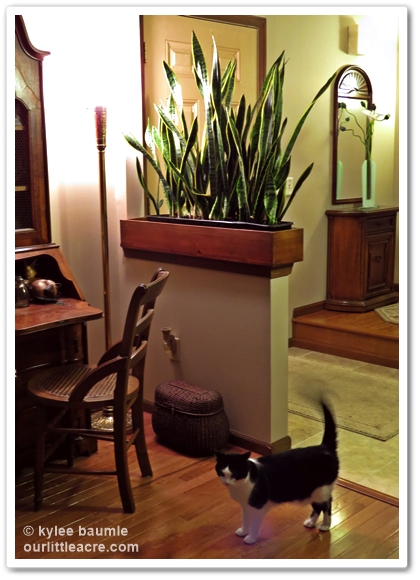
It was time for a change. And here's how it looks now:


Those sansevierias are stuffed in there. I wanted to put some ivy in at the base too, but there simply wasn't any room for it. There are a lot of new shoots coming up from the roots and I'll likely have to thin them at some point, but they're slow-growing so this should be good for quite a while.

Also called snake plant and mother-in-law's tongue, this succulent is known to be one that thrives on neglect, although you do need to remember to water it now and then. They prefer bright light, but will also grow in shade, making it highly adaptable as a houseplant.

Another benefit of Sansevieria trifasciata? It's one of the plants known for cleaning the air of toxins.

For more ideas on how to use plants to enhance your individual style inside your home, see our book, Indoor Plant Decor: The Design Stylebook for Houseplants.  It's available at Amazon, Barnes & Noble and other booksellers, as well as directly from me as a signed copy.


Sunday, April 12, 2015

Weekend Wisdom: I Like the Way the Greeks Do It


Having been the guest in homes outside the U.S., I know that different locations and cultures have what they consider to be proper guest etiquette. I try to take my cues from my hosts, but sometimes you just don't know what to give your host as a thank you gift for having you in their home, whether it be for a meal or for a few days.

Huffington Post to the rescue!

Photo of Aglaonema from my book, Indoor Plant Décor: The Design
Stylebook for Houseplants

A cut flower bouquet is always in good taste for your host, now matter where you live, but in Greece, a potted plant is a common gift.

Despina Trivoli, HuffPost Greece's Head of Life and Culture says, "The most usual gifts include alcohol, dessert (cake is very popular) or plants." Flowers in general are welcome, but usually potted plants are preferable -- something that will be able to grow in a balcony or garden.


I like that.


http://www.huffingtonpost.com/2015/03/23/houseguest-rules-around-the-world_n_6879666.html

Friday, March 13, 2015

A Quick 4-Book Gardening Book Giveaway!


My publisher, St. Lynn's Press, is celebrating St. Patrick's Day a little early by giving away four titles from their illustrious repertoire of books. They've made it easy to enter:

Green is good. St. Paddy would agree. How are you 'greening up' the planet'?

Want a chance to win one of our books by Billy Goodnick, Jan Johnsen, Kylee Baumle, Jenny Peterson and the Editors at SLP for St. Patrick's Day? 

Simply visit our page and leave a comment about how you are 'going green' on this status. That's how we'll know you'd like to win one of the books.

Deadline to comment: Midnight, EDT, Friday, March 13th. One copy of each book will be mailed out next Monday to four 'lucky' winners!


So that's it. Just visit the St. Lynn's Press Facebook page (and "Like" it if you'd like!) and leave a comment on the status that shows these four books:

http://www.amazon.com/gp/product/098556220X/ref=as_li_tl?ie=UTF8&camp=1789&creative=390957&creativeASIN=098556220X&linkCode=as2&tag=theliteraryworld&linkId=5DAGJTE4I37XYFWI
http://www.amazon.com/gp/product/098327262X/ref=as_li_tl?ie=UTF8&camp=1789&creative=390957&creativeASIN=098327262X&linkCode=as2&tag=theliteraryworld&linkId=4RMGET44FW7HI72N
http://www.amazon.com/gp/product/0985562293/ref=as_li_tl?ie=UTF8&camp=1789&creative=390957&creativeASIN=0985562293&linkCode=as2&tag=theliteraryworld&linkId=ZKU62IICGZZERCQS
http://www.amazon.com/gp/product/0985562218/ref=as_li_tl?ie=UTF8&camp=1789&creative=390957&creativeASIN=0985562218&linkCode=as2&tag=theliteraryworld&linkId=3276PO3NWJBMUQOR

If you want to check out the books further, just click on the covers above and it will take you to the Amazon page for each one. But whatever you do, you'd better scurry on over to the St. Lynn's Press page and enter to win one, because the giveaway closes at midnight EDT tonight! (Friday, March 13, 2015)


Wednesday, January 21, 2015

Wordless Wednesday: How Long Can a Dead Lemon Cypress Look Alive?


Yes, really.

Saturday, January 10, 2015

It's Houseplant Appreciation Day! (+ a book giveaway)


Yes, it's pretty, but...
It's the middle of winter and I guarantee you I'm not doing any gardening out there in the frozen tundra right now. I know the entire eastern half of the country is shivering, but with all due respect to those of you in the south that think you've got it bad, I invite you to spend a few days with me.

It will be two more months before I can even begin to think about what I might do in the gardens outside. But I've got more than enough green going on right here in the house. Those who know me know that I live in a jungle during the cold months of the year. I haven't taken a head count of my houseplants, but it's a lot. Trust me.

Today happens to be Houseplant Appreciation Day and whether you've got one houseplant or one hundred, it's always good to be reminded of why it's beneficial to grow plants in your house (whether it's winter OR summer!).

Nothing adds a spot of color to a cold winter's day like amaryllis.
(Hippeastrum 'Temptation')

  • Plants provide oxygen. Remember those oxygen bars that were so popular back in the '90s? You could go in them and breathe super-oxygenated air and it was supposed to provide all sorts of health benefits for us oxygen-deprived humans. Well, plants take your CO₂ and convert it to oxygen, so whether it's beneficial or not, you've got fresh oxygen right from the source when you have living plants in your house. Fresh is better, right? 

  • Bromeliads like it shady when they grow outside, so they make an ideal houseplant.

  • Plants clean the air.  Certain plants are known to actually rid the air of toxins. We live with all kinds of artificial chemicals wafting through the air, coming from the carpets on our floors, cleaning solutions, and plastics everywhere. NASA conducted a study to see if plants could help rid the air in an enclosed space of various toxins and found that growing just one plant for every 100 square feet of living space could do just that. There's a long list of plants that help us in this way, but here's a list of just a few that are exceptionally good at it:

    • Peace lily 
    • Snake plant 
    • English ivy 
    • Dracaena spp.  
    • Anthurium 
    • Chrysanthemum 
Peace lily (Spathiphyllum cochlearispathum) is a real workhorse when it
comes to cleaning the air.

  • Plants relieve stress. How many of us enjoy taking a walk through a garden, through the woods, through a park, when we're stressed about something? Studies have shown that environments that have live plants help reduce blood pressure and provide a sense of well-being when compared with those that don't have them.

  • This staghorn fern (Platycerium sp.) likes it in our bathroom, where the humidity
    levels are naturally higher than in other parts of the house.

  • Plants help people work better.  Again, studies have shown that working in an environment that has live plants will increase your productivity and creativity.


    Chinese evergreen (Aglaonema sp.) in my office, as featured in
    Indoor Plant Decor: The Design Stylebook for Houseplants

  • Plants help fight disease.  Plants raise the humidity levels in the air around them, and who can't use a little more humidity during winter? Those of us who have to have our heat on during this time of year know just how dry the air can get. Higher humidity levels lessen your susceptibility to colds.
Orchids are one of the air cleaners and their beautiful blooms can last for several months.


One of my favorite houseplants (and one of the easiest to grow) is the Norfolk Island Pine. I got my biggest one a few years ago when I was participating in a program by Costa Farms. If that name sounds familiar, it's because Costa Farms is the largest houseplant grower and distributor in all of North America. Go to a big box store and you'll find that most of the houseplants offered there come from Costa Farms.

This Norfolk Island pine (Araucaria heterophylla), which isn't a pine at all,
was about two-thirds the size it currently is when I got it just a few years ago.

I was fortunate to get to see their home base in Miami, Fl., a few years ago and seeing all those gorgeous plants being grown in ginormous quantities was amazing. I learned a lot about the company and how they do things, which just served to make me more appreciative of how the majority of my houseplants get from there to here.

Now that you know that houseplants are good for you, doesn't that just make you want to run out and get one? (Or two or three?) And if you aren't really sure just how to display your houseplants, let me offer a suggestion that has lots of ideas for how to do that - my book.

http://www.amazon.com/gp/product/098556220X/ref=as_li_ss_tl?ie=UTF8&camp=1789&creative=390957&creativeASIN=098556220X&linkCode=as2&tag=theliteraryworld


Amazon chose Indoor Plant Décor: The Design Stylebook for Houseplants as one of their Top 20 Books of 2013 in its category. I'm not sure exactly what the criteria was for that honor, but co-writer Jenny Peterson and I like to think it's because it's got oodles of ideas for how to use houseplants that enhance your particular home decor style, whether it's Classic Elegance, Cheap Chic, World Beat, Peaceful Zen, Modern Eclectic, Haberdashery, Traditional Mix, or Vintage Vibe.

Enter to win a copy of Indoor Plant Décor

I'd like to give a signed copy to one of my readers, so if you want to enter to win it, here's what you need to do:

1. Leave a comment to this blog post telling me your favorite houseplant

and

2. Fill out the Rafflecopter form with your contact details so I'll know how to get ahold of you if you're the lucky winner. I'll also use Rafflecopter to randomly choose a winner.

a Rafflecopter giveaway


You have until midnight EST next Sunday night (January 18, 2015) to enter, but do it now so you don't forget! Good luck and go appreciate your houseplants! It's their day!

Instructions for how to make this succulent wreath is one of eight DIY
projects in Indoor Plant Decor: The Design Stylebook for Houseplants.

*~*~*~*~*~*~*~*~*~*~*~*~*~*~*~*

If you would like to purchase a signed copy of my book, just click here. A link for purchasing is also on the right side sidebar on my blog. To purchase an unsigned copy at a discount through Amazon, click here.


Saturday, November 22, 2014

Updated Lowe's Creative Ideas Project: Swing Shelf Planter


Swing Shelf Planter in March 2013
About a year and a half ago, I did a project as a member of Lowe's Creative Ideas Garden Team in which I potted up a trio of herbs in a shelf planter that hung in a window. I designed it and making it and putting it together was a joint effort with my husband. My herbs grew well for several months in that south window, but the day came when I wanted something different.

In the summer, that window can really generate some heat, and I had a few cacti that I thought would work out better. The herbs were constantly thirsty, so I transplanted the herbs to the garden and the cacti to my red pots. They've been living happily there for a little over a year now.


Last month, I spoke at the Ohio Master Gardeners State Meeting at Ohio Wesleyan University in Delaware. My husband and I arrived early with enough time to look through the vendor's area.

'Frizzle Sizzle' at OFA 2013
I'm always attracted to unusual plants - most gardeners are - and though I vowed not to buy any plants while I was there, Groovy Plants Ranch had a couple that I simply couldn't resist. The price was good, too, at just six dollars each.

I'd first seen Albuca spiralis 'Frizzle Sizzle' at OFA in Columbus the summer of 2013. James Greenhouses had several specimens of this curly cutie on display and they were causing a lot of buzz.

This distant cousin of the hyacinth (you'd never know it though) is a bulb that must be grown in well-draining potting soil and allowed to dry out between waterings or the bulb is in danger of rotting. If you live in Zones 8 or warmer, you can grow it outside year round, but for me it has to be grown as a houseplant.

It likes full sun, and though it will grow in part shade, the more sun it gets, the curlier the foliage will be. Around late winter it will shoot up flower stalks that will bloom with yellowish-green flowers that are unremarkable but are said to have a slight vanilla fragrance to them. That's if it's grown outdoors, where it will go dormant in summer.

I wonder what it will do in summer here. I haven't been able to find any information online that tells whether it will lose its foliage in summer when grown as a houseplant. Maybe one of my readers can enlighten me?

Albuca spiralis 'Frizzle Sizzle'

I started to walked away from the vendor area with my plant as I began to prepare myself mentally for my presentation. And then this caught my eye:

 Opuntia cochenillifera f. variegata

It was a variegated prickly pear cactus - without the pricklies. Sometimes called Warm Hand Cactus or Velvet Cactus, it wasn't the lack of spines that fascinated me. It was the fact that it was variegated, because variegated plants in general are one of my weaknesses. If it hadn't been variegated, I'm pretty sure I wouldn't have noticed the plant at all. Ho hum.

Opuntia cochenillifera f. variegata is hardy to Zone 9 and needs the same care as many succulents - minimal water with good drainage and full sun/part shade. It can grow up to 3-4 feet tall, but I'm pretty sure it won't do that for me. If it does, I'll have to find another spot for it other than the swing shelf. ;-)

Four cacti and a 'Frizzle Sizzle'

In case you were wondering, that hairy cactus in the middle is an Old Man's Cactus (Cephalocereus senilis). I've had it for several years now and it's about twice as tall as when I bought it. I learned early on that I had to keep it out of the reach of Simon, one of our inside cats, because he loved to lick it and chew on it. But mostly lick it. I guess he thought it was in need of grooming.

My Old Man's Cactus is sporting a cowlick.


Friday, November 21, 2014

Growing Amaryllis: Easy for Everyone (and a giveaway!)


Hippeastrum 'Gervase'
For as much as I dread winter every year, there are some things about it that I look forward to. Thanksgiving. Christmas. Fluffy snowfalls. The smell of winter air. Curling up on the sofa with a blanket, a kitty, and a good book.

And amaryllis.

Gardening continues for me, in spite of the outside gardens going dormant during the winter months. I've got plenty of houseplants to keep me busy, both in the house and in the conservatory. Most of those simply need to be watered, but I'll pot up my collection of amaryllis all winter long and have beautiful blooms from winter through spring.

Even though I get a few new bulbs each autumn, I save the bulbs from previous years, growing them outside over the summer. This year, I set aside a specific area for growing them, using galvanized aluminum firepit rings. I plant them, making sure to keep part of the top of the bulb exposed, and let them do their thing. Usually one or two of them will reward me with a bloom stalk sometime during the summer.

This is where my amaryllis bulbs lived for the summer,
before I dug them up just before first frost.


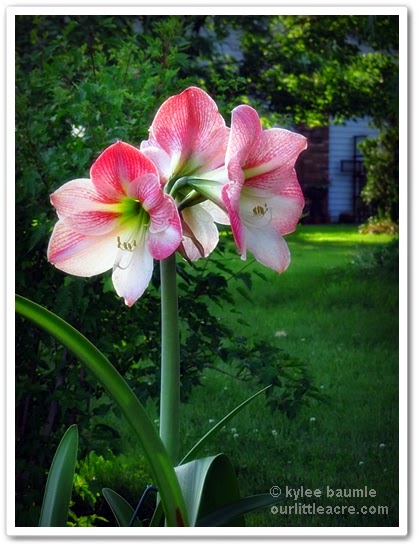
'Apple Blossom' bloomed outside in June.
Before first frost, I trim away the foliage, dig them back up and store them in the cool, dark basement until I'm ready to pot them up again.

New to my collection this year are 'Lagoon', a deep pink variety, and 'Magnum', which is red. 'Lagoon' is already potted up and beginning to grow and I put 'Magnum' in its container today. For the last three years, Longfield Gardens has sent a free amaryllis planting kit to me and being the amaryllis-crazed gardener that I am, I've really enjoyed this surprise gift.

Longfield's bulbs are some of the largest I've ever seen and a larger bulb means more blooms. Last year's Longfield bulb produced three flower stalks, and of the nearly 100 amaryllis bulbs I've grown, that was a first for me.

This year's amaryllis kit from Longfield Gardens contained a large 'Magnum'
bulb, potting medium, a plastic-lined "bird's nest" basket, and Spanish
moss for top-dressing the container.


 Potting them up is easy:

• Choose a container just a little larger than the bulb. Amaryllis like it snug. The heavier the container, the better, because by the time it blooms, it's going to be top-heavy. I use a fairly inconspicuous plant support like this one to give the flower stalk stability once it gets some height to it.

• Most bulbs like very well-draining soil, and this is especially important when planting in a container. I like to use a potting mix designed for cacti (which also need good drainage) when potting up my amaryllis and I make sure that there's a drainage hole in the bottom of the container. Soggy soil encourages bulb rot and fungus gnats and you don't want that! If the container you want to use doesn't have a drainage hole, you'll need to be extra vigilant about not overwatering.
 

• Make sure that you leave the top fourth of the bulb exposed when firming up the soil around the bulb. Water thoroughly but don't water again until you see signs of growth. Thereafter, only water when the top inch or so of soil is dry to the touch. Err on the side of underwatering if you aren't sure.


I use  Haven Brand Compost Tea for watering all my houseplants and the amaryllises are no exception. It's nearly impossible to overfeed them when using this natural, organic product.


Tips

  • Some amaryllis will have the flower stalk appear first and foliage later. Others will do just the opposite.
  • Amaryllis make great cut flowers. In fact, the blooms tend to last longer when cut and put into a vase of water. Be sure to change the water daily though.
  • You can keep your amaryllis bulbs from year to year. Continue to care for the plant in its container, or do like I do and plant them outside for the summer, after all danger of frost is past. Grow them on throughout the summer, then cut back and dig up before first fall frost. 


Here's a short video featuring some of the amaryllis blooms from my amaryllis collection over the years:


Want an amaryllis of your very own?

Now that you know how to grow them, guess what? Longfield Gardens wants to send a 'Red Lion' amaryllis bulb to one of my readers! And Annie Haven provided some extra Moo Poo Tea in with my last order, so I'll send the winner a 3-pack of that as well.

Here's what you need to do to be entered:

1. Leave a comment on this blog post, telling me about your amaryllis experience. (Have you grown them? If so, what is your favorite one? Do you keep your bulbs from year to year?)

AND 

 2. Fill out the Rafflecopter form below with your contact information. I'll use this when choosing a random winner and to contact you if you're the lucky one.

Enter by midnight EST next Sunday night, November 30th and a winner will be chosen on Monday.

a Rafflecopter giveaway


WINNER!  Rafflecopter has spoken! Lona B. is the lucky winner of the giveaway and has been notified. Thanks to all who entered and commented. Look for amaryllis bulbs in your garden centers now!

But wait! There's MORE! 

My friends Dee Nash of Red Dirt Ramblings® and Robin Haglund of Garden Mentors are each giving away a bulb from Longfield Gardens and some Moo Poo Tea too! Robin is a new amaryllis grower and I love her excitement and enthusiasm over it. Dee is a veteran grower like me and has grown some beautiful varieties. Check them out and triple your chances at winning a bulb and some Moo Poo goodness:

Garden Mentors  - "Amaryllis Advent Calendar"
Red Dirt Ramblings® - "Growing Amaryllis is Easy"


If you want to read more about my Adventures in Amaryllis, here are some links to earlier posts about them:

Amaryllis Blooms Never Fail to Deliver
Amaryllis Season Has Begun!
Green Thumb Sunday - Amaryllis 'Lemon Lime'
Remember the Amaryllis!
The Hippeastrum on the Shelf
Absolutely Amazing Awesome Amaryllis
Desperately Seeking Susan
'Tis the Season
Wordless Wednesday: 'Gold Medal' Amaryllis
Amaryllis is a 'Dancing Queen'
Play 'Misty' For Me


___________________
Longfield Gardens sent me a free amaryllis kit and has provided an amaryllis bulb for the purposes of this giveaway. Annie Haven provided a 3-pack of Haven Brand Compost Tea as a bonus in my order, which I am giving away here. All opinions about these two companies are my own.

Tuesday, September 30, 2014

Hairy Spiderwort - A 2011 GWA Treasure!


Back in the late summer of 2011, I attended the Garden Writers Association Annual Symposium, held in Indianapolis that year. As with all GWA symposiums, plants and design are front and center for most of the tours and this was no exception.

The original 1970 Robert Indiana "LOVE" sculpture stands in front of
the Indianapolis Museum of Art.

One of my favorite places was the Indianapolis Museum of Art. We had our breakfast there and then toured the gardens on the grounds. There wasn't nearly enough time for me to properly see everything that was there and I vowed to make a return trip soon. Regretfully, I've not yet done that.


The variety of plants and design at the White River Gardens was inspirational.

Same thing with the White River Gardens at the Indianapolis Zoo, which was an optional tour the day after the symposium officially ended. The grounds there were nothing short of amazing and as I've said before, some of the most attractive and interestingly designed gardens I'd ever seen for a space such as theirs. I also saw paw paw fruits on a tree for the first time and a staff member gave one to me to take home for tasting.

Whenever you get gardeners together like that, you know there will be plants going home with you. I don't remember each plant that Mom and I packed into the van as we headed home, but I do remember one, because it would require special care and I still have it.

Tradescantia sillamontana - August, 2011

While at the White River Gardens, we ate lunch and had plants for dessert. No, that's not quite right, but as we left the room where we ate, we each picked up a small Tradescantia sillamontana, commonly known as hairy spiderwort.

If you're familiar with spiderworts at all, you know that some of them are hardy to Zone 5 and some are not. I've got a couple hardy ones in my own garden...

Golden Spiderwort
Tradescantia x andersoniana 'Sweet Kate'

Dwarf Virginia Spiderwort
Tradescantia x andersoniana 'Bilberry Ice'

The one we received that day was not hardy, and some people passed on it because of that. Never one to pass on a plant with a coolness factor, I picked up my little hairy spiderwort and carried it home.

Tradescantia sillamontana is only hardy to Zone 10 (think southern Florida or Mexico, where it originates) so it's definitely a houseplant for me. In the time that I've gotten it, it has gotten quite a bit larger, partly because I've trimmed the ends and rooted them back in the pot, which is super easy to do.

Almost a succulent and xerophytic, hairy spiderwort needs the same growing conditions as plants that truly are both of these things. Well-draining soil, minimal watering (especially in winter), and a brightly lit location will keep it happy. I can't say that I haven't abused this plant, because I have. I very nearly had to dispose of it a couple of winters ago, because it got overwatered, but I cut back on the watering and it bounced right back.

Hairy spiderwort
(Tradescantia sillamontana)

This summer, for the first time since I got it, I put it outside. It was in a location that got very little direct sun (only a couple of hours in the morning) and it was rather protected from the west so there was little wind and only when we got heavy driving rains (or rains from the east) did it get much water. Because of the brighter light, its foliage color changed to a bit of a burgundy color which is quite attractive.

I love the "stacked" habit of the leaves and the burgundy color that it
takes on in the presence of brighter summer light.

Though our summer was cooler than normal, the plant thrived. It's been just beautiful all summer. Now that frost is coming soon, it's back in the conservatory for the winter. It will slow down its blooming and stop for most of the winter, but next spring it will start up again and be its beautiful hairy pinky-lavender self.

Though the foliage doesn't resemble my hardy spiderworts, its flower is a
dead giveaway to its genus, Tradescantia.


blogger templates | Make Money Online