
Saturday, January 20, 2018

How the Lifesaver Plant Got Its Name


Winter is a time when most of my houseplants get the most love they're ever going to get. That's because if I want to keep these plants - mostly tropicals - they have to live in the house with us during the winter and I generally pay more attention to those things that share my living space. We're in Zone 5b here and it gets way too cold for them to stay outside year round.

These begonias do well in the bright shade of the pergola, but need to
go inside for the winter.

One day, in the summer of 2016, I went nursery hopping with my good friend, Shelley, and while I showed some restraint as we visited various places, only buying what I needed for a photo shoot for a trade industry magazine article I was doing, I found something I couldn't live without. It only cost a few dollars, but we all know that when it comes to plants, cost often has little to do with our buying decisions.

I'd heard about the lifesaver plant many years ago and had seen photos of it - such a cactus-y looking thing with surreal candy blooms. I wondered if those flowers (I felt funny even calling them that) really looked as plasticky in real life.


But now here it was, right in front of me, and oh boy, yeah. It really did look like its photos. So I bought it. In the time since that day, it has taken turns growing in the house, in the conservatory, and outside during the summer. It seems to be a happy camper no matter where it is. You've got to love a plant like that.


Here are the growing stats:

Common name: Lifesaver plant
Botanical name: Huernia zebrina
Plant type: Succulent
Zone: 10
Light: Full sun
Water: Let dry thoroughly between watering, then soak. Tolerates neglectful watering.
Height: Under 6 inches 
Bloom time: Intermittent


FUN FACT: Huernia zebrina belongs to the same family as milkweed -  Apocynaceae. But no, monarch butterflies don't use it as a host plant. 😉


http://amzn.to/2EYfttk


For ideas on how to use houseplants that coordinate with your personal style and decor, see my first book, co-authored with Jenny Peterson: Indoor Plant Decor: The Design Stylebook For Houseplants. (2013, St. Lynn's Press)


Monday, January 30, 2017

Grow Your Own Avocados


Wow, was this ever a throwback to my college days. Back in the days of macrame, yogurt makers, and prayer plants - otherwise known as The Seventies - homes, apartments, and dorm rooms everywhere could be seen with this sitting on their window sills:


It was ever so cool to grow your own avocado plant from a pit found inside one you'd gotten at the grocery store. I did it, my friends did it, and I'm betting some of you did it too. I honestly don't remember if I was successful at actually getting that thing to germinate or not, but I tried.

With the trade situation with Mexico kind of up in the air right now, there's been a lot of talk about what things are likely to go up in price if things change. Avocados and limes are mentioned, as is Corona beer and tequila. I can live without all of them, but each one enjoys popularity here in the U.S.

So, about this growing your own avocado thing . . .  Even if I can manage to get this avocado pit to germinate, it's highly unlikely that I will be able to grow an avocado tree that produces any fruit.

First of all, I don't live where avocados would be happy. They're hardy in USDA Zones 8-11 and I'm in Zone 5b, though I do have a greenhouse and they also make excellent house plants. Secondly, even if I can keep it happy, it can take from 4-13 years for an avocado tree to bear fruit. Some trees never do yield anything.


When I cut open an avocado last week and saw that pit, it took me back (sing it with me now . . . "You fill up my senses, like a night in a forest,") and I kind of wanted to try it again. What did I have to lose?

If you want to try it too, it couldn't be easier. Just clean the avocado pit, let it dry, then poke toothpicks into it to suspend it over a jar of water, with the fat side down. Place it in a warm spot and keep the water level so that its bum is submerged. In about 2-6 weeks, you should see both a root and a stem sprouting. At that point, be sure it's in a well-lit location.

As it grows, once the stem reaches 6-8 inches, prune it in half to induce branching. Once it has started to branch, you can plant it in a container of well-draining potting soil. Be sure to leave the top part of the pit exposed, similar to how you plant an amaryllis bulb.

Don't overwater, but don't let it dry out completely. In the summer, you can put it outside, where it will likely grow faster, but make sure to bring it in once temperatures dip below 45°F.

Far out, man.


Saturday, January 23, 2016

Amaryllis - These Are a Few of My Favorite Things


If you follow me on Facebook or have been a long-time reader of Our Little Acre, you know that I'm crazy for amaryllis. I long ago lost count of how many bulbs I have, yet each year I buy a couple of new varieties just to see if that will garner a new favorite for me.

It's really difficult to choose just one, because there are now so many different ones available to us. I like 'Blossom Peacock' because the gradual shading from white to red accentuates its double blooms.

'Blossom Peacock'


Another favorite is 'Rembrandt'.

'Rembrandt'


Yet another is 'Solomon'.

'Solomon'


And 'Royal Velvet'.

'Royal Velvet'


'White Peacock'...

'White Peacock'


Oh yeah, 'Charisma', too.

'Charisma'

I haven't even touched the cybister amaryllis yet. You know, like 'Bogota'.

'Bogota'


See the problem here?

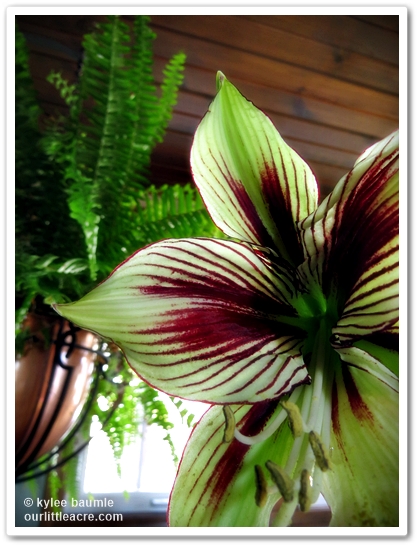
But when it comes down to it, if I had to choose just one amaryllis to take with me to that deserted island, the honor would go to 'Papilio'.


It was 'Papilio' that introduced me to amaryllis in 2005, and it was love at first sight. As I learned more about this species, it's no wonder it was the one that captured my affection.

'Papilio' is not actually a cultivar name, as denoted by single quotes. The true botanic name is Hippeastrum papilio, with its species name derived from the Latin for "butterfly," due to the resemblance of its blooms to a butterfly in flight. It differs from other amaryllis blooms in this way, and 2D photography doesn't capture the unique placement of the tepals.

Hippeastrum papilio


H. papilio was first discovered in 1967 in the tropical forests of southern Brazil. It is now considered to be endangered in its native habitat, due to increasing numbers of sugar cane and coffee plantations as well as urbanization.


This is an evergreen type of amaryllis, growing year round in USDA Zones 8-11. Its foliage and blooms are able to withstand brief exposures to frost. It readily produces offsets, although once separated from the mother bulb, may not bloom in its first year.

The 2016 incarnation of H. papilio is now in bloom. And I am in love all over again.


__________________________________
*Botanical history of H. papilio attributed to Pacific Bulb Society.


Monday, November 23, 2015

A Taste For the Exotic: A Holiday Giveaway with Longfield Gardens


From my earliest days as an honest-to-goodness gardener, I've been fascinated with unusual bulbs. Tulips and daffodils are nice, of course, but those quirky ones that you can't find just anywhere always grab my attention.

I've grown quite a few tropical bulbs over the years, in summer and winter, depending on availability, including Scilla peruviana. It's an unusual one, but not so much as its cousin, Scilla madeirensis, commonly known as Giant Madeiran Squill, which until now has not been available to the general public. If you wanted to see it, you either had to view it at a botanical garden or in its native environment.

Found on the Portuguese islands of Madeira, off the coast of northern Africa in the Atlantic, this beautiful and rare species of hyacinth is only hardy to Zones 9-10. It is easily grown in containers as a houseplant and is now being propagated commercially in Israel. Longfield Gardens sent one to me in a kit a couple of weeks ago so I could grow it for myself.
 

Everything I needed was contained in the kit: a birch bark container,
potting medium, a nice-sized bulb that was already showing signs
of growth, and some decorative Spanish moss to top it off.

I've grown bulbs from Longfield Gardens before
and they've always been some of the biggest
and healthiest bulbs I've ever seen.

All I needed to do was pot it up and water it, which didn't take me more than a couple of minutes. (Instructions for planting are found on the website.)

The bulb itself is somewhat pretty, foretelling the bloom color. It will first produce strappy foliage, sometimes freckled, and it should begin flowering in about 4-6 weeks - maybe in time for Christmas or New Year's!

Planting and care of Scilla madeirensis is similar to that of amaryllis.

Longfield Gardens' photos show its bloom to be a beautiful shade of lavender blue. Bulbs typically begin to bloom at a relatively young age (around four years), and hopefully I'll see some offsets form as it matures over the next few years.

The flower stalk has a bottlebrush silhouette that will
reach about 15" in height.
(
Photo of Scilla madeirensis courtesy of Longfield Gardens)


A GIVEAWAY! 

Would you like to grow one too? Longfield Gardens has graciously allowed me to give a gift kit away to one of my readers. All you need to do to enter to win is to leave a comment to this blog post, telling me the most exotic flower or bulb that you've ever grown. If you've never grown anything you consider to be exotic, then tell me what you've always wanted to try, but haven't just yet.

Be sure to provide a way for me to contact you, should you be the lucky winner. (You can include your email address by spelling out "at" and "dot" to avoid spambots.)


At midnight on Black Friday, November 27th, I'll randomly pick a winner and contact you so that I can get an address for shipping. Longfield Gardens will then send you a gift kit in time for holiday planting. Good luck!

~~~~~~~~~~~~~~~~~~~~~~~~~~~~~~~

UPDATE: Congratulations to Louise Hartwig, whose comment was picked by Random.org as the winner of the giveaway. Thank you to all who entered! If you still want to grow this great bulb, you can purchase it here.


~~~~~~~~~~~~~~~~~~~~~~~~~~~~~~~
Photo of Scilla madeirensis courtesy of Longfield Gardens
Further reading about Scilla madeirensis: 

http://blog.longfield-gardens.com/grow-this-an-exotic-fall-blooming-bulb

__________________________
I received a complimentary kit to grow Scilla madeirensis for the purposes of introducing this unusual bulb to my readers. I agreed to do this at the request of Longfield Gardens because I've had good experiences in the past with bulbs I've received from them and I can recommend them because of those experiences. The free kit was the only compensation I received for writing this blog post.

Sunday, July 26, 2015

I Went to a Garden Party...


Actually, I was the host for the garden party. I've been wanting to do this for several years now, because I could think of nothing more delightfully summery than to stroll through my gardens with friends, as we sipped on drinks, and chatted about the weather, families, flowers... anything, really. And this summer, we did it.

Photo by Susan Pieper

With the unpredictable weather we'd been having, I knew I was taking a real chance that it would be suitable on July 23rd for spending the day outside, but that's what faith is for, right? And it could not have been lovelier.

Nearly 20 of us gathered in the backyard and by the day's end, looking back I think I can say it was the highlight of my summer, eclipsed only by grandson Maverick's birth two weeks later. ❤

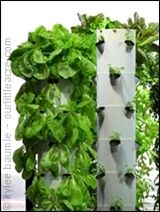
The Tower Garden provided plenty of leafy greens for our salads, and
celery for the Bloody Marys.

This summer was the first time I'd ever used a Tower Garden, and my intent was to serve a meal using the bounty from it and the rest of my garden, with a little help from the grocery store. Meghan Fronduti, my Tower Garden connection, encouraged me to do this and with Meghan in your corner, you think you can do just about anything.

My girl Jenny flew up from Texas for the party and she was such a help to me in pulling this off. I don't "do" parties, but if I can get Jenny to help me again, I just might do another one!

The Menu

We strolled and chatted and shared laughter and stories, and then settled down next to the pool for Curried Tuna Apple Salad on a bed of lettuce from the Tower Garden.


I made bite-sized biscuits containing petals from Calendula grown in my gardens out back. I used my friend Teresa O'Connor's recipe, and while the orange petals didn't really add flavor to the biscuits, they made them look pretty. They do add antioxidants and Calendula is often used as a more affordable substitute for saffron.

Not just a pretty face in the garden!
#edibleflowers

Various drinks were served, including water infused with cucumbers and strawberries (from the garden). There were Bloody Marys, with celery sticks harvested from the Tower Garden. This was a first for me for growing celery and while I had my doubts as to whether it was possible to grow it in the Tower Garden, it did beautifully!

For dessert, we had miniature cheesecakes, topped with blueberries from my Brazelberries® Peach Sorbet™ plants, grown in our Berry Barn.


After we finished eating, we all retired to a shady spot under one of our 200-year-old oak trees for a fun White Elephant type of gift exchange. In this instance, I provided the gifts, mostly from the bounty of swag bag items I've received over the years.

Photo by Meghan Fronduti

One member (not naming any names) liked her gift so well that she hid it and gave the stink eye to anyone who even looked her way with the intent of stealing it. It was all in good fun.

Crescent Garden provided a couple of containers that I fell in love with at
P. Allen Smith's Moss Mountain Farm in April. This one is "Eye Am" and it's
available in several colors.

The table arrangements were simple Ball jars filled with local wildflowers that
Jenny and I cut from the roadside nearby that morning - black-eyed Susans,
Queen Anne's lace, ironweed, and wild lettuce.

There's always a cat or two patrolling Our Little Acre.
Photo by Marsha Ross


The entrance to Max's Garden
Photo by Marsha Ross

Several people wore garden hats, including Marsha Ross and my mom.

Thank you, Meghan, for taking this photo of Jenny and me. We rarely get
our picture taken together, for some reason.

 
The day was warm and the pool was tempting, so Angie Bidlack, Sarah
Messmann and Kara Fritz took advantage of it.

The new kitchen saw its first party as the bar lived up to its name.

It was a beautiful afternoon with so many lovely guests, I'm not sure we could duplicate it, but I'm giving it some thought for next year. Thank you to everyone that attended, because without each and every one of you, this little get-together would not have happened.


Tuesday, July 7, 2015

I Bought it For the Foliage


This spring, I was walking around the garden centers, in search of petunias to fill lots of spots in the garden, since I had declared this year to be The Year of the Petunia here at Our Little Acre. I found an orange one that I decided I needed, and not too far away on the bench was a plant with foliage that looked like it was just made to go with that petunia.

I can imagine all kinds of wonderful things this would complement!

I bought them both and potted them up in a hanging container for the gazebo:


Even though I knew full well that the beautiful-foliaged plant was a Fuchsia, for some reason I didn't expect it to do this:


This just might be my most favorite plant of the summer.

~~~~~~~~~~~~~~~~~~~~~~~~~

Fuchsia austromontana 'Autumnale'
Zone: 10-11
Light:  Part shade to Shade


Sunday, April 12, 2015

Weekend Wisdom: I Like the Way the Greeks Do It


Having been the guest in homes outside the U.S., I know that different locations and cultures have what they consider to be proper guest etiquette. I try to take my cues from my hosts, but sometimes you just don't know what to give your host as a thank you gift for having you in their home, whether it be for a meal or for a few days.

Huffington Post to the rescue!

Photo of Aglaonema from my book, Indoor Plant Décor: The Design
Stylebook for Houseplants

A cut flower bouquet is always in good taste for your host, now matter where you live, but in Greece, a potted plant is a common gift.

Despina Trivoli, HuffPost Greece's Head of Life and Culture says, "The most usual gifts include alcohol, dessert (cake is very popular) or plants." Flowers in general are welcome, but usually potted plants are preferable -- something that will be able to grow in a balcony or garden.


I like that.


http://www.huffingtonpost.com/2015/03/23/houseguest-rules-around-the-world_n_6879666.html

Monday, February 16, 2015

Longwood Gardens: Shades of Gray


It would just be too tacky to make a play on "that movie" that premiered over the weekend, so I won't do that. But I have to show how much better Mother Nature does it anyway.

In my last blog post, I shared some photos of last spring's visit to Longwood Gardens.The conservatory there is a world all in itself, with each partof it worthy of an essay highlighting its features. It was the lovely shades of gray in its Silver Garden that especially caught my eye this visit.

Take a look:


So many of these plants exhibiting gorgeous shades of gray/silver/blue look as if they would be feathery soft to touch (and some are), however those stunning agaves are anything but. Flowers are beautiful, to be sure, but the Silver Garden of the conservatory is a prime example of how foliage, with subtle hues and bold textures, can be a stunning element of design.

http://www.amazon.com/gp/product/0985562226/ref=as_li_tl?ie=UTF8&camp=1789&creative=390957&creativeASIN=0985562226&linkCode=as2&tag=theliteraryworld&linkId=7PJ357WGNEJPX6VX Fellow St. Lynn's Press authors, Christina Salwitz and Karen Chapman, have written one of the best books on this subject – Fine Foliage: Elegant Plant Combinations for Container and Garden.


blogger templates | Make Money Online