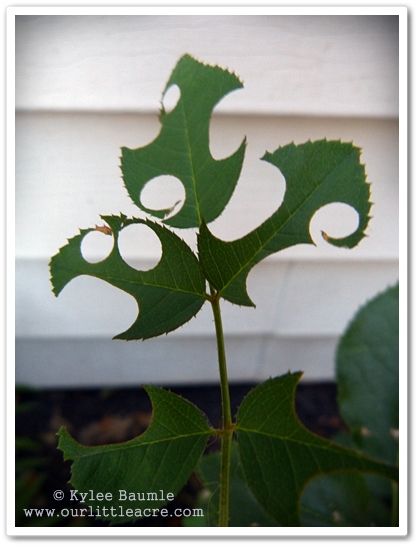
 All this thinking about and drooling over roses reminds me of a day last summer when I all of a sudden noticed holes in the leaves of some of my roses. I got down for a closer inspection of things, looking for aphids, caterpillars, beetles, anything that might have been having rose leaves for lunch, and I saw nothing. Stems, leaves, and buds were clean as a whistle. But something was clearly munching when I wasn't looking.
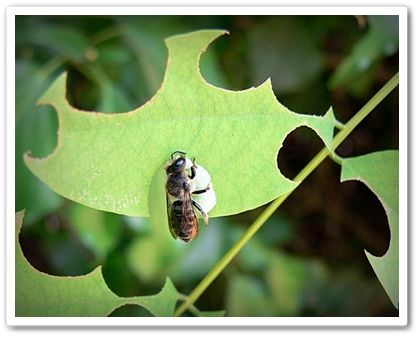
Then I saw it happen. In the matter of less than a minute, I saw a small bee, looking much like a honeybee, land on a leaf and quickly and methodically excise a perfectly round piece and fly off with it. That sent me inside a-Googling, to see what was making Swiss cheese out of my beautiful green, glossy rose leaves.
 Leaf-cutter bees, a.k.a. alfalfa bees, like to use rose leaves to line their nests. They don't form colonies like honeybees, instead preferring to raise their young in solitary nests. They are important pollinators and rarely cause more than cosmetic damage to rose bushes or their other favorites - green ash and lilacs. I also noticed they liked our golden privet bushes. Sometimes they'll bore into the soft wood of cut rose canes, so to prevent them setting up housekeeping there, you can put white glue on the ends of the canes after pruning.
The adult lives about two months, and is most active during the time alfalfa is in bloom. About half a mile south of our house, there was a large alfalfa field, so the visiting bees probably came from there. They never became a problem and because of their value as pollinators, insecticides are not recommended, nor are they particularly effective. They do have natural enemies - parasitic bees and wasps, velvet ants, and certain blister beetles.
 Another thing I noticed with one of my roses - 'Diana, Princess of Wales' - was that the back side of it began showing discoloration of its foliage and then it just dried up and withered away. The front side was fine and I was puzzled. I took a picture of the damage and posted it in the forums on Dave's Garden, and I was promptly asked if we owned a cat. Ummm...yeah. Quite a few of them, in fact. Did I notice if any of them 'sprayed'? Ummm...yeah again.
I suspected Jinx, our 16-pound black Big Boy, of being the culprit. We'd seen him do this lots of times in our garage and on the door of the pool house, where several of our cats stay at night. He was the terror of the neighborhood, and anything that entered his space was subject to bullying or worse. There was little that he was afraid of and he was quite proud of his conquests, as most cats are, and often brought them to our porch to show them off to us. I always felt bad for our UPS man, because you just never knew what carnage there might be by our front door. Birds, rabbits, voles, mice ... he was quite the hunter.
 Two months ago, after six years with us and being the senior member of our current crew, Jinx went missing. He was a smart cat and while he wasn't terribly affectionate - okay, he wasn't affectionate at all - he was fiercely loyal. He never strayed far, and he was road savvy. We always tried to put him in the garage for the night (we couldn't put him in the pool house with the others, because well, he was special you know, and required private quarters), because if we didn't, he would take off for the field behind our house, to do whatever cats do in the dark of night. Then, sometime between 2:00 and 4:00 a.m., we'd be awakened by this 'tink, tink, tink', and know that Jinx had come home.
  We have a wooden pergola over our patio, and it was a wondrous thing to see him scamper up the wooden posts to the top of it and then over to the roof of our family room, which was below our bedroom window. He'd pick at the screen of our window, and we had better let him in, because he wasn't going to quit tinking until we did.
Two days went by, and no Jinx. We checked the next-door neighbor's storage barn to see if he'd accidentally gotten shut up inside (it had happened before), but he wasn't there. I was on my way home from work, talking to Romie and we discussed what our next step was going to be in trying to find him. Romie was taking a walk down by the cemetery as we were talking and all of sudden, he said, "Oh no." I knew he'd found Jinx. He had gotten hit and was laying by the side of the road. Of all our cats, we never thought Jinx would be the one to have his life end this way. When I got home, we buried him in the garden and it was pretty somber around the house that night.
We'll probably have a healthier rose bush this summer, but we miss you, big guy...






 I did some some research and found out what they were.









 "Bejeweled"


