
Friday, July 31, 2009

A Wing Is Not a Breast


I don't like chicken wings. Chicken wings are bony things with not a whole lot of meat on them and it's dark meat at that. I like white meat. In fact, I love chicken breast just about any way you want to fix it. But I don't care for dark meat. So when we pulled into Wendy's drive-thru recently and I saw they had a new item on the menu - Asian Chicken - my taste buds got excited. I read their description - plump and juicy all-white meat cut from 100% whole chicken breast - and I knew that it was going to be just the thing that satisfied my appetite.

But instead of "Asian Chicken" showing on the order screen, I saw "Asian Wings". I told the young lady taking my order that I didn't order wings, I ordered the Asian Chicken made with chicken breast. She said, "Asian Chicken is wings." I again stated that I didn't want wings, I wanted the breast and she continued to insist that the Asian Chicken was wings.

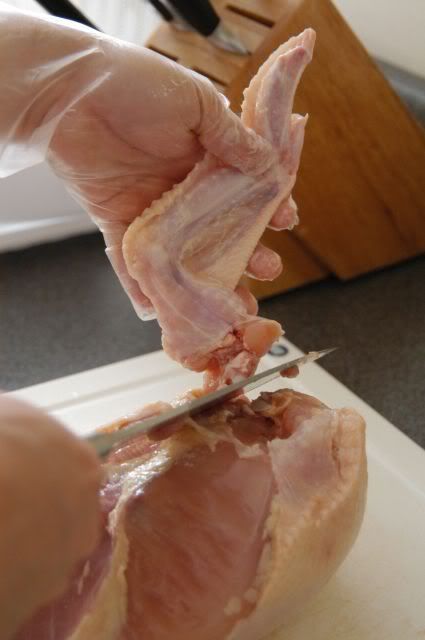
Now I have cut up a chicken or three in my time and I guarantee you that the breasts of those chickens were not the wings of those chickens. To illustrate this, if you look closely at the two photos below, you will notice that the two photos are different. This is because the chicken breast and the chicken wing are two different things.
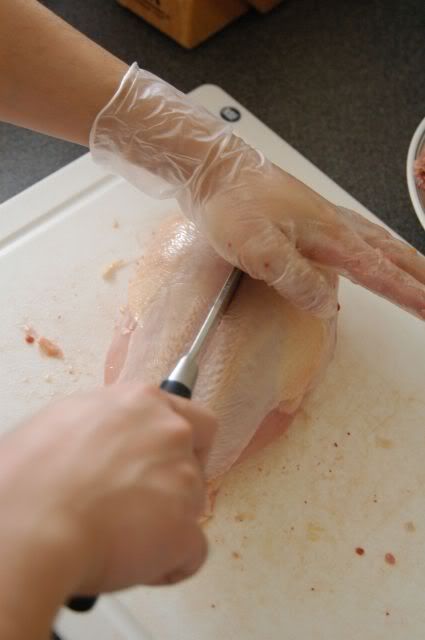
Chicken Breast


Chicken Wing

After determining that one of us was confused, I decided to forgo ordering the Asian Chicken, because the last thing I wanted was for my order to end up actually being chicken wings, as was showing on the order screen. I proceeded to order a single hamburger, even though it wasn't what I really wanted.

As we pulled up to pay for our meals, I decided I would try again and I asked the person taking our money if they did indeed have Asian Chicken breasts as described (and shown in a photo) on the menu. I thought maybe the person taking the order was new and not yet familiar with the new items on their menu. I still really wanted that Asian Chicken, as long as it was made from the breast.

The money taker looked at me with a blank stare as if to say, "I have no freakin' idea. I just take the money." What she really said was, "I'm not sure what you're talking about, let me get a manager." Well, let me tell you, the manager was in no mood to deal with customers. He leaned out the window and in an exasperated tone of voice and with an equally exasperated look on his face, said to me, "What can I do for you?"

As Romie sat rolling his eyes, I once again asked about the Asian Chicken breast that I'd seen on the menu. "Is it wings or is it breast?" I asked, "Because a chicken wing is not the same thing as a chicken breast." He looked at me and said, "Correct."

Silent stares were exchanged between us. We were getting nowhere. Well, that's not entirely true, because I was getting more confused while the manager looked as if he understood everything just perfectly and what was my problem anyway?

At this point, he asked if I would like the 800 number for Wendy's, which I politely declined. I prefer to deal with corporate via e-mail. We paid for our order and proceeded to the next window, where the person who had taken our order thrust the bag containing our food at us and said, "Here." I think maybe I wasn't their favorite customer that day, but I honestly wanted to know just what the heck their Asian Chicken really was. Is it wings or is it breast?

We left Wendy's and I got my cell phone out and called my dad. In earlier years, my dad owned a grocery store and also did custom butchering. If anyone could clear this up, it would be my dad. "Dad? You know about parts of a chicken, don't you? The wings are dark meat and the breast is white meat, and they aren't the same parts, are they?"

Dad kind of laughed and said, "Do you really need me to tell you that?" I answered, "No, but maybe someone needs to tell Wendy's that."

Now those of you who eat wings and don't give a hoot whether they're white or dark meat are probably thinking I'm making a big deal over this, but if you're a picky eater like I am and you know the difference between a wing and a breast, you'll understand the point of all of this. But right now, I'll cut to the chase. From what I can gather from their website, Wendy's takes white meat from a boneless chicken breast, cuts it up, lightly breads it, and cooks it in a sweet and spicy sauce, then calls it Asian Chicken wings even though it isn't really wings.

To that, I can now only ask, "Why?"


As I was relaying this story to a good friend of ours, he said I should have asked the manager, "If your girlfriend asked you if you'd like to feel her breast, then gave you her arm, would you be happy with that?" I nearly choked on my hamburger.


____________
Photos of chicken parts from Cooking For Engineers.
Photos of Asian Chicken from Wendy's. Looks like breast to me. But it's wings. Sigh.
Wednesday, July 29, 2009

Never Fear, the Monarchs Were Here!


In the past few weeks, I've been whining about the lack of Monarchs in the garden. The first one of the season that I spotted was way back in late May and its early arrival made me think there would more of them than usual this summer, but we've only seen two more since then. We have prepared a banquet of Asclepias plants of various sorts for their babies to munch on and heaven knows there's no shortage of nectar, so where are the butterflies?

Every day I do at least one walk-through of the garden, where I simply observe and enjoy whatever happens to be blooming and growing there. No weeding, no deadheading, just a nice relaxing stroll. Usually, my camera is hanging around my neck, because every time it isn't, you can be sure I've missed a photo op and I'm sent running back to the house to retrieve it.


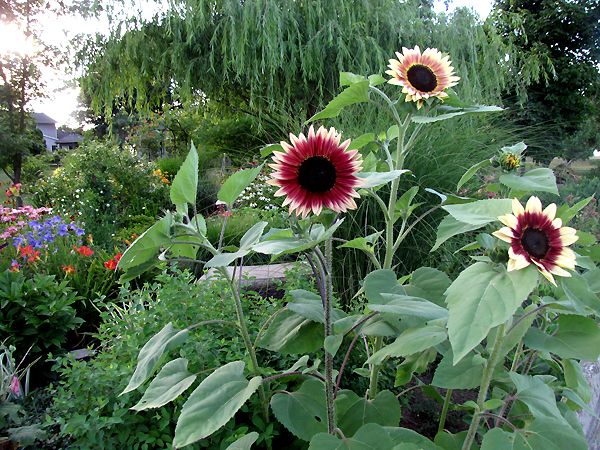
Today I walked around behind the fence that runs on two sides of Max's Garden so I could get a better look at the blooming sunflowers. They are being shy this year by showing only their backsides to anyone who walks through the garden. I've planted sunflowers in the past and we always had blooms facing east, south, and west. This year, they all face east. All. Day. Long.

After I had a good look at the 'Apricot Twist' seeds that grew up to be something else (mislabeled seed packet??), I wanted to take a close look at the Swamp Milkweed (
Asclepias incarnata) that grows lush and full back in that same corner. Observation has taught me that the Monarchs love this plant the best of all and it usually plays host to several Monarch caterpillars at a time throughout the summer. My goal was to see if I could find any eggs on its leaves, which would be evidence that at least one Monarch had been here.

The first thing I saw was a gigantic wasp. I think it may have been longer than the Cicada Killers!


Great Golden Digger Wasp

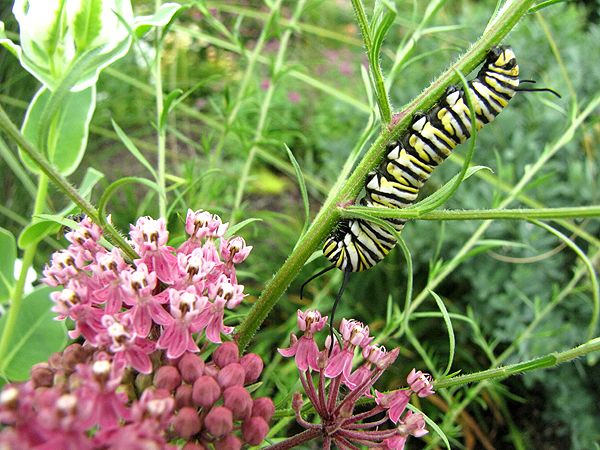
All of a sudden, something caught my eye and there was no need to me to look for Monarch eggs. There was a full-grown Monarch caterpillar that was large enough to tell me that a chrysalis is in the offing. A quick scan of the rest of the plant showed another smaller one.


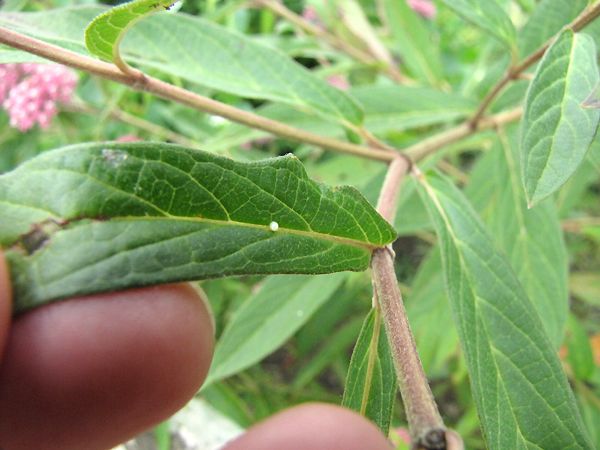
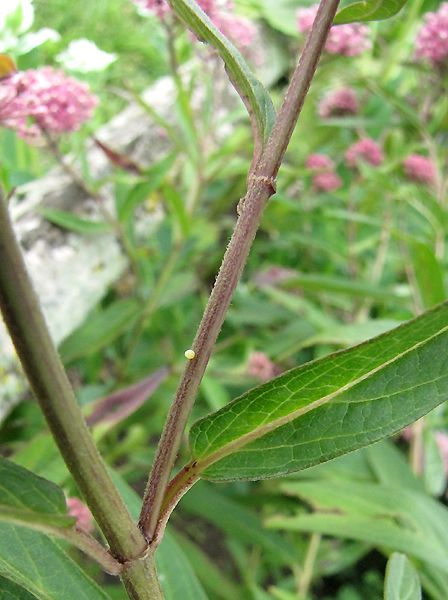
I still looked for eggs because I'd never seen one before (I'd never looked). It didn't take me long to find a few of them, each singly laid. Two on leaves and one on a stem.


So all is well in our Monarch Waystation. They've
been here, they are here, and they will be here.


Monday, July 27, 2009

And Here's the "Something"


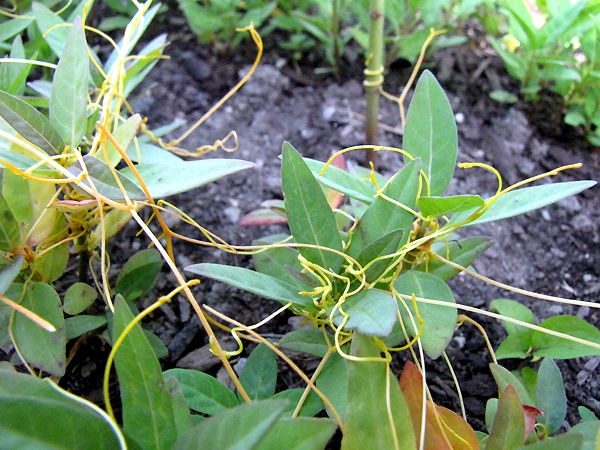
Yesterday, when I blogged about the wicked and disgusting Iris borers, Romie made the comment, "It's always something." So true. And today's something is Dodder. Never heard of it? Neither had I. I'd never seen it prior to this summer either.

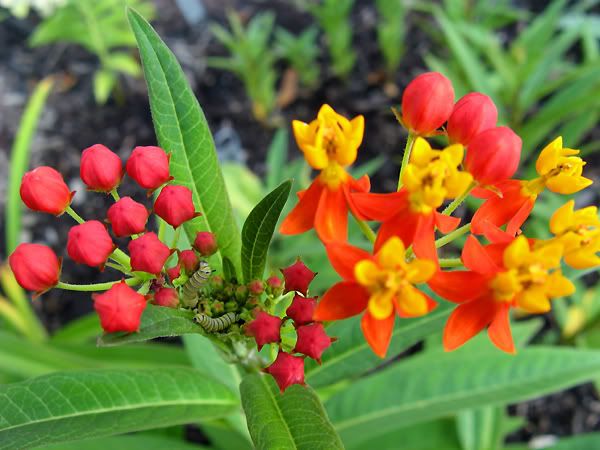
I'd noticed orangey threadlike tendrils had been winding themselves around some of the Asclepias curassavica (Scarlet Milkweed) seedlings for a couple of weeks now. I tried pulling them off, but it wasn't as easy as it looked. Just when I thought I had it all, there was some more. And it was so tiny and so tenacious!

This morning, I posted a description of what we had on Twitter and asked if anyone knew what it could be. I hadn't yet taken a photo of it, so I thought it might take awhile before someone recognized what I was talking about. But Annie in Austin knew right away: "Hope it's not Dodder: http://bit.ly/3rmbZd."

Her link took me to the Missouri Botanical Gardens website, which I've used before in a number of ways, including their
Kemper Center for Home Gardening. The information there confirmed that we did indeed have Dodder (Cuscuta).

Dodder on my Asclepias curassavica seedlings

Dodder, a member of the Morning Glory family, is an annual here in Ohio, but it readily self-seeds unless steps are taken to eradicate it. It's parasitic and by living off the host plant, it many times will kill that plant. We were fortunate in that it was found in an area of our garden that largely contains annuals. Fortunate in that it's recommended that you remove the infected plants and I'd much rather lose an annual than a perennial, of course.

Romie and I pulled the tendrils off and in the end, only had to pull a few seedlings before we got it all (as far as we know). This year hasn't been the best for growing annuals at Our Little Acre. Most of them should be way taller and blooming their heads off by now. Many of them aren't and this Asclepias is one of them. We just need some good hot weather and some rain!


The Dodder wasn't having any problems growing though. We'll monitor that area, because I fully expect it to return. I'm checking out the possibility of using Preen® pre-emergent herbicide in the soil there to prevent its return, because that's something we have on hand. Glyphosate (Round-Up®) will kill the plant itself, but I'd rather prevent it from growing in the first place and don't really like using Round-Up® if we don't have to.

UPDATE: I received a response from the makers of Preen® today-

Dear Kylee,
Currently we do not have a garden product that will prevent Dodder weed seeds from germinating, nor do we have a product that will kill existing Dodder. We recommend you contact your local cooperative extension agency for their advice/recommendations on controlling this weed as eradication is almost impossible.
Thank-you & Have a good day!

Warmest Regards,
Terese Clay
Customer Service
Lebanon Seaboard Corporation


___________________
Photo of Asclepias curassavica in bloom was taken 8-23-08. If you click on the photo, you'll see a larger version and you might also see something besides flowers!


Sunday, July 26, 2009

Boring Irises


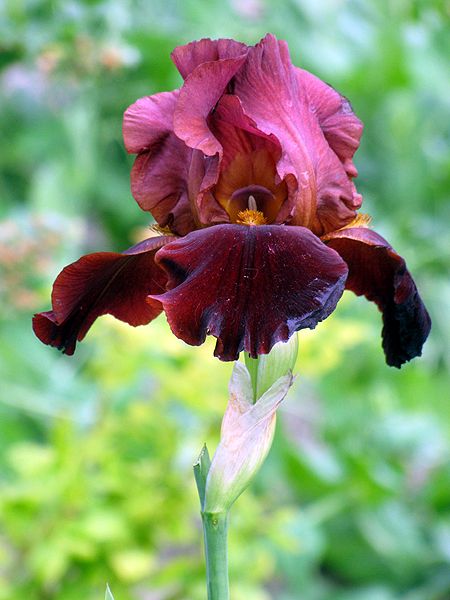
Did that title draw you in? Did you think to yourself, "Irises, boring?? How can that be?" Well, it's not what you think. I love Irises and to me, they're anything but boring. I do like some better than others, but they each have their endearing qualities, not the least of which is their colors and they way they're dispersed on the blooms.

But I'm not the only one who loves Irises.

This year, I'm waging all-out war on a not-so-little pest called Macronoctua onusta - Iris borer. I suspected them last year, but hadn't actually found one. This year, a couple of my Irises needed dividing, so I dug them up and it was then that I came face-to-face with the worm.

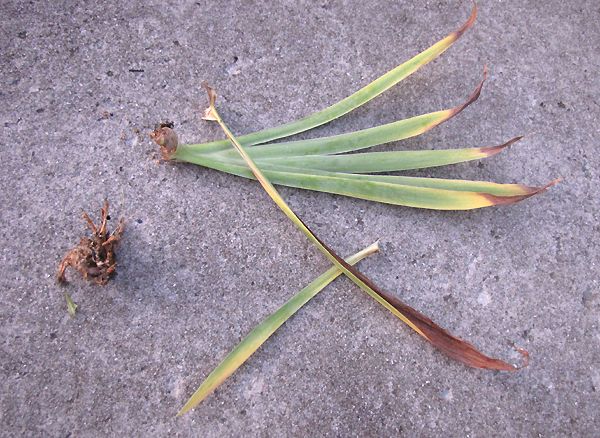
In years past, I recalled pulling center leaves out of the fans because they'd turned yellow. They came out easily and I did suspect that something was causing this, but it didn't happen often and it didn't seem to be harming the Iris a whole lot, so I didn't do anything. Therein lies my grave mistake.


The borer lays eggs in the leaves, where they hibernate all winter. In the spring, they hatch and the caterpillars (much too nice of a word for these disgusting things) work their way down the leaves into the rhizomes, where they gorge themselves on the heart of your Irises. The result is a mushy rhizome and usually death of that particular part of an Iris clump.
And what's worse, they like Siberian and Japanese Irises too, as well as Blackberry Lilies (Belamcanda chinensis). Ask me how I know.

That's the Reader's Digest version of the Iris borer story. For a great detailed tutorial of what to do about this problem, visit
The Renegade Gardener's page, Iris Borer Alert!


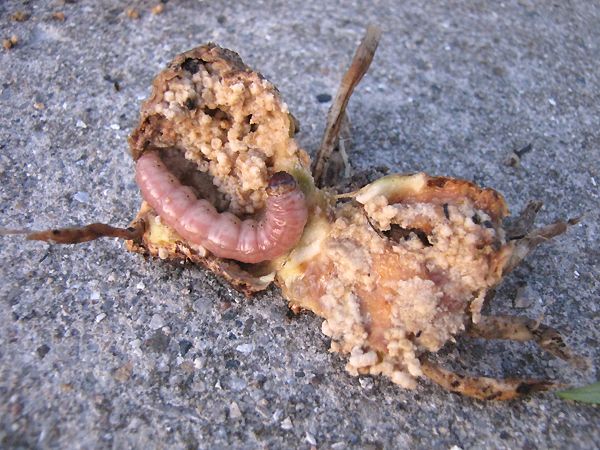
Tonight, I found yet another Iris that's been attacked by the borer. My 'Edith Wolford' had a fan lying on the ground, so I investigated and found a mushy rhizome. I dug it up and there it was - the Queen Mother of all borers:


It was two inches long and a disgusting shade of flesh-colored pink. The previous ones I'd found were smaller and white. I suspect the rest of the plant is infected, so when I have more time this week, I'll dig the entire thing up (as I did the others that were infected) and check them.


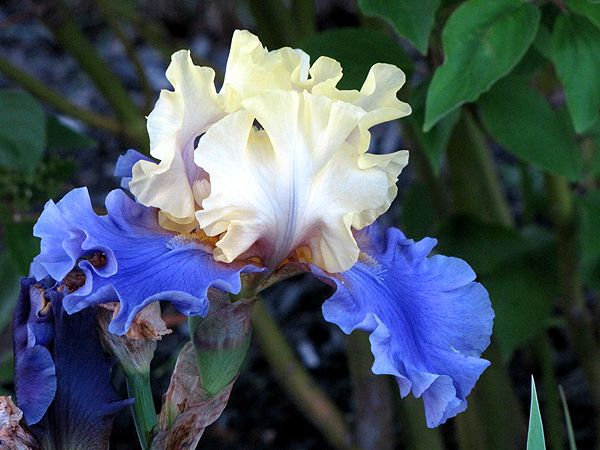
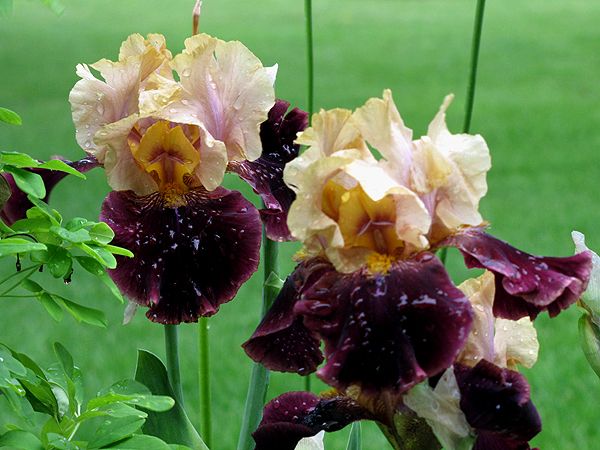
I called Romie out to the driveway to see what I'd found and he took one look at it and sighed, "It's always something..." Yes, it is, and while this shows the unpleasant side of gardening, I like to remember its better side:

'Edith Wolford'


'Princess Caroline de Monaco'


Unknown cultivar


'Red at Night'


'Immortality'


Helen's Iris


Tuesday, July 21, 2009

Shrinking Violets


During the last two visits to Schedel Arboretum and Gardens, I drooled all over the Korean Violets (Viola koreana 'Sylettas'). It was a melancholy drool, because I'd once had the beauties in my own garden. I say "once" because they no longer grow at Our Little Acre.

It's not that I didn't want the unusually-marked violets anymore. Au contraire! I loved them and hoped they would do as violets are prone to do - pop up everywhere. But they did just the opposite. After purchasing them from Bluestone Perennials in 2005, and living for a year after that, they slowly declined and the last they were seen around these parts was oh, back around 2006 or thereabouts.


I don't think it had anything to do with where I purchased them or the health of the plants. They looked good for quite awhile and I was happy when I saw them popping up the following spring after I'd planted them. Getting through an Ohio winter is no small feat for some plants, and though violets are among the hardiest, I was still cheering when they unfolded their pretty little leaves for the first time after the snow had melted. But by the end of the season, they were gone.

Bluestone quit selling them sometime after that, because in order to ease my heartbrokenness over their disappearance, I thought I'd just buy some more, but they were no longer in their catalog. I vowed to find them elsewhere, but as often happens in the spring of any year, other busy work grabbed my attention and they were temporarily forgotten.


So now it's 2009 and I'm strolling through Schedel's Japanese Garden, and oh my...what a healthy, large crop of Korean Violets there is! As I said, drooling ensued and I was hopeful that I'd find a small pot of them sitting in their "For Sale" area. Nope. So I asked at the Visitor's Center if they might sell me some. Nope. They liked them too, of course.


I have looked again for places to purchase the violets and found a few. I must get right on that before something else distracts me. Something like a garden task that is still on my list.


As I said before, our gardens are one of eight on the menu of the Van Wert Master Gardeners Garden Tour on August 9th. There are always things to be done in the garden throughout the summer, but because of the upcoming tour, I feel a bit rushed instead of doing things at my leisure.



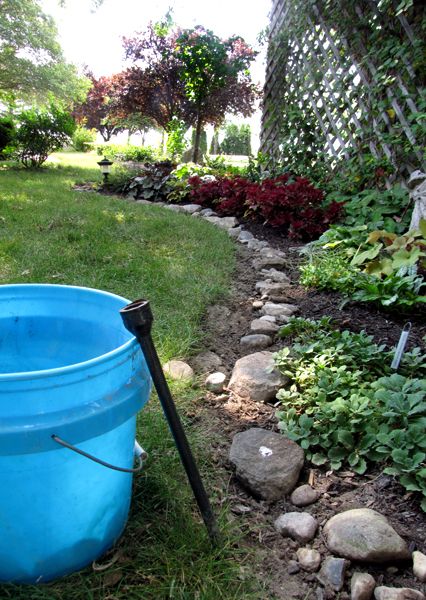
Today, the task was redoing the stone borders around some of the gardens. Several years ago, I laid field stone we'd gathered from the farm fields around our house. Over time, the rocks sank deeper and deeper into the ground and in some cases, they had become completely covered by soil and mulch.

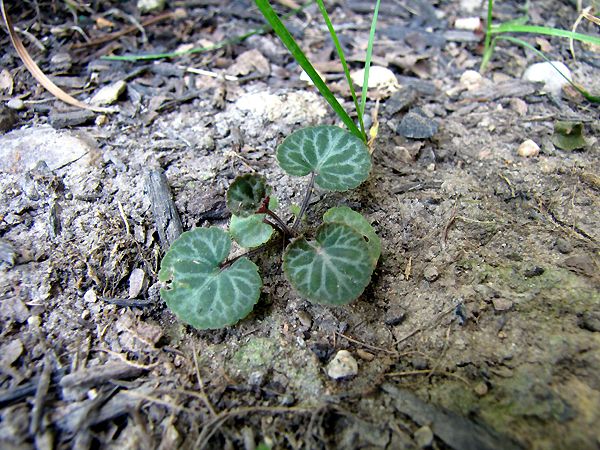
I was down on my knees, working on lifting the rocks in the Trellis Garden border, when I came across a tiny plant, no more than two inches across at its widest point. When it registered as to what this plant actually was, I let out a holler across the yard to Romie. It was a Korean Violet! I couldn't believe it.


It was growing in rock-hard clay, about two feet from where I'd planted the original clump four years ago. It had probably bloomed, produced seed, and the tiny seeds had lain dormant until this year. Violet seeds need light to germinate, so it probably got exposed during spring, when I planted something new near this same location.

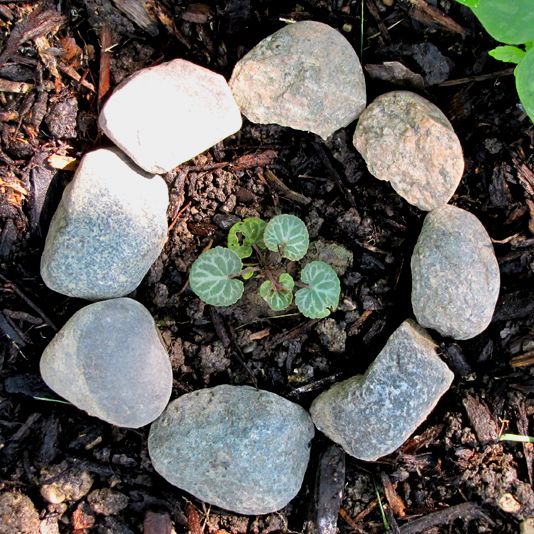
I debated whether or not to move it, not wanting to take any chances of losing this tiny treasure, but it was growing in a location where it was likely to get trampled accidentally, so I decided to move it to the garden just north of the pool house. There it will be in dappled shade and pretty much out of the way of errant feet.

I put a circle of stones around it to remind myself that it's there, since it really is very small. I'm hoping it will grow large enough to bloom and produce seed and then spread.

Never underestimate the power of a seed!


Saturday, July 18, 2009

Mean Green Mullein Machine


Two winters ago, Romie and I took a walk down the old railroad bed in my hometown. Being winter, not much was looking green, but we noticed a fuzzy plant that seemed to be laughing at the frigid temps and the snow. It fascinated me and when spring came, we returned to dig it up for relocating in our garden.


Soon I learned that our little plant was
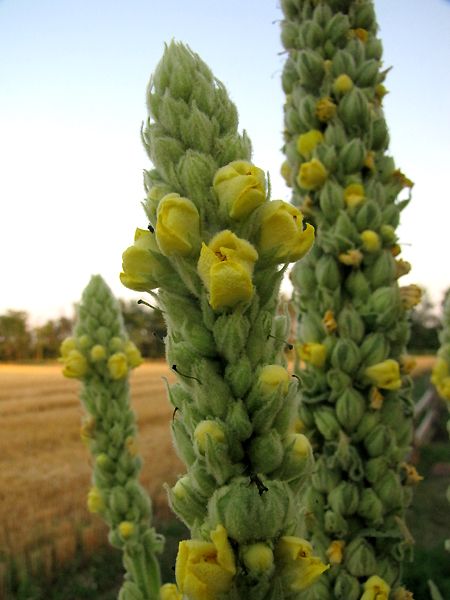
Common Mullein (Verbascum thapsis) and that it wasn't going to stay little for long. I planted it in a mostly shaded spot in the heart of Max's Garden and that first summer (2008), it shot out a flower spike that grew to maybe four feet tall, but I'd expected taller.


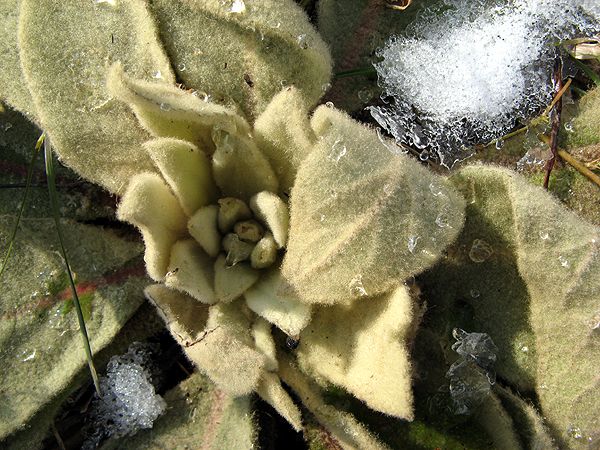
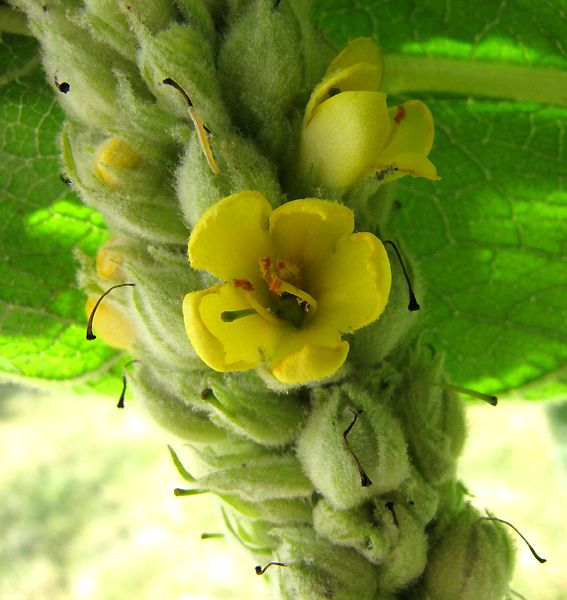
The way each leaf comes off the main stem reminds me of a ruffled pinafore.

This year, we moved the Mullein to the Orphan Garden, where we grow a variety of things. If a plant isn't performing well, I put it in the Orphan Garden to give it one more chance to straighten up and grow right. If it doesn't, into the compost it goes. That's a short trip, because the compost bins are right beside the Orphan Garden. I didn't move it because it wasn't growing well, I just didn't like where it was and didn't quite know where to put it just yet.

It became clear pretty early on this spring that the Mullein was going to grow taller than four feet in this new location. You could almost watch it grow taller from one day to the next.


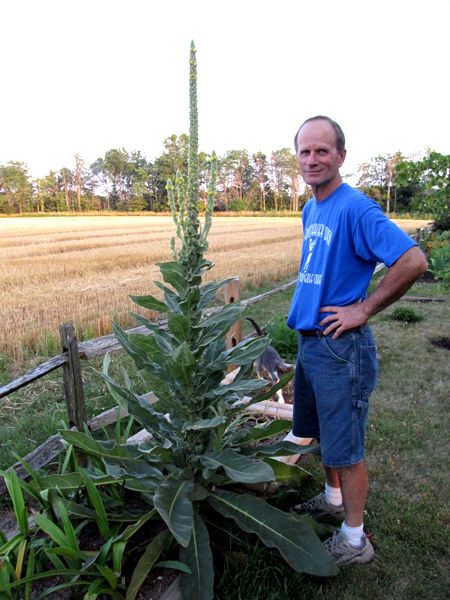
This photo was taken on July 9th and at this point it was just over seven feet tall (Romie is 6' 1"). Today, just ten days later, it stands more than eight feet tall, is sprouting auxiliary stems, and shows no signs of slowing down.

How high can it go?


Great Mullein or Common Mullein
Verbascum thapsus
Zone 4-10
Biennial


From the Ohio State University website:

Common mullein blooms from June through September. Plants must reach a critical size before flowering is initiated, which normally occurs during the second year but may be delayed until the fourth year of growth.

An individual plant produces 100,000 to 180,000 seeds. Seeds have no special mechanisms for dispersal and usually fall close to the parent plant. Once buried in soil, they can become dormant and survive for years. In a study begun in 1879, common mullein seeds buried in soil remained viable for 35 years.


  • 'Mullein' is from the Latin 'mollis' meaning soft.

  • Leaves of common mullein have been used as lamp wicks and Romans used plants dipped in fat as torches.

  • Leaves of common mullein were placed inside shoes for warmth.

  • Quaker women, forbidden to use makeup, rubbed the leaves on their cheeks to give the appearance of wearing rouge. The hairs on the leaf caused an allergic reaction to the skin, thus turning the skin red.

  • A yellow dye made from common mullein flowers was used by Roman women to color hair.


Wednesday, July 15, 2009

Blooms in July


I wasn't going to participate in Garden Bloggers Bloom Day this month, then I took a walk through my gardens with my camera hanging around my neck and there were some things just begging to be photographed. July always promises great color in the garden and this year's version is no exception.

Daylilies are the stars of the garden right now, but I'll save those for a separate post. Here's the best of the rest:


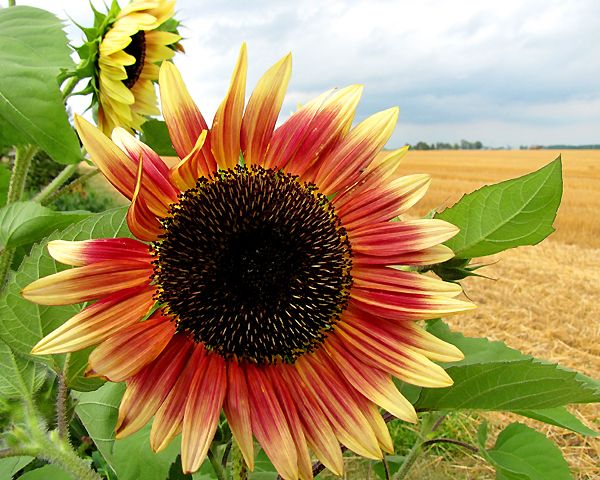
The only thing wrong with these sunflowers is that they always face east and they're on the east edge of the garden. Facing the wheat field. I have to jump the fence to look at them!


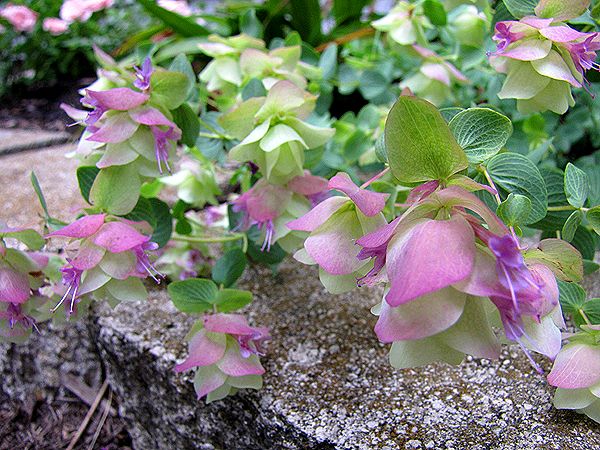
Origanum rotundifolium 'Kent Beauty'


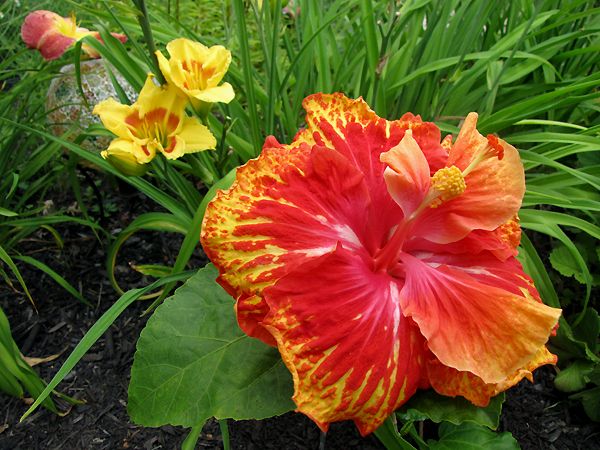
Hibiscus rosa-sinensis 'Sun Showers' with Hemerocallis 'Leprechaun Eyes' in the background.


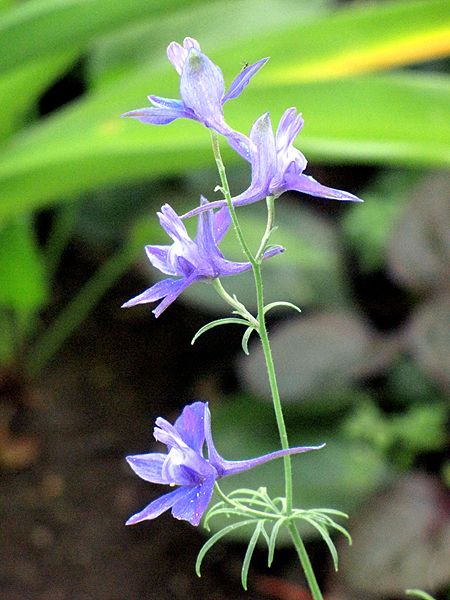
My mom gave me a jar full of seed that was labeled "Larkspur." I planted it and this is what I got. Feathery foliage and a mixture of colors of blue, pink and darker pink. Consolida regalis, maybe? Lovely!


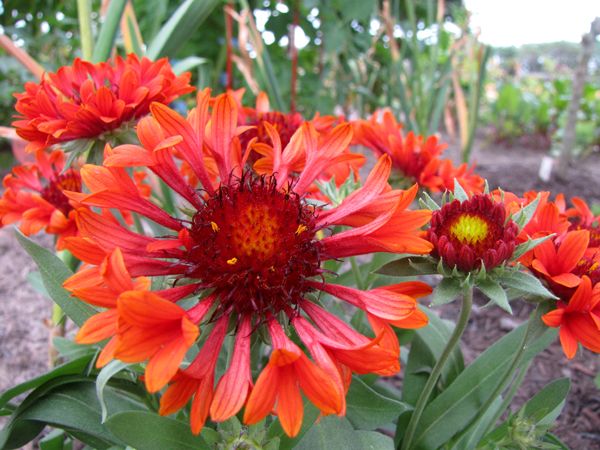
Gaillardia 'Tizzy'
I've seen hardiness for this one listed at both zone 5 and zone 6. Of course, I'm hoping for 5.


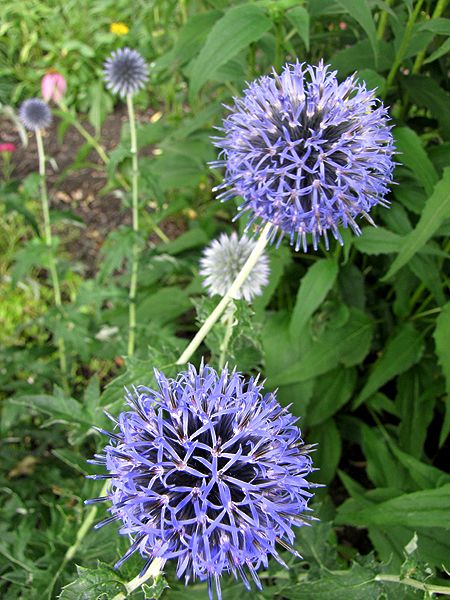
Globe Thistle (Echinops ritro)
Just to the left of these, out of the picture, grows Sea Holly (Eryngium planum). It's blooming now, too, and its purply-blue stems and blooms are a nice echo.


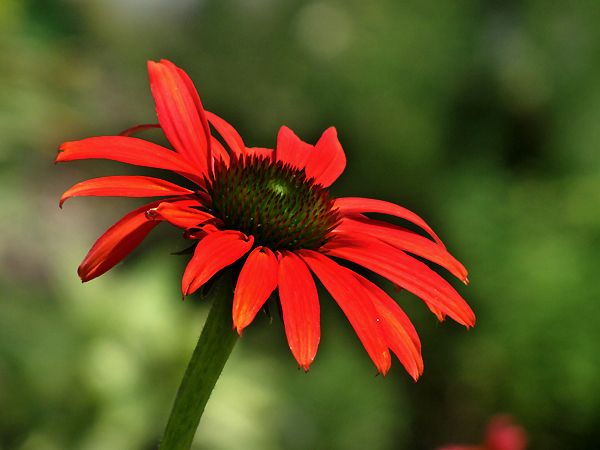
The camera generally has a hard time with reds, especially when the sun is shining on them, but this Echinacea 'Tomato Soup' is pretty true to color.


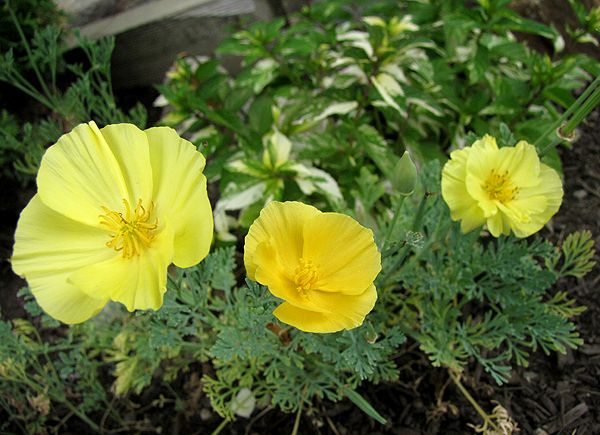
Eschscholzia californica 'Dairy Maid'
California poppies, like poppies in general, are normally not the easiest things for me to grow, but this year I've gotten more blooms than the single one I got last year.


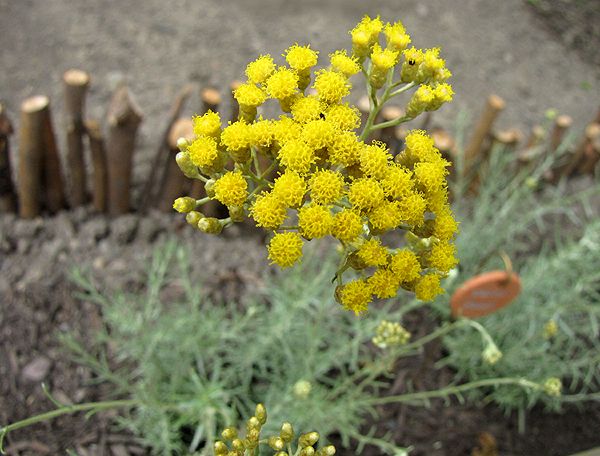
Curry Plant (Helichrysum stoechys)
Highly fragrant. I go out of my way to catch a whiff of this when I'm in the garden. Yummy!


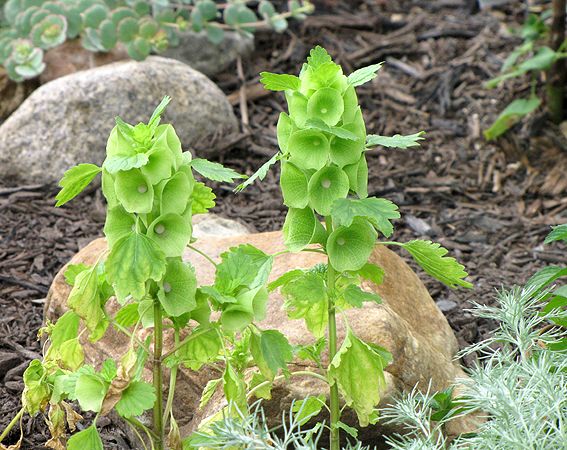
Bells of Ireland (Moluccella laevis)
I'm thrilled to pieces that I've got two good plants of this from the many seeds I sowed. This is one plant that I find very difficult to grow, but I absolutely love those bells!


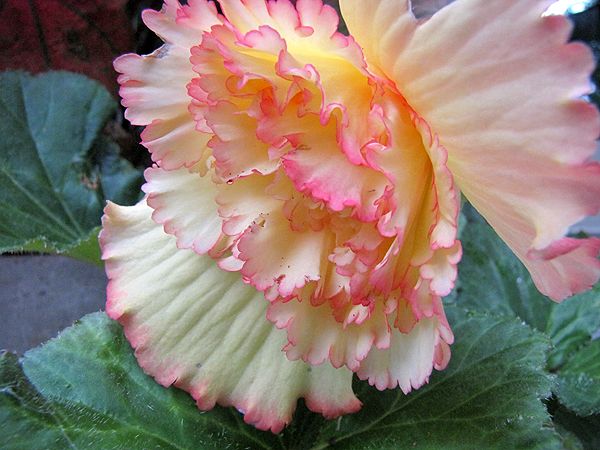
Begonia x tuberhybrida
This was one of those pre-packaged deals at one of the big box stores.


Can't get enough of those sunflowers!


Visit May Dreams Gardens to see more great July blooms!


Tuesday, July 14, 2009

Herbarium Amoris - A Book Review


Herbarium Amoris by Edvard Koinberg
$39.95
($29.19 and free shipping at Amazon)
Taschen America LLC

I've been fascinated by herbariums ever since I first found out what they were. Towards the end of the 19th century, it became popular to collect specimens of plants, including foliage and flowers, press them and preserve them. Properly done, each was labeled with their Latin name, common name, where collected, and when. I have actually started one of my own, with plants grown in my garden.

Edvard Koinberg, a Swedish photographer and gardener, has done an herbarium using plants he's grown in his garden, too. Except his herbarium consists of photographs of those plants, not the actual plants themselves.

The remarkable thing about his photos are not necessarily the plants, but the intimate way in which he has photographed them. Inspired by fellow Swede Carl Linnaeus, considered to be the father of binomial nomenclature and taxonomy, Koinberg focuses on the sexual parts of plants. By human comparison, this collection is surely X-rated, but worthy of a venerated spot in every library.

Rarely has a book had such an effect on me as this one. Within five minutes of browsing through its pages of breathtaking images, I was nearly moved to tears. I don't need to tell a gardener about the unbelievable beauty and intricacies that each flower holds and perhaps seeing them up close and personal in this way won't elicit such a strong response from everyone, but as I felt my throat tightening, my reaction surprised even myself. I don't normally do this in response to pictures of flowers.


Each image has been created under perfect conditions - perfect lighting, black background, perfect angles. The flowers themselves aren't always perfect though, in fact, some of the most beautiful photos are of spent flowers and dusky seedheads. The photos are arranged according to the calendar year, with the first photos showing a flower's beginnings and the last ones as the flower gives way to dying petals, just as they do in the garden.

The book is coffee table material, being of typical size for such tomes, and that's the best place for it, so it can be enjoyed by those who happen to sit within arm's reach of it. There are 280 pages and at a list price of $39.99 (Amazon price $29.19 and free shipping), there's really no excuse not to own it or give it as a gift. It's worth far more than its cost.


Edvard Koinberg was born in 1964 in Stockholm, Sweden. He has worked as a freelance photographer and graphic designer since 1989, commissioned by press, businesses and organizations. The last few years he has focused on personal projects, where plants and gardens are recurring themes, which has resulted in a number of exhibitions. He has sought to depict plants following the artistic tradition of the Swedish Age of Enlightenment. Dutch painters from the 17th and 18th centuries have also been important inspirations. You may learn more about Koinberg and his work by visiting his website.

_________________
The product or merchandise being reviewed in this blog post was the sole compensation for testing and reviewing the product. All opinions expressed here are mine, with no suggestions whatsoever by the manufacturer or distributor. If I like it, I'll say so. If I don't, I'll say that, too.

Monday, July 13, 2009

Schedel Revisited


It was a nice day on Sunday. Perfect for taking a stroll through a garden. So we picked up Adam and Kara and headed north to Schedel Arboretum and Gardens. It was my second visit there this summer, but it was the first time for both Kara and Adam and Romie, too.

When the growing season is basically five months long, a month or two can make a big difference in how things look and Schedel was perfect proof of it.

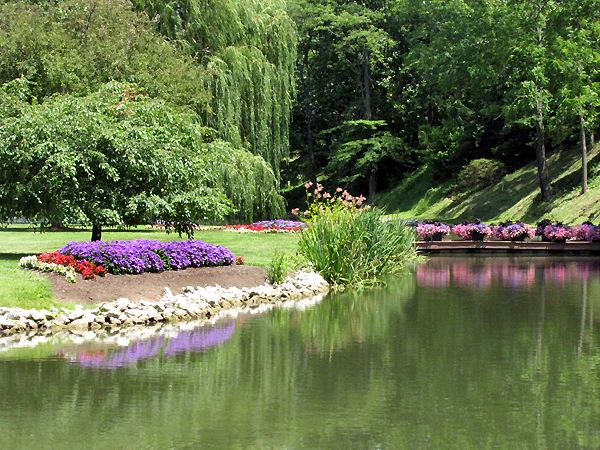
May 22, 2009


The annuals that were just being planted when I was there in May had matured into full and lush beauties, though the cannas are yet to bloom.

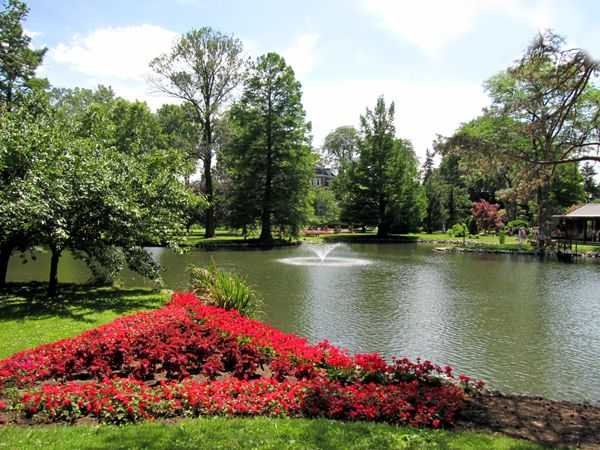
July 12, 2009


This was my third visit ever, and each time I've been here was at a different time of year - fall, spring, and now summer - so I tried to focus on things I'd not noticed as much in previous visits. For example, I'd never taken the footbridge over to the other side of the lake.
The view from over there is a different kind of pretty.


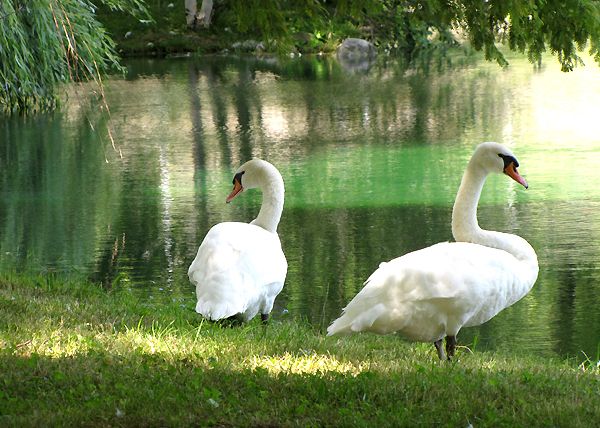
The swans were showing off for us.


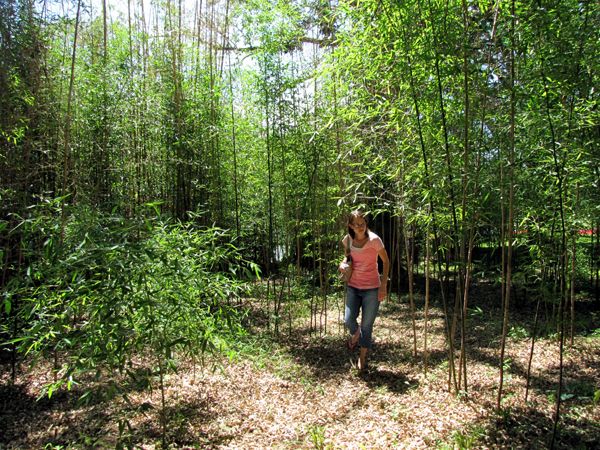
I didn't know there was a bamboo "forest" on the other side, complete with a path for walking through it.


There was some poison ivy on the path, which Kara and I didn't notice until it was too late, and we had worn flip-flops, so we were sure to wash our feet as soon as we got home. Kara announced that she wasn't allergic to it, although both her dad and I are, so time will tell if she inherited our allergy or not. Actually, I hope we both were able to wash our feet soon enough before that question can be answered!


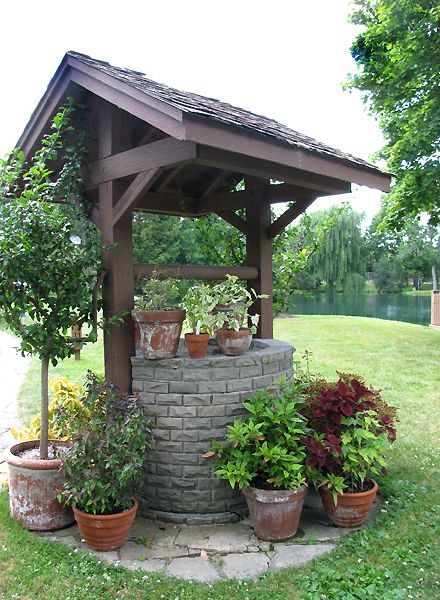
There are many containers with tropicals and unusual annuals grouped in various areas around the property.


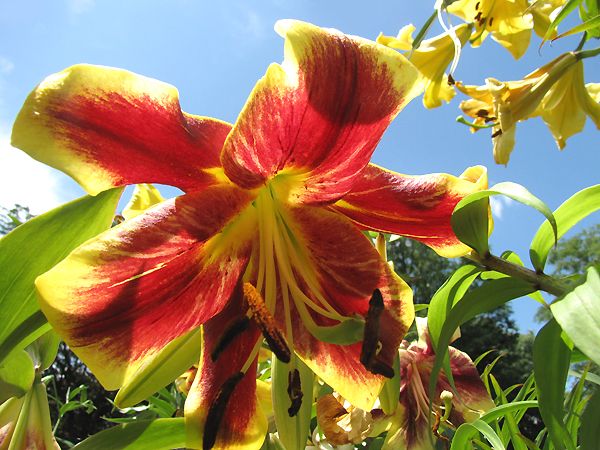
And it's lily season!


Orienpet Lily 'American Heritage'


More scenes from the day...

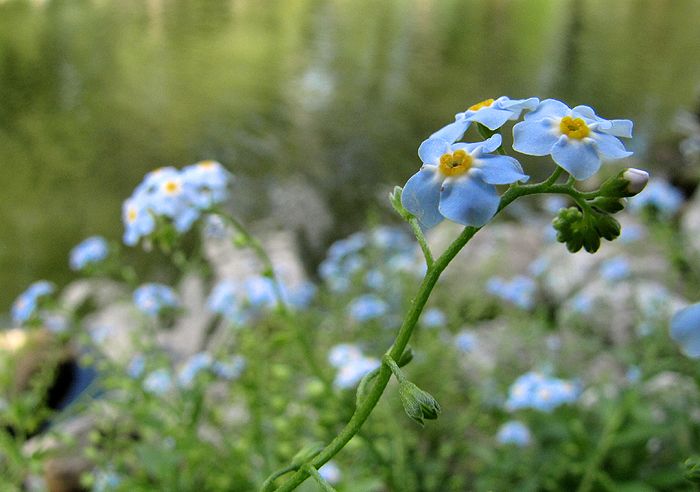
The Forget-Me-Nots were in full bloom down by the water.


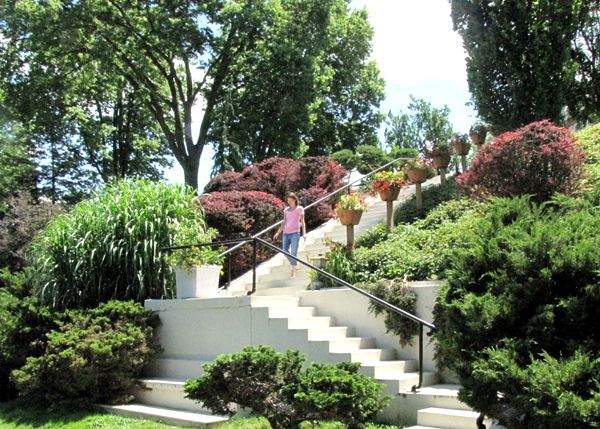
The stairway descending from the house area.


If you look to your right once you reach the bottom of the stairs, this is what you see.


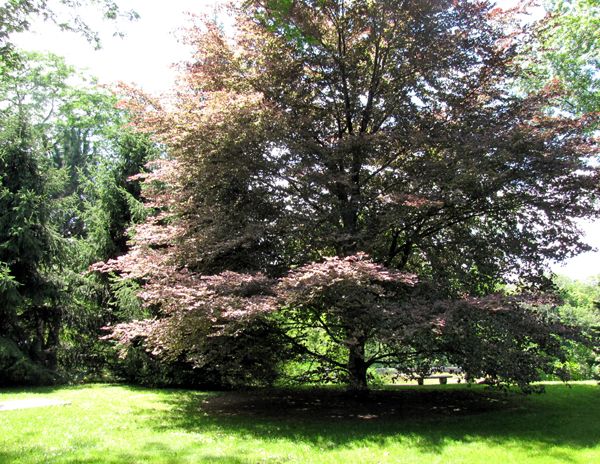
I'm coveting this gorgeous Tricolor Beech tree.


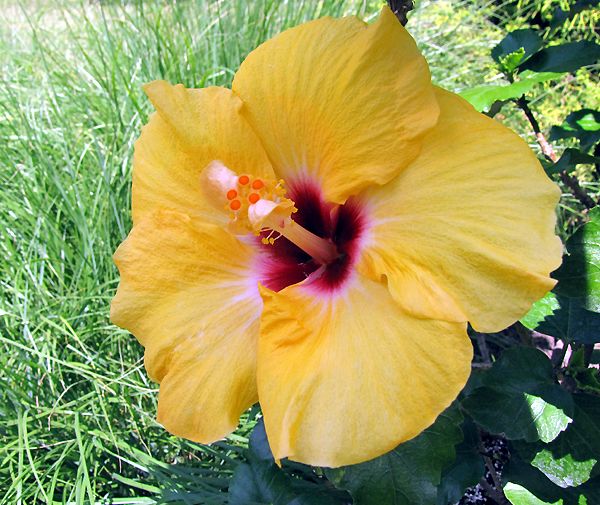
Several tropical Hibiscuses were in bloom.


Art and sculpture are an integral part of the Schedel experience and there was an exhibition being held while we were there.

"St. Francis"
by Barry Woods Johnston
$13,500


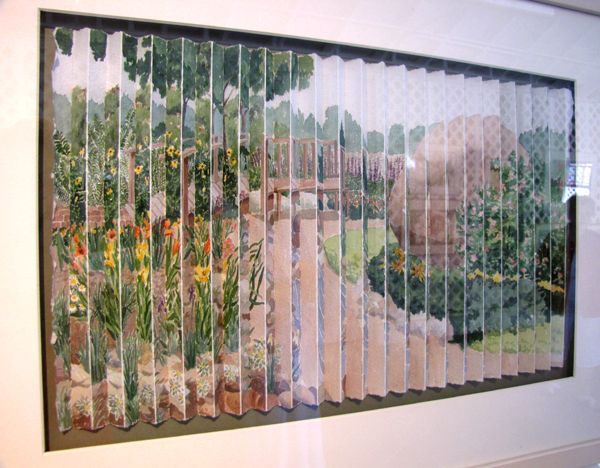
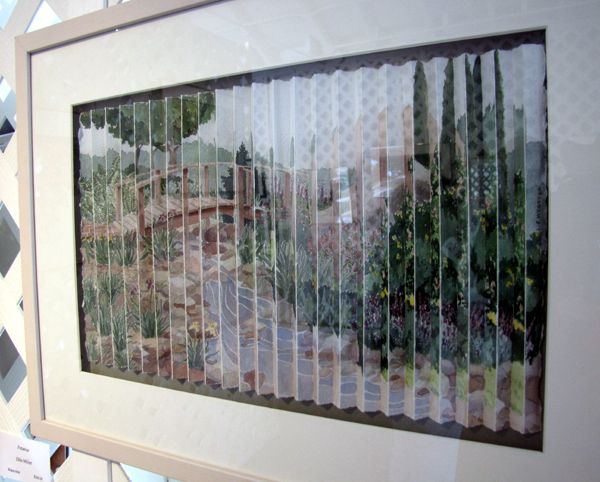
Here's a unique way of doing things - watercolor on pleated paper - that gives you two art pieces in one. I absolutely loved these works by Lucy Jane Webster. There were several on display and for sale at $350-400 each.

View from the left


View from the right

Yes, it's the same picture!


Schedel shares the excess plants from their gardens with the public by offering them for sale at prices too good to resist. The last time I was here I bought one Japanese Anemone plant for $2.00. There were more available this time and I bought two more to add to those I already have in my garden, since I now seem to have inadvertently stumbled upon The Secret to growing them.

We couldn't leave Elmore without stopping at Bench's Greenhouse, just a few miles away, which was still selling their entire plant inventory at 40% off. This time, I showed remarkable restraint, only purchasing two small Delphinium nudicaule 'Laurin' to replace one I'd had a few years ago.

At that time, I didn't realize it was a perennial and planted a different plant in its place in the fall. The following spring, a small sprig of it came up, but transplanting it proved to be the fatal blow. This is a charming plant that I'm glad to have once again.


Saturday, July 11, 2009

Garden Tour Preview


Our Little Acre had a visitor today. Janice, a Master Gardener from Van Wert, drove out to see the gardens. She's part of the group sponsoring the garden tour on August 9th, in which we have been asked to participate. Though she will be seeing our gardens at that time, I always welcome anyone who wants to walk through my gardens with me, any time of the year.

Actually, the gardens probably look better right now than they will in August. By that time, much of what provides colorful beauty to the gardens will be past their prime. Some will even show signs of dying back, especially if we continue having this dry, dry summer. But no matter what time of the year, there's always something pretty and worthwhile seeing.

Janice will be participating in the garden tour this year as well. I remember seeing her gardens a couple of years ago when she was on that year's tour. She lives in town in a beautifully restored Victorian home with gorgeous gardens to go with it. We talked about how the garden changes over time due to loss of trees or growth of them. Certainly more or less sun or shade can make a difference and we as gardeners have to adjust our gardens to accommodate the changes.

Finally, after several weeks of no rain, we got .7 of an inch this morning, with lightning and thunder and everything! It was badly needed and a couple more rains like that in the next few days would be wonderful, but not likely to happen, so we'll continue to drag the hoses around with us. It's going to take a lot more rain than that to close up the cracks in the yard and the gardens.


There's lots of color in the garden right now. Most of it comes from the established perennials, as most of the annuals grown from seed are not yet blooming. If you visited my gardens right now, this is some of what you'd see:


Endless Summer Hydrangeas - 'Bailmer' and 'Blushing Bride' (L-R)


Max's Garden


Willow Chair beside the garden pond


Max's Garden


Flower boxes on front porch railing


Veronica 'Icicles'


First Sunflower bloom (Helianthus 'Apricot Twist')

EDIT: Though the seed packet says 'Apricot Twist', I don't believe that's what they are. They look more like 'Strawberry Blonde' to me!


Friday, July 10, 2009

Let Sleeping Bees Hang


These bees with the long antennae can be seen "hanging out" on the Miscanthis sinensis in the evenings. They're cute little fuzzy things and are quite lethargic when disturbed, but not aggressive in the least. If they fall off, they just fly back up and hang on.


So what are they?


The folks over at The Great Sunflower Project say they're likely of the large genus Melissodes, commonly called Long-Horned Bees due to the males having long antennae. These are solitary bees that make their nests in the ground, lining them with a waxy substance that they secrete.

They favor flowers in the Aster family, including sunflowers, daisies, and asters. We have all three in our gardens. Sunflowers, in particular, are highly dependent on Melissodes for cross-pollination.


Solitary bees are not likely to sting, because they don't have a hive to defend. Usually, they will only sting if they get caught in your clothing or feel directly threatened by your behavior, such as swatting at them. "Bee" respectful of them, and they'll return the favor!

I first noticed them clustering last evening and at first I thought they were all dead. Not dead, just sleeping! They did it last year, too, but I'd forgotten about it until I saw them again. They hang onto the blades of grass with their jaws. Now how that is restful, I have no idea, but I'm not a bee.

Thursday, July 9, 2009

Garden Crossings & Walters Gardens


After a quick breakfast at our hotel, we headed northwest to just outside Zeeland, where Garden Crossings garden center is located. I'd long admired their plants online though I'd not yet ordered from them. They send out a great newsletter and from the moment I started planning a trip to Frederik Meijer Gardens, I knew I wanted to visit nearby Garden Crossings.

We were greeted by Marilyn as we walked in the door and a short time later, she introduced us to her son, Rod, who along with his wife Heidi, owns Garden Crossings. Their business is in the Garden Watchdog Top 30 and out of hundreds of garden centers nationwide, this is no small honor. Seeing their plants, both in the retail section as well as where they were being packaged for mailing, it's apparent that their excellent rating is well-deserved.


I had walked in there not intending to buy much, if anything, since I'd pretty much already filled my garden for the year, but left there with two trays of things and a large herbaceous peony. Mom was in the same position I was, yet she too purchased her fair share of plants.

Rod took quite a bit of time with us as we asked about various plants as to their performance, hardiness, etc., and it was nice to be asked ourselves about our experience with different plants, even some that they don't carry. There's nothing more enjoyable than to talk plants with someone who knows plants and it's apparent that Rod knows his stuff.

I waffled over buying a Lobelia ('Monet Moment') and after having put it back, Rod and I were walking through the plants and he mentioned that it was his favorite Lobelia. After some discussion, I decided to go ahead and purchase it. I picked one up and as we were checking out, he said, "We have a fuller plant than that. Let me get it for you." Now that is how I want to be treated when I go to a garden center.


Display Gardens in front of Garden Crossings


My purchases at Garden Crossings:

  • Paeonia lactiflora 'Soft Salmon Joy'
  • Echinacea 'After Midnight'
  • Gaillardia 'Tizzy'
  • Coreopsis 'Sienna Sunset'
  • Lobelia 'Monet Moment'
  • Digitalis purpurea 'Candy Mountain'
  • Digitalis 'Goldcrest' 'Waldigone'
  • Heuchera villosa 'Christa'
  • Papaver orientale 'Harlem'
  • Delosperma dyeri 'Red Mountain'
  • Tiarella 'Mystic Mist'

There were others that tempted me, such as Salvia 'Wild Thing,' but they were marginal for our growing zone, and at this point in my gardening, with such large gardens to take care of, I'm not willing to baby too much of anything.


Before we left, Rod told us to make sure and visit Walters Gardens, just a few miles south, in Zeeland. Though they are wholesale only (some of your plants may have come from Walters Gardens by way of your local garden center), they have beautiful display gardens and we were glad Rod had mentioned them to us.


Delphinium elatum 'Morning Lights'
I don't know when I've seen Delphiniums so tall!


I've drooled my way through their website for a couple of years now and someday I'd love to drive up for the one time during the year when they allow the public to tour their facility. I just know their acres of greenhouses hold treasures untold.


After a quick lunch, we drove a short way to Frederik Meijer Gardens and Sculpture Park on the northeast side of Grand Rapids - our main focus of this two-day trip. We saved the best for last. I took nearly 300 photos while there and will show some of them in a separate post.

Tuesday, July 7, 2009

Mid-Summer's Musings


My grandma, who will be 95 on her next birthday, is staying with us for two days. Something she always likes to do is take a walk through our gardens. The profusion of blooms always amazes her. She talks about how much things have grown and changed since the last time she saw them, even if it was just last week. Gardens are like that.

As we walked by the small corn patch, she exclaimed, "Look at that sweet corn! How tall it is!" Our son-in-law said the same thing over the weekend. They noticed it was taller than usual, and they would both know, having grown up on the farm and in the case of my grandma, making a living by farming.


While the old adage "knee high by the 4th of July" doesn't ring true for corn anymore, due to hybridization, our corn is still taller than normal this summer. It began tasseling out last week and just this morning, the bumblebees were doing their job of pollinating.

"If the corn is knee-high by the fourth of July,
It'll make corn, wet or dry."


I always feel like summer is half over by the time July 4th rolls around. Planting is done, growing is well under way, and maintenance is the order of the day. Somewhere along the line, we have switched from wishing this or that would hurry up and bloom to wishing things would slow down.

The wheat in the fields around us has turned that beautiful shade of golden yellow and it's being harvested as I type. The first of the trifecta is gone, and before we know it, the soybeans and corn will have gone the way of the wheat.


In reality, there's a lot of summer left. Hot summer. Just like the last two summers, I feel as if I've grown a tail as I drag the water hose around with me. Each year I vow to just let the plants duke it out with the dry weather, but then I see some of them looking wilty and I just have to quench their thirst. We really could use some rain.

This year, we've been asked by the Van Wert Master Gardeners to open our gardens to the public for their yearly garden tour in August. We aren't really doing anything differently because of it, although it did provide leverage as I "encouraged" Romie to build fencing around the pool equipment at the back of the pool house.

Until then, we will enjoy these salad days of summer, relishing in each new bloom as it appears and joins the rest of those that make up the color palette of the garden.

Echinacea 'Sunrise'


Unnamed hybrid daylily by Lana Wolfe


Leucanthemum x superbum 'Wirral Pride'


Lilium 'Tiger Rose'


Monday, July 6, 2009

Michigan State University Gardens


Up the road from Hidden Lake Gardens, is Michigan State University in East Lansing. In my next life, I'm going to attend MSU and major in Horticulture. It's clear just by walking through the campus that growing things is a Very Big Deal there.

Michigan State was chosen as an All-America Selections flower trial garden in 1978. The grounds surrounding the horticulture education buildings are covered with bed after bed of nearly 1000 different annuals, all labeled with their names, date introduced, and the grower. There were some familiar to us, and some not yet introduced to the public, still in trial.

In addition to the AAS demonstration gardens, the walkways and buildings are beautifully landscaped. The rose gardens were in full bloom and fully fragrant as we tried to see it all before we got rained on. You could easily spend most of a day just perusing the gardens of MSU.

Slide Show of MSU Demonstration Gardens


The jewel of the gardens is the 4H Children's Garden, much of which provided inspiration to my mom when she proposed creating a
children's garden in Van Wert to her Master Gardener group.


Entrance


This building faces a mini amphitheater where educational programs are conducted.


Green roof over service building


Just across from the entrance to the children's garden is a large peacock topiary. The flowers planted in it aren't fully grown to fill the spaces yet, but it's still an impressive structure.

Just across the railroad tracks that run through campus is the Clarence Lewis Landscape Arboretum. Contained within the arboretum are individual landscape gardens, where students can practice their skills and get ideas.

Slide Show of MSU Demonstration Gardens


Obviously, our initial plan of seeing these gardens plus the next stop on our Michigan Garden Tour (Frederik Meijer Gardens & Sculpture Park) was just a little bit ambitious as the result of our being unaware of the size scope of the beauty both Hidden Lakes and MSU held.
We arrived at our hotel in Grandville, near Grand Rapids, shortly before 8:00 and after a late supper at Panera's, we called it a night. The next day was going to be just as fun and flower-filled as this one.

Next:
Garden Crossings Garden Center, Walters Gardens, and Frederik Meijer Gardens & Sculpture Park

Thursday, July 2, 2009

Hidden Lake Gardens


Mom and I took to the road again. Mom's friend Sue joined us on this expedition to Michigan, where we spent two days touring several gardens that I'd not seen before, as well as a garden center I'd wanted to visit for quite some time.

Our first stop was at Hidden Lakes Gardens, near Tipton, Michigan, and part of Michigan State University, although it's located 40 miles from the school. The Gardens are in a very rural setting, which is key to their beauty. As the name suggests, there is a lake and a small pond and some of those rolling hills that we flatlanders find so appealing.

The Pond


Originally purchased in 1926 by Adrian businessman, Harry Fee, it was Mr. Fee's dream to own property with a lake. Some time after the acquisition of the property, he constructed a road around the lake and landscaped the property to enhance the beautiful views. He later opened it to the public so they could enjoy it too, and donated it to Michigan State University in 1945, wanting the property to also be used also for educational purposes.

Swans on Hidden Lake


The original 200 acres has grown to over 750, which now includes a 250-acre arboretum. Located within the arboretum is a collection of over 300 dwarf and rare conifers, donated to the gardens by Justin Harper, from his personal collection in E. Moline, Illinois, in 1981.

Abies koreana 'Blue Cones'


Native Plants Garden


A conservatory was built in 1961 and houses a collection of houseplants and other non-native exotic plants. There are three rooms in the conservatory: Temperate, Arid and Tropical.


Clivia miniata


Bougainvillea behind sculpture


Scuttellaria costaricana


Blooms on Cocoa Tree (Theobroma cacao)


The bonsai collection is just outside the conservatory and was acquired through a series of donations.


The perennial gardens are official
All-America Selections Display Gardens near the visitor's center and are located on a hill overlooking the pond.


Lysimachia punctata 'Alexander'


Yarrow (Achillea)

Hosta Hillside was originally Mr. Fee's rock garden, which overlooks Hidden Lake and contains over 800 hosta varieties. It was designated an Official American Hosta Society Display Garden in 1995, only the second garden in the nation to receive the distinction.

Mom and Sue stroll through the hostas on Hosta Hillside


Hosta Hillside overlooks Hidden Lake


Mom and Sue enjoy some wild raspberries, growing in the woods across from Hosta Hillside


As we were driving through the grounds on our way out, these Great Spangled Fritillaries caught our eye and I stopped the van to take their picture. I don't know if the butterflies enhanced the beauty of the flowers or the other way around.

Great Spangled Fritillary on Asclepias tuberosa


Next: Michigan State University in East Lansing.


blogger templates | Make Money Online