

Tuesday, March 17, 2009

First Crocus and Other Things


First Crocus
March 15, 2008


It's as if they were waiting for Garden Bloggers' Bloom Day to make their debut. Several days ago, I noticed the purple crocus (that I didn't plant) was showing color. This little clump (that I didn't plant) is the first to bloom every year. I don't know where they came from, because I didn't plant them. I simply enjoy them.

These are blooming earlier than in previous years. In 2007, the first blooms of the season were the double snowdrops and they burst forth on
March 14th. The crocus were much later. Last year, they weren't even "showing any color in their buds yet" on Garden Bloggers' Bloom Day for March.

They may bloom first because they are on the south side of our family room, which is my famous microclimate. I'm certain it's a solid zone 6 there, maybe even bordering on 7, and I'm hoping this means the Coreopsis 'Limerock Dream' that I planted last fall will prove it to be true.


Other outside blooms this Bloom Day are the double snowdrops (Galanthus nivalis 'Flore Pleno'), which have been in bloom for a couple of weeks or so.


The witch hazel hasn't really dazzled me like I expected it would. The blooms are very small and have to be looked at up close and personal to be appreciated. Maybe it's because it's the first year for it since being planted last year. Maybe it's because it's a native and not a hybrid.

Both the pussy willow and the Japanese Fantail Willow are blooming with their soft pussy-toes. The Japanese Fantail toes are much smaller than the pussy willow's.

Japanese Fantail Willow
Salix sachalinensis 'Sekka'


American Pussy Willow
Salix discolor


I brought some of the pussy willow branches inside a few weeks ago and forced them. Now I'm letting them remain in water to hopefully root so I can have more plants. I did that with forsythia last year and now we have another shrub.

The warm temperatures coupled with the fall leaf cover have produced a few surprises. As I've been working in the gardens to clear out the leaves that blew in over the winter, I'd estimate that 90% of what's out there is showing signs of life, either with buds along the stems of branches or new green growth at the base of the plants. The remaining 10% will likely not be far behind if the warm weather persists.

Probably the biggest surprise was the 'Pink Panda' strawberry plant:


Kind of ragged, but a bloom nonetheless!

~~~~~~~~~~~~~~~

Apologies to Carol at May Dreams Gardens, host of Garden Bloggers' Bloom Day, for the lateness of my post (again). Let's see...what can my excuse be this time?

My Irish Garden


Facebook is famous (or infamous, depending on how you look at it) for their quizzes. They are quirky and a total waste of time. That doesn't stop me or thousands of others from taking them now and then, however. You can take a quiz that tells you what season you are (I'm Summer), what flower you are (Nigella), and where you should be living. I took that quiz yesterday:

"You belong in Ireland. You love the countryside and you want to spend your life being surrounded by green. You love small towns where you can relax in the pub and have a chat, and several pints! Sunny destinations aren’t important for you, you’d rather be in this beautiful country, where the people are chatty and down to earth and where culture surround you everywhere you go.”


Okay, let's go! Well, in reality, that's not going to happen, so how about a little bit of Irish in my garden? Not in time for St. Patrick's Day - not in my garden - it's too cold yet on March 17th for much to be blooming besides snowdrops and crocuses. But later there will be Oxalis.

Oxalis is better known as the shamrock plant, because it has three leaves on its foliage. That's what we're familiar with, and some of the Oxalis plants have interesting foliage. That, combined with their delicate flowers, makes for a fun and garden-worthy plant.


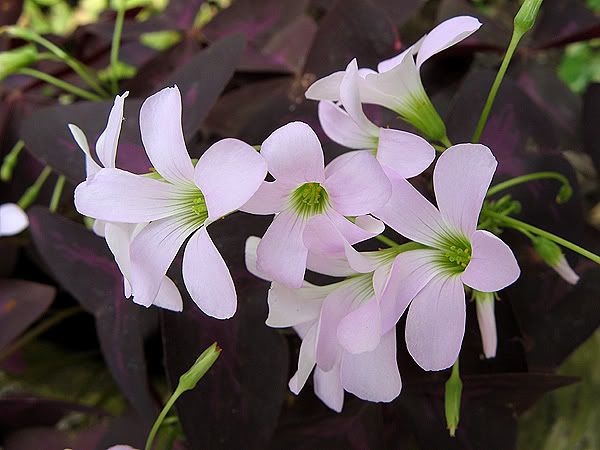
Often called Brazilian Butterfly Plant or False Shamrock, the burgundy leaves of Oxalis triangularis (subsp. papilionaceae) are in sharp contrast to the pale lavender flowers.


The Iron Cross (Oxalis tetraphylla) is the one better known to be the "good luck" shamrock. These amazing little bulbs just keep producing leaves and flowers all summer long if you let them soak up the sun and give them plenty of water. Both bulbs are tender to our zone, so I have to be sure to bring them in for the winter, but they store well and have performed year after year for me.


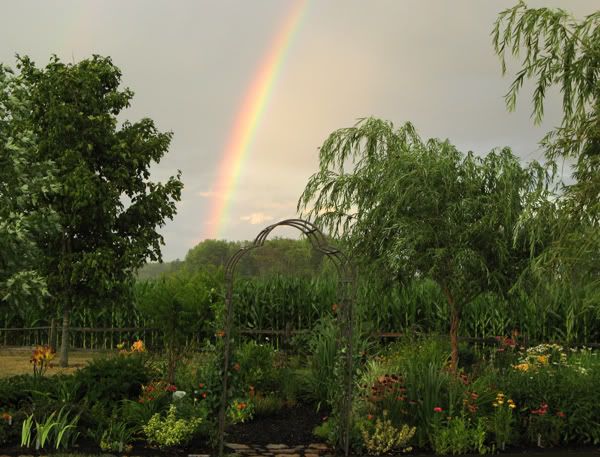
And what garden would be complete without a leprechaun? They can be elusive, you know, but when I saw the rainbow over Max's Garden one day, I just knew he was somewhere nearby.


Ah, yes. . . here he is. . .

Hemerocallis 'Leprechaun Eyes'


And more eyes!

Rudbeckia hirta 'Irish Eyes'


On this St. Patrick's Day, I will be spending the day in the garden, as it is unseasonably warm and will be near 70° F. It's my favorite kind of day. I hope you enjoy yours, too.


May there always be work for your hands to do.
May your purse always hold a coin or two.
May the sun always shine on your windowpane.
May a rainbow be certain to follow each rain.
May the hand of a friend always be near you.
May God fill your heart with gladness to cheer you.

~Irish blessing~


Sunday, March 15, 2009

Kaffir Lily (Clivia miniata)


Clivia miniata

It's both Green Thumb Sunday and Garden Bloggers' Bloom Day. Oh, and the Ides of March, too. What a day! I haven't ventured outside just yet, to see what's blooming out there. I expect to find the first blooms of crocus and perhaps the primrose has opened up, but inside, there is plenty. Numerous amaryllis are still providing vibrant color, the Streptocarpella is still in bloom, and of course, the orchids. But there's a new girl in town.

Yesterday, I attended a continuing education class on ethics and jurisprudence, as required for my license renewal to practice dental hygiene in the state of Indiana. This was part of the total 14 hours I need, and while I've got more than that already for this licensing period, I still have one more required class to take before I'll be finished - CPR. I'll get that one before the year is over.


On the way home, I stopped at Meijer to see what they were offering in the way of spring flowers. They generally have something that's a little out of the ordinary and I wasn't disappointed.

As I walked through the front door, I think my jaw probably dropped open when I saw a large display of Clivia miniata, in all its orange goodness right there, before God and everybody.
It didn't take me long to pick one out. I found one that had a second flower stalk coming up, so I grabbed that one and checked out.

I'd been wanting a Clivia for some time now. Mom had one a couple of years ago - hers was yellow - and I'd seen them several times at the botanical conservatory in Ft. Wayne. Now I have one of my very own, and as everyone knows, I really needed another houseplant.


Clivia miniata


Origin: South Africa
Zone: 9-11
Soil:
Clivias require soil that drains freely, as these plants like it on the dry side. A mix that includes bark will work well. They like to be pot bound and only require repotting about every 3-5 years.
Water:
During its winter rest period, keep the plant fairly dry. When growing period resumes in the spring, water thoroughly when the soil has become dry, then let it dry between waterings. Misting of the leaves is not recommended.
Light:
No direct sunlight. They grow well inside with a northern exposure, or anywhere that receives bright light without direct exposure to sun. Outside, place in a shaded area.

Clivias are known as a tough and easy houseplant, if you don't overwater it. During the winter, keep it fairly dry in a cool room (50-65°F) for about three months. You must do this to trigger blooming, which follows the rest period. Fertilize monthly with a half-strength 20-20-20 fertilizer during the growth period until September.


Join Green Thumb Sunday


blogger templates | Make Money Online